11 January 2026 The Future is the Product of the Past

Rare 3,300-Year-Old Faience Mask Unearthed at Dilmun Burial Site in Bahrain

Archaeologists in Bahrain have uncovered a rare and enigmatic artifact from the ancient Dilmun civilization: an ornamented pottery head known as a faience mask, dating back more than 3,300 years. The discovery was made at the Hilla (Al-Hillah) archaeological site, shedding new light on burial practices and material culture during the Middle Dilmun period.

The faience mask was found inside a collective grave containing the remains of two women and an infant, offering rare insight into social and funerary traditions in ancient Bahrain. The findings were officially presented at an archaeology conference organized by the Bahrain Authority for Culture and Antiquities (BACA), highlighting the Kingdom’s ongoing efforts to document and preserve its rich heritage.

A Rare Find from the Dilmun Civilization

Faience masks are extremely uncommon in Bahrain. This particular artifact represents only the second example ever excavated in the country, making it one of the most significant archaeological discoveries in recent years. The ceramic head, believed to have been placed with the deceased as part of burial rituals, remains largely mysterious due to the limited number of comparable finds.

According to BACA archaeologist Mashaal Al Shamsi, who leads the current excavations at Hilla, the mask has not yet been thoroughly studied. “Further research needs to be conducted into the faience face,” she explained. “It’s one of those objects that hasn’t been highly researched, especially in Bahrain. There is only one academic paper that briefly mentions it.”

Al Shamsi confirmed that a detailed scientific study is now underway, with plans to publish new findings on both the faience mask and associated grave goods.


📣 Our WhatsApp channel is now LIVE! Stay up-to-date with the latest news and updates, just click here to follow us on WhatsApp and never miss a thing!!


Faience masks are extremely uncommon in Bahrain. This particular artifact represents only the second example ever excavated in the country.  Credit: Bahrain Authority for Culture and Antiquities (BACA)
Faience masks are extremely uncommon in Bahrain. This particular artifact represents only the second example ever excavated in the country. Credit: Bahrain Authority for Culture and Antiquities (BACA)

Excavations at the Hilla Site

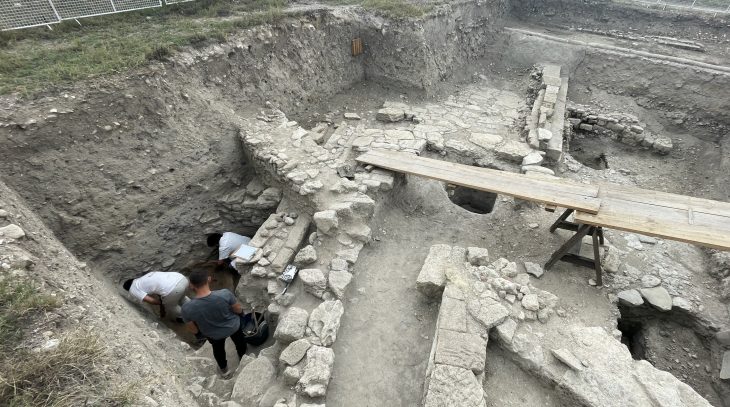
The Hilla Site, named after the village of Hillat Abdul Saleh in southern Bahrain, is an important archaeological area containing layered remains from different phases of the Dilmun civilization. Current excavations focus on Middle Dilmun soil layers, dating roughly between 1600 and 1000 BCE, a period marked by complex burial customs and expanding trade networks.

In addition to the faience mask, archaeologists recovered a variety of artifacts from the grave and surrounding sediments. These include seashell rings, a sewing needle or awl, a large ceramic vase, and kohl applicators, some of which were identified through careful sand sifting. The presence of personal adornments and cosmetic tools suggests ritualized burial practices and possibly beliefs related to the afterlife.

Understanding the Dilmun Period

The Dilmun civilization, referenced in ancient Mesopotamian texts, was a major trading hub connecting Mesopotamia, the Indus Valley, and the Arabian Peninsula. Bahrain is widely recognized as the heartland of Dilmun, with thousands of burial mounds and settlements scattered across the island.

Middle Dilmun burial sites are particularly valuable to researchers, as they reflect evolving social structures, gender roles, and spiritual beliefs. Collective graves, such as the one found at Hilla, may indicate family burials or shared ritual significance, though further analysis is needed.

Preserving Bahrain’s Ancient Heritage

BACA continues to play a central role in uncovering and safeguarding Bahrain’s archaeological legacy. Discoveries like the Hilla faience mask not only enrich academic understanding of Dilmun culture but also reinforce Bahrain’s importance as one of the oldest continuously inhabited regions in the Gulf.

As research progresses, archaeologists hope the rare faience mask will offer new perspectives on craftsmanship, symbolism, and funerary traditions in ancient Bahrain—unlocking stories that have remained buried for more than three millennia.

Cover Image Credit: Bahrain Authority for Culture and Antiquities (BACA)
Related Articles

Prehistoric Masterpiece Discovered in Northern Sweden: White Quartzite Arrowhead

12 July 2025

12 July 2025

A bifacially crafted arrowhead made of white quartzite has become the most remarkable discovery at an archaeological excavation in northern...

Hidden Iron Age Treasure Links Sweden to Ancient Baltic–Iberian Trade Routes

8 September 2025

8 September 2025

Archaeologists have discovered Sweden’s first complete plano-convex ingot, revealing Iron Age maritime trade links between the Iberian Peninsula, Scandinavia, and...

Vietnam’s Nguom Rock Roof: A 124,000-Year-Old Paleolithic Site of Global Significance

29 September 2025

29 September 2025

Hidden along the limestone slopes above the Than Sa River in Thai Nguyen province, northern Vietnam, rises the monumental Nguom...

A Mysterious Chapel Discovered in Istanbul Bagcılar

3 August 2023

3 August 2023

While Istanbul continues to surprise with the richness of its historical heritage, this time a chapel was discovered in Bağcılar....

Kashmir’s Forgotten Temple? Shivlings and Ancient Idols Found Beneath Sacred Spring

4 August 2025

4 August 2025

A routine restoration of the Karkoot Nag spring in the Salia area of Aishmuqam, Anantnag district, Jammu & Kashmir, has...

3500-year-old grape seed remains found in western Anatolia

12 September 2023

12 September 2023

Archaeologists at the Aşağıseyit Höyük (Aşağıseyit Mound) site in western Anatolia’s Denizli have uncovered a 3,500-year-old grape seed. Aşağıseyi Höyük...

An ancient “fridge” have uncovered at the Roman legionary fortress of Novae, Bulgaria

30 September 2022

30 September 2022

Polish archaeologists, during excavations at the Roman legionnaires’ camp in Novae, discovered a container that could be described as an...

Research Uncovers a Long-Isolated North African Human Lineage in the Central Sahara from Over 7,000 Years Ago

4 April 2025

4 April 2025

A recent study conducted by a team of researchers from the Max Planck Institute for Evolutionary Anthropology, including senior author...

A 1,100-year-old lead amulet of Bulgarian soldiers sieges Constantinople found

31 March 2023

31 March 2023

A lead plate amulet bearing an inscription in Cyrillic dating from the times of Tsar Simeon the Great was discovered...

An intact Punic Tomb was Discovered in Malta

29 May 2021

29 May 2021

İntact a tomb dating to the Punic period was found in Tarxien. The Superintendence of Cultural Heritage has announced the...

3000 years old wooden wishing well discovered in Germany

7 January 2023

7 January 2023

In the town of Germering, in the Germany state of Bavaria, archaeologists have unearthed the remains of a well-preserved Bronze...

7,000 years ago the earliest evidence for the cultivation of a fruit tree came from the Jordan valley

17 June 2022

17 June 2022

Tel Aviv University and Jerusalem’s Hebrew University researchers have unraveled the earliest evidence for the domestication of a fruit tree....

Mysterious ruins discovered at the bottom of Lake Van, Türkiye’s largest lake

16 August 2023

16 August 2023

At the bottom of Lake Van, Türkiye’s largest salty soda lake with 3,712 square kilometers, divers discovered a cemetery and...

The Lost Georgian King: Archaeologists Discover the Tomb of Ashot the Great Beneath Gevhernik Fortress

8 October 2025

8 October 2025

High in the misty mountains of northeastern Türkiye, where emerald valleys carve through the rugged Artvin landscape, an ancient fortress...

Archaeologists Discovered the Largest Inscription Ever Found in Sri Lanka

10 February 2024

10 February 2024

Archaeologists discovered the largest inscription ever found in Sri Lanka. The largest inscription ever discovered in Sri Lanka was found...

Comments
Leave a Reply

Your email address will not be published. Required fields are marked *