
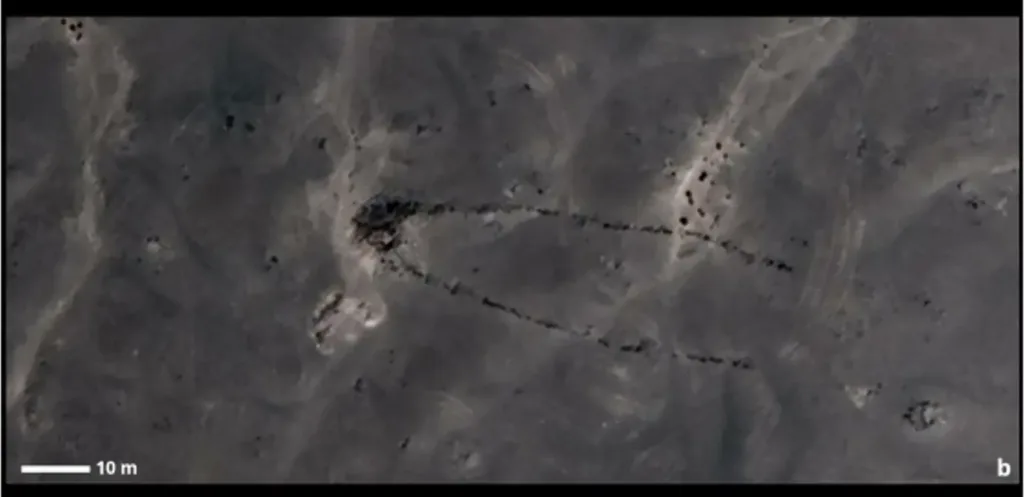
A mysterious stone monument stretching 54.5 meters across the Western Sahara has revealed a remarkably preserved prehistoric burial context dating back approximately 4,400 years. Beneath its unusual arrangement of limestone slabs, archaeologists discovered an undisturbed human burial. The findings provide the first direct chronological evidence for a distinctive class of prehistoric Saharan monuments whose origins and functions have long remained uncertain.
In one of the driest regions of the Western Sahara, two long rows of stones extend eastward from an oval mound, creating a shape unlike conventional prehistoric tombs. Known as an antennae tumulus, the monument at Wadi Lawash el Telli measures 54.5 meters from end to end. Although similar structures occur across parts of North Africa, archaeologists have struggled to establish when they were built or how they were used.
Now, research published in African Archaeological Review has provided answers to both questions. An international team led by Joaquim Soler of the Catalan Institute for Cultural Heritage Research examined the monument’s construction and analyzed human remains recovered from its interior. Two radiocarbon dates place the burial between approximately 4,417 and 4,100 years ago, establishing the first absolute chronology for this particular monument type in the Atlantic Sahara.

An Unusual Monument Extending Across the Desert
The structure consists of two distinct architectural elements. At its western end stands an oval burial mound measuring approximately 12.5 by 10 meters, while two elongated arrangements of limestone blocks extend eastward across the surrounding gravel plain. Together, these elements create the monument’s characteristic antenna-like appearance.
The builders used locally available Devonian limestone, placing slabs and blocks directly onto the ground without mortar. Although the entire monument stretches more than 54 meters, the mound rises no higher than three meters. Its construction suggests that a relatively small group of people could have assembled it without specialized stoneworking equipment.
The two stone extensions follow an orientation of approximately 102 degrees from geographic north. Similar alignments have prompted suggestions that certain Saharan monuments may have held astronomical significance. However, the researchers emphasize that an astronomical function has not been demonstrated for the Lawash el Telli structure.
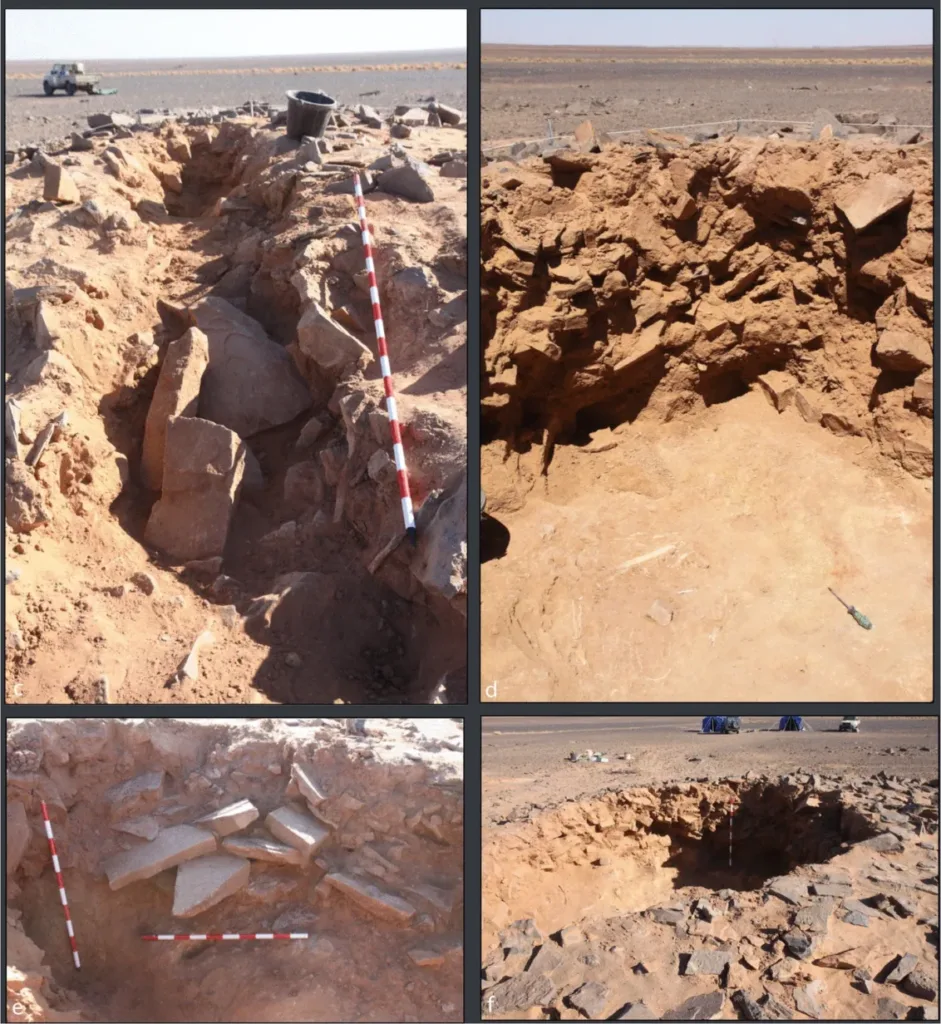
A 4,400-Year-Old Burial Hidden Beneath the Stones
Excavations revealed a carefully protected burial space beneath the mound’s outer limestone covering. Large stone slabs formed an internal protective structure, under which archaeologists discovered the remains of a single individual. The burial showed no evidence of disturbance or subsequent reuse, allowing researchers to examine its original arrangement.
The deceased had been placed on their back along a north–south axis, with the head toward the south and the legs folded sideways. Dental evidence suggests the individual was approximately 25–35 years old at death, although poor skeletal preservation prevented researchers from determining their sex.
The only artifacts recovered alongside the remains were four small circular beads made from ostrich eggshell. Researchers believe these may have belonged to personal ornaments worn by the deceased. No distinctive pottery, tools, or other grave goods were present to help identify the individual’s cultural affiliation.
Establishing the burial’s age initially proved difficult. The bones contained insufficient preserved collagen for conventional radiocarbon dating, and attempts in 2018 failed. Researchers eventually analyzed the mineral component of two bone samples in 2025, obtaining consistent results that placed the burial between 4,417 and 4,100 calibrated years before present.
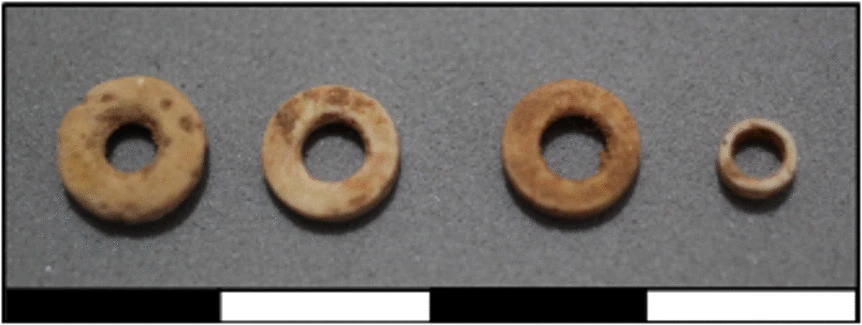
Four circular beads made from ostrich (Struthio camelus) eggshell, the only artifacts recovered from the 4,400-year-old burial at Wadi Lawash el Telli in Western Sahara. Credit: Soler et al., African Archaeological Review (2026),
What the Monument Reveals About Prehistoric Sahara
The new chronology places antennae tumuli within a broader tradition of stone funerary monuments that developed across the Western Sahara during the Late Neolithic. Related structures occur in southern Morocco and Mauritania, while other forms, including crescent-shaped tombs, appear throughout the region.
The results indicate that antennae tumuli overlapped chronologically with some crescent-shaped funerary monuments. This provides researchers with a firmer basis for comparing different burial traditions and examining changes in the treatment of the dead across prehistoric Saharan communities.
The surrounding landscape adds another dimension to the discovery. Less than a kilometer from the monument lies part of the Sluguilla Lawash rock art complex, where researchers have documented 2,068 engraved figures distributed across approximately 27 kilometers. These images include animals and other motifs associated with prehistoric populations, although the researchers caution that the nearby rock art cannot yet be directly linked to the people responsible for constructing the tomb.
For archaeologists, the importance of Lawash el Telli lies not simply in its extraordinary length but in the evidence preserved beneath its stones. The burial confirms that at least one example of these enigmatic monuments served a funerary purpose, while its newly established age provides a chronological reference for future investigations elsewhere in the Sahara.
Soler, J., Ventura, H., Rufí, I. et al. Chronology and Funerary Practices Associated with Antennae Tumuli in Western Sahara. Afr Archaeol Rev (2026). https://doi.org/10.1007/s10437-026-09666-8
