3 February 2026 The Future is the Product of the Past

In a Wisconsin lake, archaeologists discover a 1,200-year-old dugout canoe

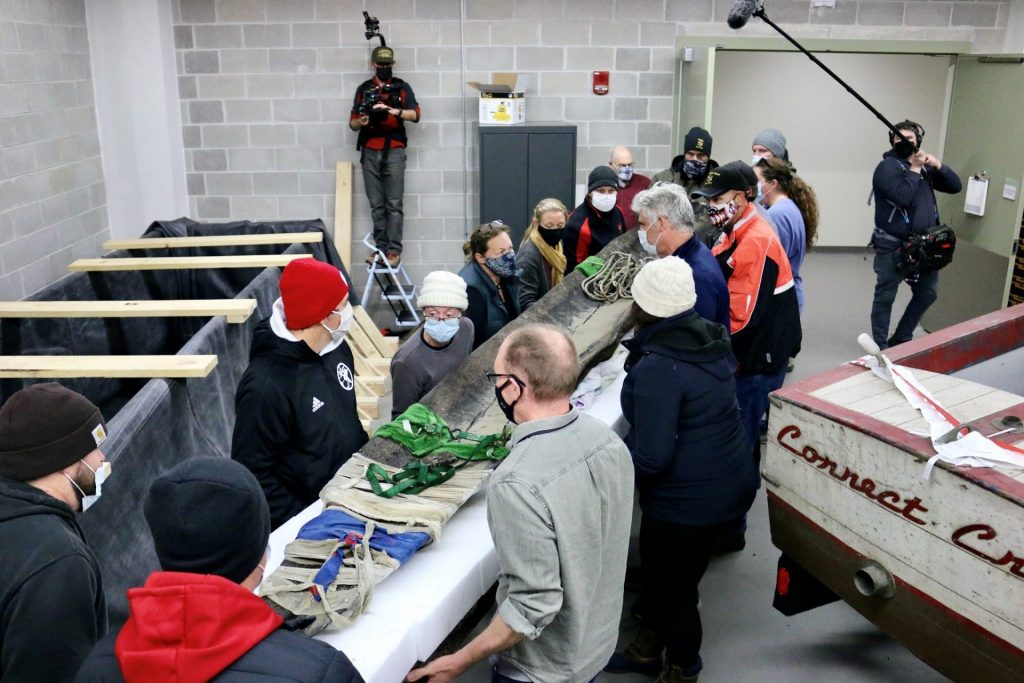
Maritime archaeologists from the Wisconsin Historical Society have discovered a dugout wooden canoe in Lake Mendota, Wisconsin, USA.

Carbon analysis dates the canoe to roughly AD 800, centuries before Europeans arrived on the continent. It was discovered with net sinkers showing that it was used for fishing in the lake. The canoe could be the oldest water vessel known in the state that is still completely intact.

The canoe was located at a depth of 30 feet in June 2021, and divers from the Wisconsin Historical Society and the Dane County Sheriff’s Office worked together to recover it from the lakebed.

“The dugout canoe found in Lake Mendota is a significant artifact of the continuum of canoe culture in the Western Great Lakes region,” said Christian Overland, the Ruth and Hartley Barker Director & CEO for the Wisconsin Historical Society.
Wisconsin Historical Society
Photo: Wisconsin Historical Society

“The canoe is a remarkable artifact, made from a single tree, that connects us to the people living in this region 1,200 years ago. As the Society prepares to open a new history museum in 2026, we are excited about the new possibilities it offers to share Native American stories and culture through the present day,” said Overland.


📣 Our WhatsApp channel is now LIVE! Stay up-to-date with the latest news and updates, just click here to follow us on WhatsApp and never miss a thing!!


The canoe was moved to Wisconsin’s State Archive Preservation Facility in Madison, where it was placed in a custom-built storage tank, according to officials. To assist preserve the boat from physical degradation, the vat includes water and a bio-deterrent. The vat will eventually be filled with a chemical solution that will replace the water in the wood’s cellular structure. It is predicted that the preservation procedure will take three years.

Cover Photo: Wisconsin Historical Society

Related Articles

Iron Age Warriors Bend the Swords of Their Defeated Enemies

22 April 2021

22 April 2021

Archaeologists from the Westphalia-Lippe Regional Association (LWL) announced that a metal detector has discovered “one of the largest Iron Age...

1,800-Year-Old Roman Victory Goddess Relief Discovered Near Hadrian’s Wall at Vindolanda Fort

21 May 2025

21 May 2025

A rare and symbolically powerful Roman sandstone relief depicting Victoria, the goddess of Victory, has been unearthed at the Vindolanda...

Yes — Camels Really Lived in Basel During the Roman Era!

4 January 2026

4 January 2026

Archaeologists in Switzerland have uncovered compelling evidence that reshapes our understanding of everyday life in Roman-era Europe: camels — yes,...

Frozen but Not Forgotten: 2,500-Year-Old Tattoos of Siberian Ice Mummy Digitally Reconstructed

31 July 2025

31 July 2025

Siberian Ice Mummy: Unveiling Ancient Tattoo Traditions of Iron Age Siberia In a groundbreaking fusion of archaeology and modern imaging,...

One of the greatest gold treasures in Danish history found in Vindelev

6 September 2021

6 September 2021

Near the town of Jelling in Denmark, one of the biggest treasures ever found dating from the sixth century has...

2,700-year-old Military Roman Port Found in Parion, Türkiye

18 July 2024

18 July 2024

Underwater studies in Parion, a 2,700-year-old port city from the Roman Empire in Kemer village of Biga district of Çanakkale...

A new study reveals that “Bog Bodies” were part of a Millennia-old tradition

10 January 2023

10 January 2023

Archaeologists have studied hundreds of ancient “Bog Bodies” discovered in Europe’s wetlands, revealing that they were part of a millennia-old...

A 3,300-year-old tablet found at Büklükale from Hittite Empire describes catastrophic invasion of four cities

11 March 2024

11 March 2024

Archaeologists have unearthed a 3,300-year-old clay tablet depicting a catastrophic foreign invasion of the Hittite Empire in Büklükale, about 100...

Czech Discovery Reveals One of the Largest Celtic Settlements in Central Europe

8 July 2025

8 July 2025

Over 13,000 artifacts, including gold coins and Baltic amber, discovered in one of Central Europe’s largest Celtic settlements. A groundbreaking...

The first and largest astronomical observatory of the 6th century BC discovered in Egypt’s Kafr El-Sheikh

24 August 2024

24 August 2024

Archaeologists in Egypt unveiled the first and largest astronomical observatory from the 6th century BCE in the Buto Temple at...

A rare treasure with ornaments nearly a thousand years old was discovered in Staraya Ryazan, Russia

18 August 2021

18 August 2021

During expeditions of the Institute of Archeology of the Russian Academy of Sciences, a rare treasure with ornaments of about...

Archaeologists discovered a dragon made of mussel shells in in Inner Mongolia

26 August 2023

26 August 2023

Archaeologists discovered a dragon made of mussel shells earlier this week in Chifeng, North China’s Inner Mongolia Autonomous Region, which...

First European farmers’ heights did not meet expectations

9 April 2022

9 April 2022

A combined study of genetics and skeletal remains shows that the switch from primarily hunting, gathering and foraging to farming...

Archaeologists found a mysterious stone tablet in Georgia that contains an unknown language

5 December 2024

5 December 2024

Archaeologists have unearthed a basalt tablet with inscriptions in an unknown language near Lake Bashplemi, in the Dmanisi region of...

Hungarian Archaeology Student Discovers Rare Bronze Figurines at Roman-Era Brigetio Site

31 July 2025

31 July 2025

A remarkable archaeological discovery emerged this July at the ancient Roman site of Brigetio in Komárom, Hungary. First-year archaeology student...