
11 February 2026 The Future is the Product of the Past

Gold Roman Fidelity Ring: A 2,000-Year-Old Symbol of Love Discovered in Bulgaria

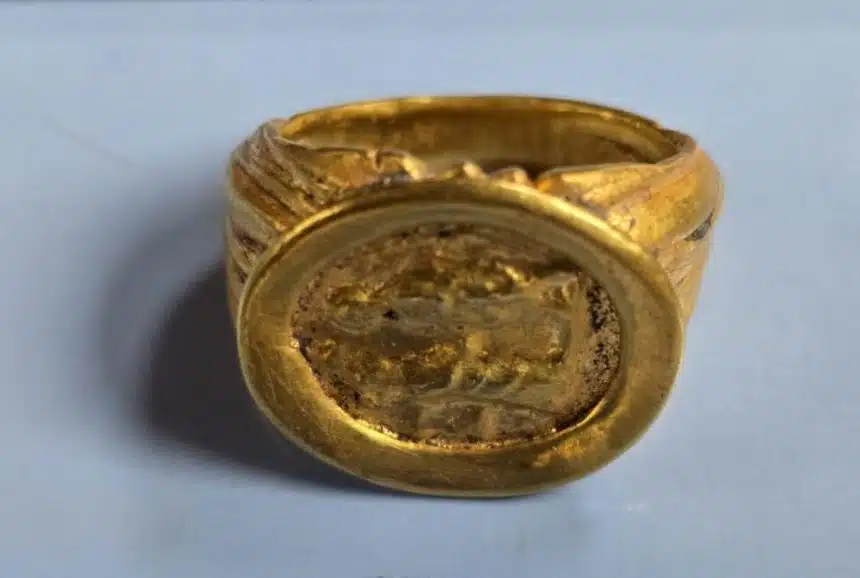
Archaeological excavations in Ancient Bononia, located in modern-day Vidin, Bulgaria, have revealed a remarkable discovery that sheds new light on Roman social life and marital traditions. A gold Roman fidelity ring, weighing 23.63 grams, was unearthed during the final days of the 2025 excavation season, at a depth of nearly six meters. Dating to the late 2nd to early 3rd century AD, the artifact is considered one of the most significant Roman finds in the region in recent years.

A Rare Roman Fidelity Ring

According to excavation director Assoc. Prof. Dr. Zdravko Dimitrov, the ring belongs to a category known as Roman marital fidelity rings. These rings were exchanged between newlyweds during the Roman Empire and served a role similar to modern wedding bands. Unlike plain rings, fidelity rings often featured symbolic imagery emphasizing loyalty, unity, and legal marriage.

The Bononia ring has an oval gold bezel engraved with the image of a married couple, a powerful symbol of partnership and lifelong commitment in Roman culture. The oval plate is soldered onto the band, which is decorated with parallel grooves (cannelures) on both sides—a refined decorative technique common in high-quality Roman jewelry.
Ancient Roman gold fidelity ring discovered in Bononia (modern-day Vidin), Bulgaria, during archaeological excavations by the National Museum of Bulgaria. Credit: National Museum of Bulgaria.

Local Craftsmanship and Ratiaria’s Goldsmiths

Experts believe the ring was locally produced, most likely in one of the renowned goldsmith workshops of Ratiaria (modern-day Archar), a major Roman city near the Danube. During the 2nd century AD, both Bononia and Ratiaria transitioned from military outposts into thriving civilian and economic centers, benefiting from trade routes along the Danube frontier.

Roman gold fidelity rings were typically worn by women, symbolizing not only emotional devotion but also legal marital status. In some cases, these rings also served as personal seals, reinforcing their importance in Roman daily life.


📣 Our WhatsApp channel is now LIVE! Stay up-to-date with the latest news and updates, just click here to follow us on WhatsApp and never miss a thing!!


Bononia: A Strategic Roman and Byzantine Hub

Ancient Bononia was founded as a Roman fort and later developed into a prosperous city within the province of Moesia Superior. Its strategic position along the Danube Limes made it a key point for trade, military logistics, and communication.

Interestingly, the same excavation zone yielded another major discovery from a much later period. About two meters above the Roman layers, archaeologists found a lead seal belonging to Basil, the Byzantine strategos of Bdin, dating to the early 11th century AD. This artifact dates to 1003 AD, when the Byzantine Empire reconquered the region during the reign of Emperor Basil II.

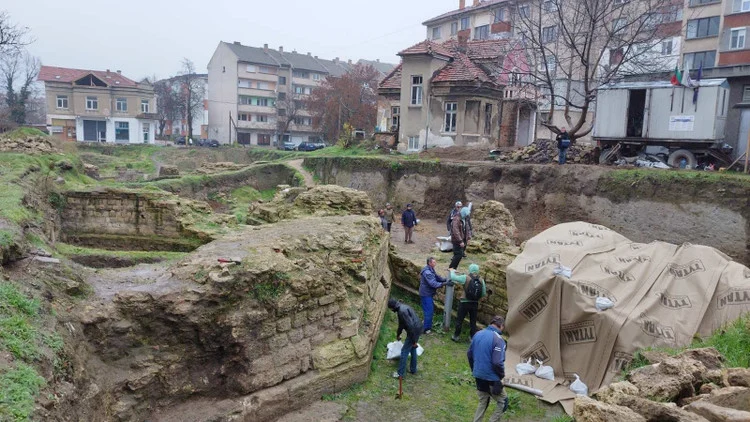
The repeated discoveries in this area—located near Tower No. 10, just inside the fortress entrance—suggest it was a heavily trafficked zone where valuable objects were likely lost over centuries of continuous movement and occupation.
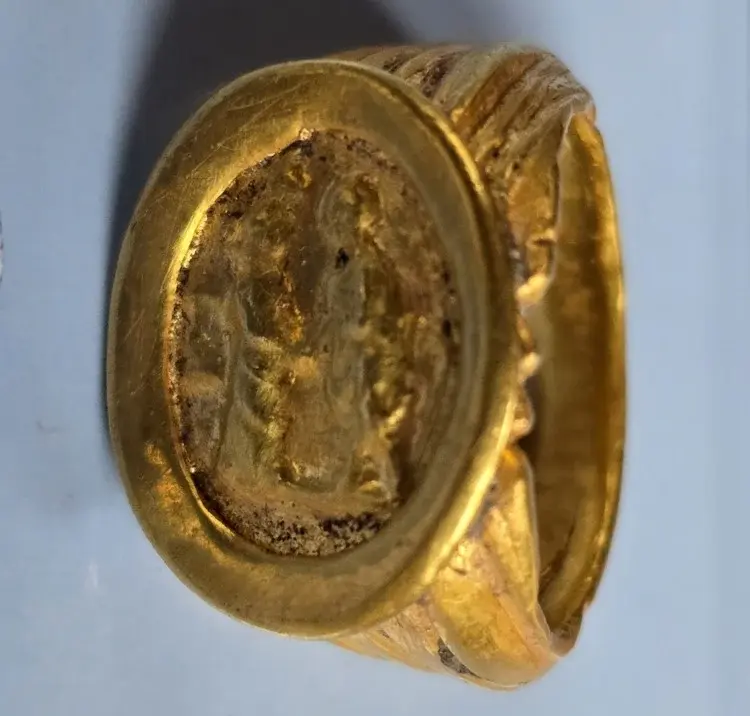
In closer detail, the center of the ring is oval-shaped and engraved with an image of a couple. Credit: National Museum of Bulgaria.

The Symbolism of Roman Love and Loyalty

Roman fidelity rings were more than decorative jewelry. They represented trust, legal marriage, and social identity. The depiction of couples holding hands or facing each other symbolized harmony and mutual respect—values strongly emphasized in Roman marital ideology.

Gold rings, in particular, indicated status and prosperity, making this discovery even more significant. The weight and craftsmanship of the Bononia ring suggest it belonged to a wealthy local family during the city’s peak period.

Ongoing Excavations and Cultural Preservation

The 2025 excavation season at Ancient Bononia has officially concluded, with conservation work currently underway to protect the site through winter. Local authorities have confirmed that funding will continue for future archaeological research at Bononia and the nearby Baba Vida fortress moat, ensuring further discoveries in one of Bulgaria’s most historically rich regions.

This extraordinary find not only enriches our understanding of Roman jewelry and marriage customs, but also reinforces Bononia’s importance as a cultural crossroads where love, power, and history intersected over two millennia ago.

Cover Image Credit: National Museum of Bulgaria.

Related Articles

In Poland, a 45-meter-long mysterious tunnel found under the ruins of the Saxon Palace

9 September 2023

9 September 2023

A mysterious underground tunnel was found under the ruins of the Saski Palace in Pilsudski Square in Warsaw, the capital...

Excavations at Körzüt Castle unearth 2 cuneiform inscriptions and a new Urartian Susi temple

25 October 2023

25 October 2023

During the rescue excavations carried out at the Körzüt Castle in the Muradiye district of Van province in eastern Turkey,...

A ‘Talismanic Grave Tablet’ Believed to Protect From Evil Found in Silifke Castle

3 September 2024

3 September 2024

During excavations in the Silifke castle located on lies on a hill in the town with the same name in...

Iron Age Warriors Bend the Swords of Their Defeated Enemies

22 April 2021

22 April 2021

Archaeologists from the Westphalia-Lippe Regional Association (LWL) announced that a metal detector has discovered “one of the largest Iron Age...

Roman era total of 46 early settler burials discovered in Germany

17 September 2023

17 September 2023

Students from Goethe University Frankfurt, in collaboration with the Hesse archeology department at the Darmstadt branch of the State Monument...

Part of lost star catalog of Hipparchus found hidden in Medieval parchment

22 October 2022

22 October 2022

Hipparchus’ fabled star catalog, which had been thought to be lost, was discovered concealed in a medieval parchment that had...

5,000-Year-Old Hewn Winepress and Canaanite Ritual Site Unearthed Near Tel Megiddo

7 November 2025

7 November 2025

Archaeologists in northern Israel have uncovered extraordinary evidence of ancient wine production and early Canaanite worship, shedding new light on...

Rare 832 copper coins from the Portuguese era unearthed in Goa, India

11 November 2023

11 November 2023

In Sattari, Nanoda, in the state of Goa on the west coast of India, 832 copper coins that are believed...

Tang-e Chogan bas-relief carvings, Majestic treasures of Sassanid art, are under threat of destruction 

9 March 2022

9 March 2022

Treasures of Sassanid art, some of Tang-e Chogan’s bas-reliefs are under threat of complete destruction due to lack of maintenance...

New Study Finds, 4,000-Year-Old Toolkit Unearthed Near Stonehenge Was Used to Work Gold

16 December 2022

16 December 2022

Archaeologists from the Universities of Leicester and Southampton in the United Kingdom recently published a study claiming that enigmatic artifacts...

Marble inlay floors found in a Sunken Roman villa in Baia, the Las Vegas of the ancient world

9 April 2023

9 April 2023

Expansion of research activities in the Terme del Lacus area in the sunken Baia park, known as the ‘Las Vegas’...

A prehistoric monument consisting of three round enclosures, one of which resembles a horseshoe, was discovered in France

7 April 2024

7 April 2024

Archaeologists from the French National Institute for Preventive Archaeological Research (INRAP) unearthed an unusual, prehistoric monument in the shape of...

Medieval Toy Workshop Unearthed in Freiburg: Archaeologists Discover Forgotten Childhood Treasures

6 September 2025

6 September 2025

Archaeologists in Freiburg, a historic city in Germany, have uncovered a medieval pottery workshop where clay toys were once crafted....

Fragments of the World’s Oldest Known Rune Stone Discovered in Norway

3 February 2025

3 February 2025

Archaeologists have found fragments of the world’s oldest known rune stone at the Svingerud burial field in Norway and fitted...

The 3,000-Year-Old Ancient City is Under Danger

8 February 2021

8 February 2021

For the port planned to be built in Izmir’s Aliağa district, a part of the 3,000-year-old ancient city is in...