
10 February 2026 The Future is the Product of the Past

Archaeologists Discover Roman-Era Industrial Settlement at Future Bilmer Berg II Business Park in Germany

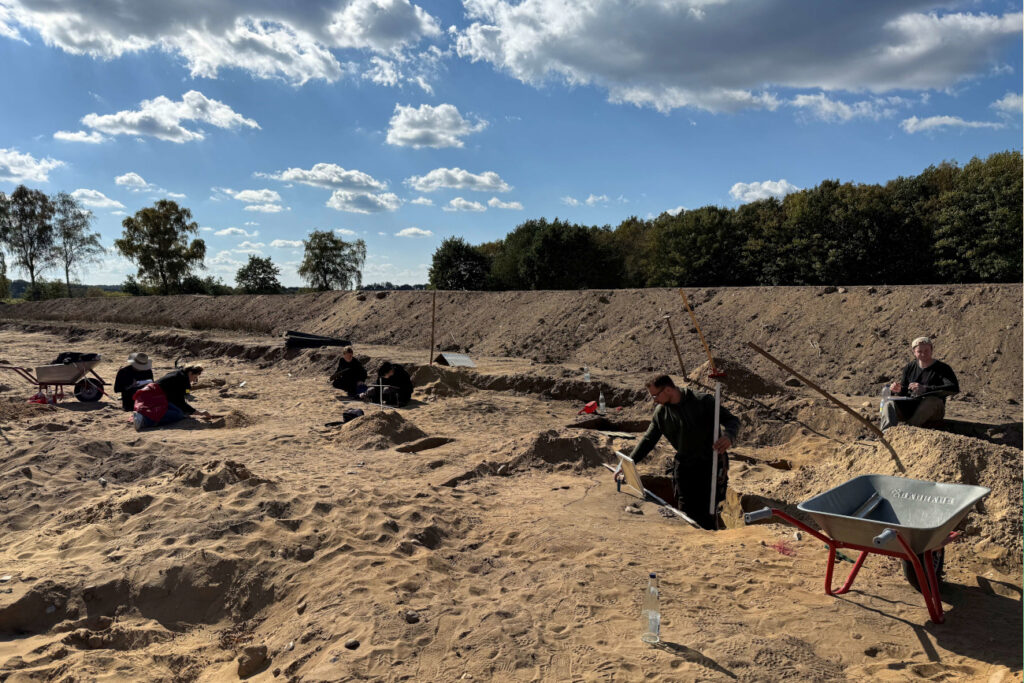
At first glance, the sandy field near the B209 road does not appear remarkable. Yet for archaeologists, the site in the eastern part of Lüneburg (Lower Saxony, Germany) has become a treasure trove. Excavations at the future business park Bilmer Berg II have revealed a significant industrial settlement dating back to the Roman Imperial period.

Collaborative Excavations with Strong Local Support

The archaeological work is being carried out in close cooperation between the City of Lüneburg’s archaeology department, the applied archaeology office AGIL, led by Dr. F. Andraschko, students from the University of Hamburg, as well as the local economic development agency WLH (Wirtschaftsförderung im Landkreis Harburg GmbH) and GEB mbH (Gesellschaft für Entwickeln und Bauen).

Evidence of Large-Scale Metalworking

Findings show that the area was inhabited for centuries, from the Late Bronze Age (around the 8th century BC) up to the late Roman Imperial period and Migration Era (around the 4th century AD). Particularly striking is the evidence of a large industrial settlement from the first centuries AD.

“The site shows an extraordinarily high density of evidence for metalworking,” explains city archaeologist Tobias Schoo. More than 100 bloomery furnaces and numerous heating hearths provide proof of extensive iron smelting and processing activities.
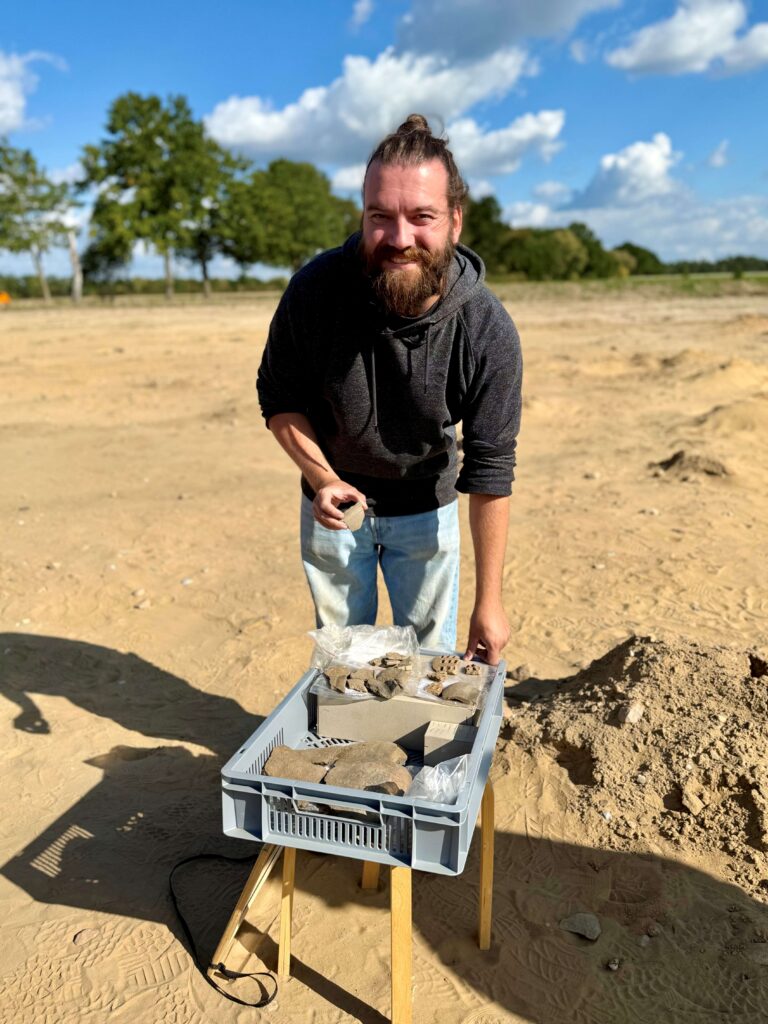
The excavations at Bilmer Berg provide us with unique insights into the early settlement and economic history of our region," says city archaeologist Tobias Schoo. Credit: City of Lüneburg
The excavations at Bilmer Berg provide us with unique insights into the early settlement and economic history of our region,” says city archaeologist Tobias Schoo. Credit: City of Lüneburg

Remarkable Finds: Pottery and a Roman Coin

Among the discoveries are decorated pottery fragments, a spindle whorl used in textile production, and a rare highlight: a Roman silver denarius from the early 2nd century AD, found by a volunteer metal detectorist.


📣 Our WhatsApp channel is now LIVE! Stay up-to-date with the latest news and updates, just click here to follow us on WhatsApp and never miss a thing!!


“The excavations at Bilmer Berg give us unique insights into the early settlement and economic history of our region,” Schoo emphasizes. The high concentration of metalworking remains makes the site one of the largest known industrial settlements of the Roman period in Lower Saxony, Germany.

Archaeology Meets Economic Development

Currently, excavations are ongoing along the planned road corridor of the business park. Further investigations will follow next year across the remaining areas. The City of Lüneburg has expressed its gratitude to all partners involved for enabling archaeology and modern economic development to progress hand in hand.

“These archaeological studies are essential preparatory steps for the start of development work on the first construction phase between Friedrich-Penseler-Straße and Oheweg,” explains René Meyer, Head of Land Management at WLH. Importantly, the archaeological program will not delay the planned infrastructure development.

Groundbreaking Scheduled for November

“The development works are on schedule, and the official groundbreaking ceremony is planned for the end of November,” Meyer confirms. The WLH is developing the Bilmer Berg II business park in cooperation with the City of Lüneburg, the GEB mbH (Volksbank Lüneburger Heide), and the Lüneburg Economic Development Agency.

Hansestadt Lüneburg

Cover Image Credit: Hansestadt Lüneburg

Related Articles

Roman-era structures unearthed in northwestern Turkiye dam site rescue excavations

18 May 2024

18 May 2024

Rescue excavations at the Reşitköy Dam site in the northwestern Turkiye province of Balıkesir have unearthed Roman structures, including a...

10,000-year-old rock art discovered in the Indian village of Medikonda

3 July 2021

3 July 2021

Rock art containing tiger, human and animal figures was found at the Jogulamba Gadwal site in Telangana, India. The New...

2900-Year-Old Erzin Stele: A Key to Understanding the Hittite to Greek Mythological Transition

5 April 2025

5 April 2025

In a significant archaeological discovery, a basalt stele was unearthed in 1987 by O. Günay while plowing his field at...

5000-year-old female figurines found in a Ukrainian cave

15 May 2023

15 May 2023

Archaeologists discovered five clay female figurines hidden inside a hole in a wall in Verteba Cave, in the Borshchiv Region...

Experts to uncover the secret of the monumental and three-dimensional Urartian statue found on Garibin Tepe

2 November 2024

2 November 2024

In an area where rescue excavations were conducted last year, archaeologists discovered a basalt stone statue from the Urartian period...

Medieval Mummy Seized in Niğde, Türkiye, Amidst Smuggling Crackdown

12 March 2025

12 March 2025

Authorities in Türkiye have detained six individuals in the Bor district of Niğde, who were allegedly attempting to sell an...

The free online course from the Colchester Museums and University of Reading Department of Archeology

12 July 2021

12 July 2021

The opportunity to be among the first to examine 2,000-year-old cremated remains from Roman Britain and learn about the origins...

Oldest known arrowheads uncovered in the Americas

24 December 2022

24 December 2022

Archaeologists from Oregon State University have discovered projectile points in Idaho that are thousands of years older than any that...

Mysterious 1,600-Year-Old Roman-Era Burial Unearthed in Delbrück-Bentfeld, Germany

15 June 2025

15 June 2025

Archaeologists have uncovered a rare and mysterious Roman-era burial in Delbrück-Bentfeld, Germany, revealing a unique glimpse into the region’s ancient...

Archaeologists find 4 Umayyad epigraphs in the ancient city Knidos

24 May 2022

24 May 2022

Archaeological excavations in the ancient city of Knidos connected to Datça District of Muğla province in western Turkey have unearthed...

Amateur divers discover ‘enormously valuable’ hoard of Roman coins

27 September 2021

27 September 2021

Two amateur free divers have found one of the largest collections of Roman coins in Europe off the east coast of Spain. Luis Lens...

Six New Aramaic Inscriptions Unearthed at Ancient City of Zernaki Tepe in Eastern Türkiye

15 October 2025

15 October 2025

Archaeologists have discovered six new Aramaic inscriptions at Zernaki Tepe, a 3,000-year-old ancient city in eastern Türkiye’s Van Province. The...

Archaeologists opened an untouched Etruscan tomb

31 October 2023

31 October 2023

In Vulci Archaeological Park, central Italy, a 2,600-year-old intact double-chambered Etruscan tomb that was discovered in April and had remained...

Byzantine-Era Monastic Complex Discovered in Sohag, Egypt

8 January 2026

8 January 2026

Archaeologists in Upper Egypt have uncovered the remains of a remarkably well-preserved monastic residential complex dating back to the Byzantine...

Human Activity on Curaçao Began Centuries Earlier Than Previously Believed

28 March 2024

28 March 2024

New research co-led by Simon Fraser University and the National Archaeological Anthropological Memory Management (NAAM Foundation) in Curaçao extends the...