2 February 2026 The Future is the Product of the Past

A Polish-Croatian team discovered Ancient Roman Temple under a Croatian 18th Century church

Under an 18th-century church, the Church of St. Daniel in Danilo near Sibenik, Croatia, the foundations of an ancient Roman temple have been found.

Sibenik is the location of the former Roman city of Ridit, though the secret of the ancient temple was previously unknown.

Finding the temple made use of LIDAR aerial scanning technology.  Using LIDAR techniques, the Polish-Croatian team found the frame of the temple’s entrance, which is likely all that remains of an old colonnade. According to archaeologists, the temple once measured 66 feet by 33 feet and had walls that were significantly larger than they are now.

Discovering team, in addition to the church, the team also found a nearby cemetery, which is said to have been in use between the 9th and 15th Centuries.
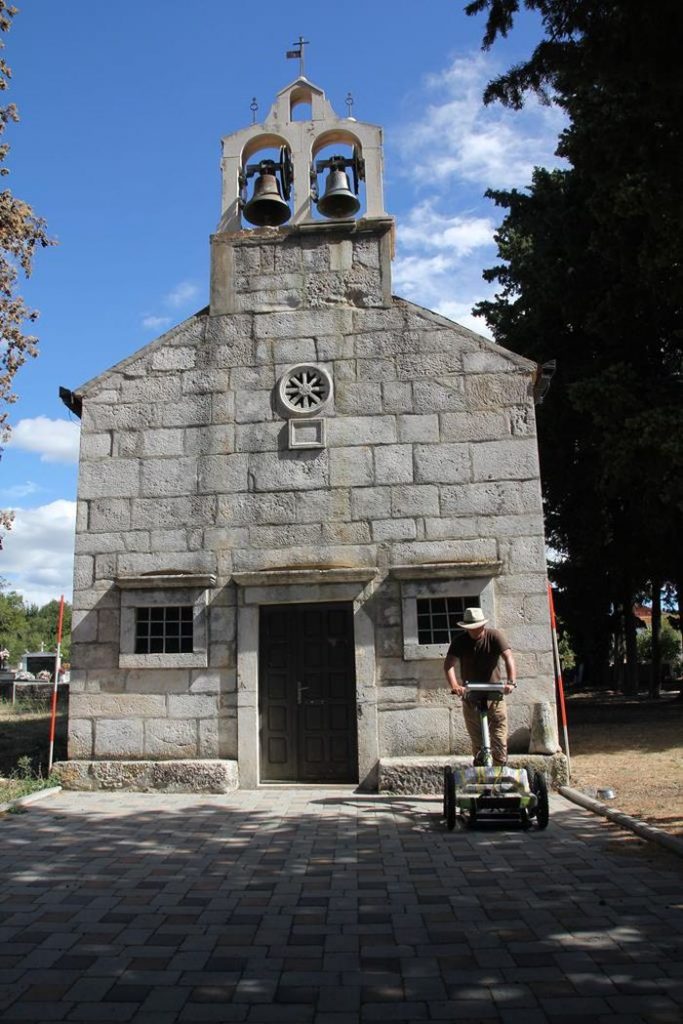
Georadar survey around the church in Danilo, under which relics of the Roman sacral building were discovered. Photo: O. Orłowska

Polish research leader, Professor Fabian Welc of the Institute of Archaeology of the Cardinal Stefan Wyszyński University in Warsaw said that the temple was most likely part of a larger forum, which would have once been the location of several important public buildings, including courts and offices. He said, “The data we have collected indicate that under today’s church and the adjacent cemetery, there are relics of a temple, which was part of the forum, the most important part of a Roman city.”


📣 Our WhatsApp channel is now LIVE! Stay up-to-date with the latest news and updates, just click here to follow us on WhatsApp and never miss a thing!!


He added that the forum was the centre of the social and economic life of the inhabitants of every Roman municipium (city). This forum was located at the intersection of the main communication arteries and was also the central point in the city.
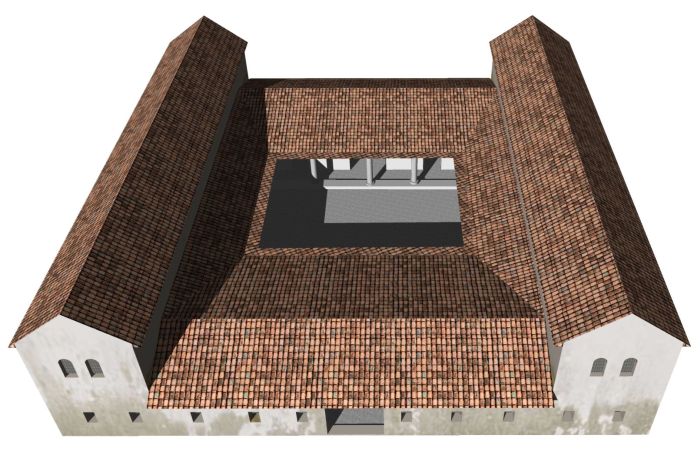
Reconstruction of a building with a courtyard made by Professor Fabian Welc.

According to scientists, the church was not the only structure built on the ruins of the former temple. The nearby cemetery, which operated from the ninth to the fifteenth centuries, was also partially within its original range. Some medieval graves were dug directly into Roman bath relics, as was the adjacent massive building with a central courtyard and a portico surrounded by numerous rooms.

Professor Welc said: “This means that the extensive medieval cemetery was founded directly on the relics of Roman buildings.”
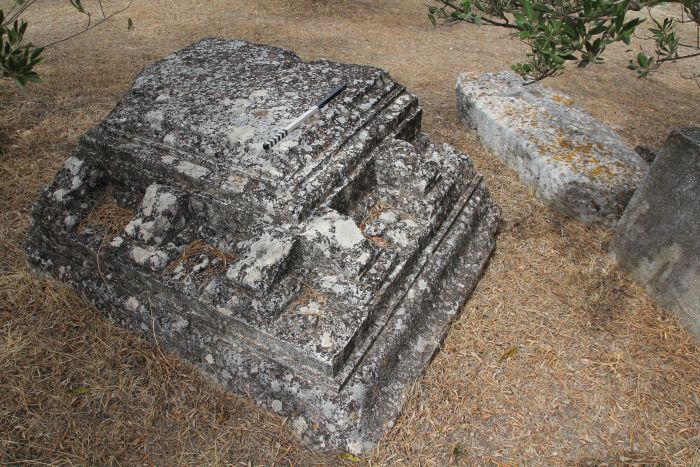
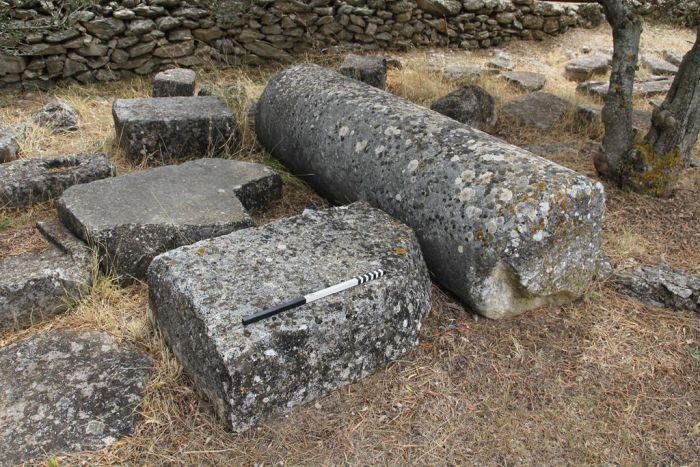
A fragment of an ornamented monumental beaming of the Roman temple was unearthed in the 1950s in the medieval cemetery near the church in Danilo. Photo: Fabian Welc

Archaeological research has been undertaken in Danilo for the last 70 years. The joint Polish-Croatian project started in 2019. It is carried out by researchers from the Institute of Archeology of the Cardinal Stefan Wyszyński University in Warsaw, the Institute of Archaeology in Zagreb, and the Šibenik City Museum.

PAP

Cover Photo: Fabian Welc

Related Articles

A rural necropolis from Late Antiquity discovered in northeastern France

5 November 2022

5 November 2022

Inrap archaeologists have unearthed a small rural necropolis from the late 5th century (Late Antiquity) at Sainte-Marie-aux-Chênes in northeastern France....

A Rare Find That Stuns Archaeologists: Ancient 3,500-Year-Old Dagger Found in Germany’s Heartland

22 August 2025

22 August 2025

A simple family walk near the village of Gudersleben in Nordhausen County, in Thuringia, central Germany, has turned into a...

Excavations at Aizanoi in Western Turkey to Resume

29 March 2021

29 March 2021

The ancient city of Aizanoi is located in the town of Çavdarhisar, 57 km from the center of Kütahya (Turkey’s...

India’s Longest Iron Age Spears Found in Tamil Nadu: One Measures 2.5 Meters

28 January 2026

28 January 2026

Archaeologists in southern India have uncovered what is now believed to be the longest Iron Age iron spear ever found...

Ancient Celtic Bone Pen Found in Southern Germany

14 December 2024

14 December 2024

From August to October this year, the State Office for the Preservation of Monuments (LAD) in the Stuttgart Regional Council...

7,000-year-old Ritual Complex Found In Jordan Desert

23 February 2022

23 February 2022

The team of French and Jordanian archaeologists has discovered a 7,000-year-old ritualistic complex near what is thought to be the...

2,500-Year-Old Phoenician Shipwreck Being Rescued By Spanish Archaeologists

6 July 2023

6 July 2023

A 2,500-year-old Phoenician shipwreck has been found underwater in the southeastern Spanish region of Murcia. An extraordinary Phoenician shipwreck dating...

Archaeologists discover bones of a woman who lived 14,000 years ago at a site in The Iberian Peninsula

13 August 2021

13 August 2021

Archaeologists have discovered the bones of a lady who lived 14,000 years ago, the earliest traces of a modern burial...

Bronze Age Treasure Found in Swedish Forests

30 April 2021

30 April 2021

A man who studied the forest to make a map for the orienteering club in western Sweden made an incredible...

Archaeologists Discover Old Bulgarian Inscription and Rich Finds at Nikopol Fortress Excavations

2 September 2025

2 September 2025

This summer’s archaeological season at the Nikopol Fortress has yielded one of the most remarkable discoveries in recent years: an...

Name of Iranian city identified on 1800-year-old Sassanid clay seal

9 April 2024

9 April 2024

In a stunning archaeological find, the name “Shiraz” was identified on a clay sealing from the Sassanid era written in...

Archaeologists found a 2,000-year-old Roman road in Cluj-Napoca in northwest Romania

23 January 2023

23 January 2023

Archaeologists from the National Museum of the History of Transylvania have discovered a well-preserved 2,000-year-old Roman road in the city...

Archaeologists discover a “Seleucid satrap tomb” in the ancient Greek (Seleucids) city of Nahavand in Iran

16 May 2022

16 May 2022

Archaeologists announced on Saturday that they discovered a tomb believed to be the tomb of a Seleucid satrap or general...

Anthropologists say humans have been using personal ornaments to communicate about themselves without the fuss of conversation – for millennia

24 September 2021

24 September 2021

Anthropologists believe that for millennia, individuals have used personal decorations to communicate about themselves without the hassle of dialogue. They...

Study refutes previous assumptions, DNA evidence rewrites story of people buried in Pompeii eruption

8 November 2024

8 November 2024

Researchers from the University of Florence, Harvard University, and the Max Planck Institute for Evolutionary Anthropology in Leipzig analyzed the...