9 March 2026 The Future is the Product of the Past

A Mikveh or Jewish ritual bath discovered in basement of former strip club in Poland

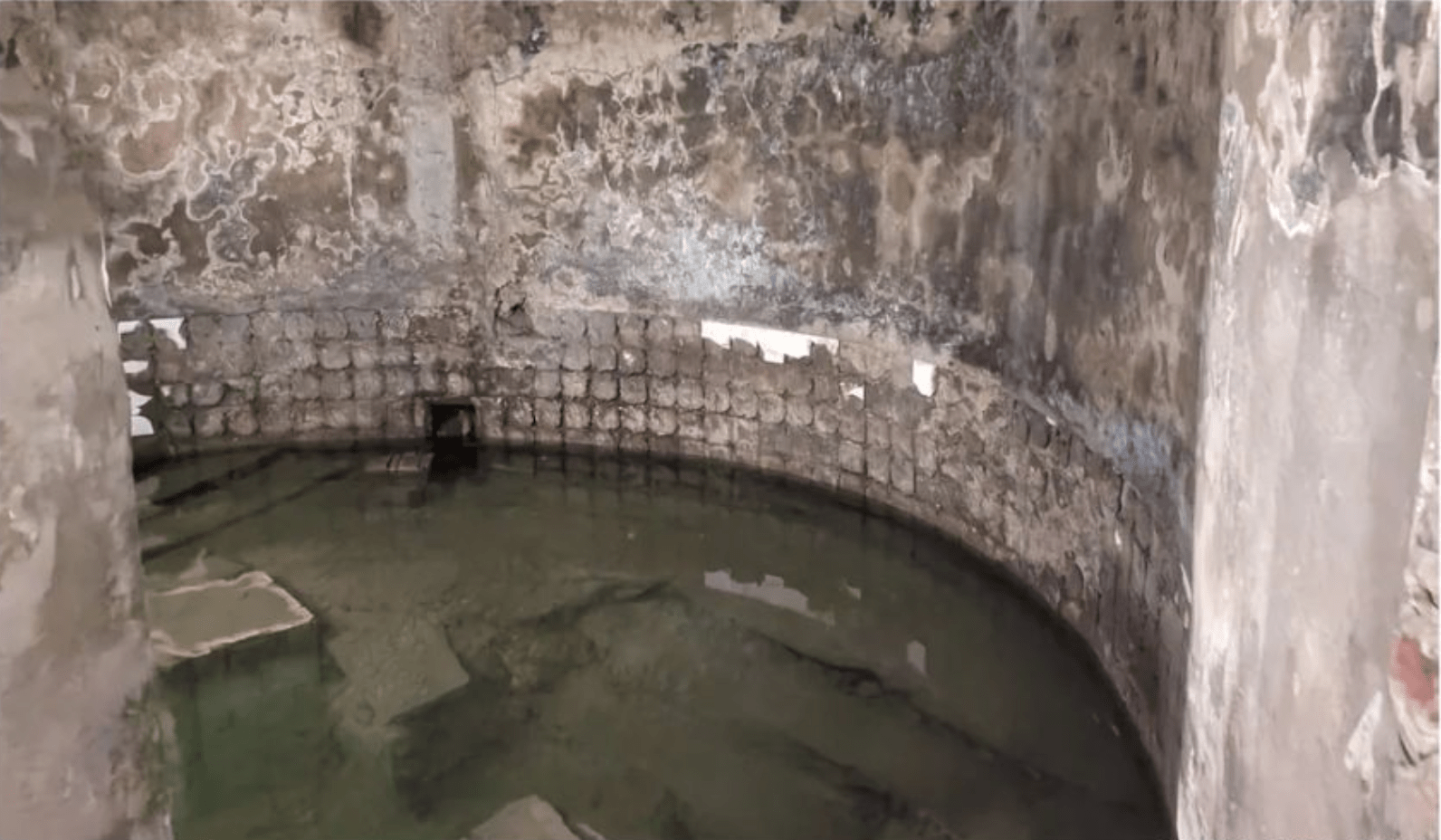
Marian Zwolski, a Chmielnik businessman, bought a former nightclub that had been closed for 15 years a few years ago. When he opened the basement door to his new home, he found something unexpected: a mikveh, or Jewish ritual bath.

Before the Holocaust, the population of the town of Chmielnik, Poland, was around 80% Jewish. Sephardic Jews, having been expelled from Spain during the Inquisition, settled in Chmielnik and eventually built a synagogue in 1638.

After the war, only four Jews remained. Today, the building houses a museum of the town’s Jewish life and history. Now another Jewish heritage site has been discovered, in an unlikely place.

The Sphinx nightclub in the town of Chmielnik, in southern Poland, closed about 15 years ago. The bar in the deserted building is still visible, complete with a Heineken sign on the wall and a sign that states that no one under the age of 18 may be served alcohol. Additionally intact is the pole upon which strippers once performed.

The building was recently purchased by Marian Zwolski, a Chmielnik-native businessman and amateur historian. He was astounded by what he saw when he opened the door to the basement, which is located beneath the dance floor. He learned that he now owned a rare and magnificent Jewish heritage site.


📣 Our WhatsApp channel is now LIVE! Stay up-to-date with the latest news and updates, just click here to follow us on WhatsApp and never miss a thing!!
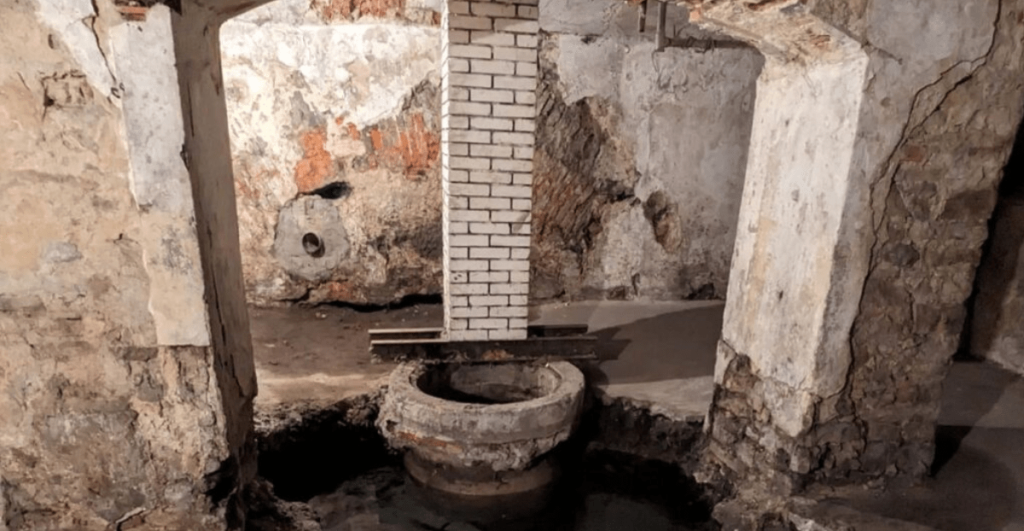


Visitors to the former nightclub are greeted by an unusual site: a large mikveh, or ritual purification bath, full of water. Its blue-and-white floor tiles have held up well. In one corner, there are stars of David on the walls. An adjacent room holds a smaller mikveh that was used by women.

The bath’s blue and white floor tiles are still there, as are Stars of David on the wall. A smaller mikveh, likely used by women, is in a neighboring room.

“It’s astonishing,” said Meir Bulka, who advocates for the preservation of Jewish heritage in Poland, in an interview with Haaretz. “You enter the basement, and you’re in another world. It’s like a time capsule.”

Zwolski, who also operates a funeral home in nearby Kielce — the site of a 1946 pogrom that killed 42 Jews — told Haaretz he is hoping to turn his new mikveh into a tourist attraction, possibly a museum.

“I was born and raised here, so I care about the history of the place. I don’t want it to disappear,” Zwolski says. “I encourage the people to remember the past and I also call on you, the Jews, to preserve it and see to it that it is memorialized.”

Cover Photo: Ofer Adaret
Related Articles

DNA Elucidates Mysteries of the Iron Age Log Coffin Culture in Thailand

9 February 2024

9 February 2024

The Northwestern Thailand highlands region of Pang Mapha is dotted with dozens of caves that contain some incredibly odd prehistoric...

1-meter tall bronze statue found in China’s Sanxingdui Ruins-Video

17 June 2022

17 June 2022

Chinese archaeologists have discovered a 1-meter tall bronze statue at the site of ancient Sanxingdui ruins site in southwest China’s...

Rare 13th-Century Coin Hoard Discovered at Berlin’s Molkenmarkt Excavations

10 August 2025

10 August 2025

Archaeologists have uncovered a remarkable treasure dating back to the 13th century during the ongoing excavations at Molkenmarkt, the historic...

A 3300-Year-Old Canaanite Shipwreck Ever Discovered with All Its Cargo off Israel’s Coast

21 June 2024

21 June 2024

An Energean natural gas surveying vessel operating about 90 kilometers (56 miles) off the coast of Israel discovered a ship...

Storeroom and Soup Kitchen Unearthed in Ancient Timbriada: New Clues to Pisidia’s Forgotten City

25 September 2025

25 September 2025

Archaeologists have uncovered a 2,200-year-old storeroom and soup kitchen in the ancient city of Timbriada, located in Isparta’s Aksu district....

A bronze tablet from 2000 years ago proves that Greek was spoken in Anatolia and that a multicultural life existed ‘Anisa tablet’

12 April 2024

12 April 2024

The Anisa bronze tablet proves that Greek was used in Anatolia 2000 years ago and that a multicultural life existed....

Tens of Thousands of Ancient Bronze Coins Dating from the 4th Century Discovered Off Sardinia

4 November 2023

4 November 2023

A diver spotted something metallic at the bottom of the sea off the town of Arzachena in the Sassari province...

How Clean Were the Hittites? A Sophisticated Hygiene Culture 3,000 Years Ago, Revealed by New Research

29 January 2026

29 January 2026

For a civilisation that flourished more than 3,000 years ago, the Hittites may have been far more concerned with cleanliness...

Archaeologists unearth the Torah Ark of the Great Synagogue of Vilna, destroyed in Lithuania

30 August 2021

30 August 2021

In Vilnius, the capital of Lithuania, in excavation exposed the Torah ark and bimah (raised prayer platform) of the Great...

From Toy to Treasure: Detectorist’s ‘Lucky Mistake’ Reveals 2,000-Year-Old Roman Brooch in Dorset

25 September 2025

25 September 2025

A metal detectorist in Dorset, southwest England, has unearthed a 2,000-year-old Roman brooch. Initially mistaken for a child’s toy, the...

Archaeologists found 5 unique sculptures representing the Kakatiya art style in Siddipet

19 July 2021

19 July 2021

13th-century statues were found near a temple tank in the Siddipet district in the northern province of Telangana, India. On...

Exciting discoveries at Accana Mound: 3,250-year-old seal belonging to Hittite prince and Akkadian cuneiform texts discovered

19 November 2021

19 November 2021

A 3250-year-old seal of the Hittite prince and a 3400-year-old cuneiform tablet was found in Accana Höyük (Mound) in the...

Birkleyn Caves is “the Place Where The World Ends”

18 January 2025

18 January 2025

The Birkleyn Caves were known as “the place where the world ends” and as “the place where the water of...

Archeologists discover 2000-year-old Roman coins on the deserted Swedish island of Gotska Sandön

14 April 2023

14 April 2023

Archaeologists found 2,000-year-old Roman coins on the Swedish deserted island of Gotska Sandön. Previously, ancient Roman coins were discovered on...

Archaeologists Discover Kazakhstan’s Earliest Human Burial — A 7,000-Year-Old Neolithic Grave at Koken

24 October 2025

24 October 2025

Archaeologists in eastern Kazakhstan have uncovered the country’s oldest known human burial, dating back around 7,000 years. Found beneath Bronze...