29 December 2025 The Future is the Product of the Past

Egypt discovers five 4,000-year-old ancient tombs in Saqqara necropolis

The Egyptian Ministry of Tourism and Antiquities announced recently the discovery of five 4,000-year-old ancient tombs in the Saqqara archaeological sites southwest of Cairo.

“The Egyptian archaeological mission uncovered five tombs about 100 meters northwest of the Merenre Pyramid in southern Saqqara,” the ministry said in a statement.

According to Mostafa Waziri, the head of Egypt’s Supreme Council of Antiquities, the five tombs — all of which are in good condition — belonged to senior royal officials.

The tombs contain finds and objects dating back to the end of the Old Kingdom spanning from 2686 BC to 2181 BC and the beginning of the First Intermediate Period spanning from 2181 BC to 2055 BC.

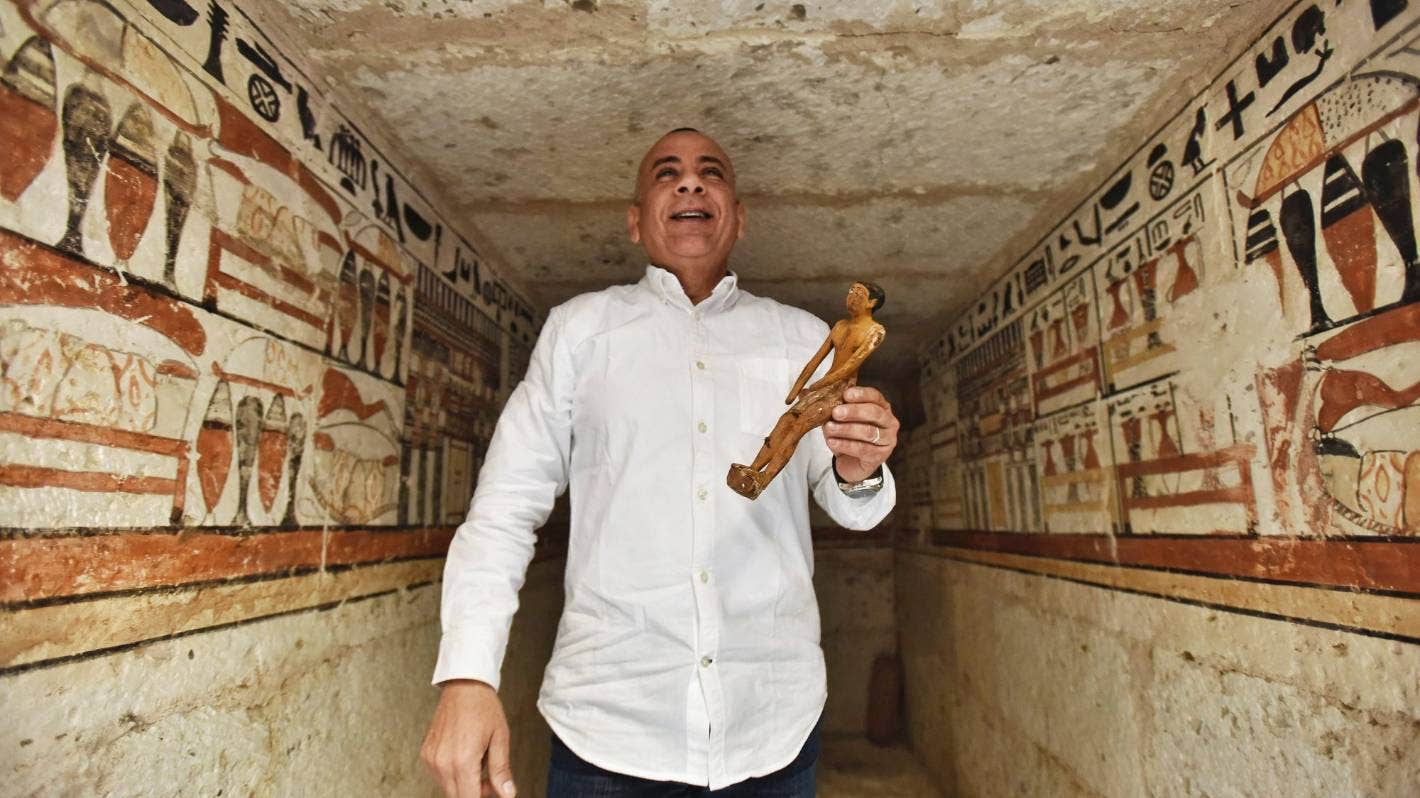
The Ministry of Tourism and Antiquities said one of the tombs belonged to a top official named Iry. A limestone sarcophagus and colorful decorations were found in the tomb. This tomb has a shaft that leads to a burial chamber whose walls portray a funeral with offering tables, the facade of a palace, and seven oil pots.


📣 Our WhatsApp channel is now LIVE! Stay up-to-date with the latest news and updates, just click here to follow us on WhatsApp and never miss a thing!!
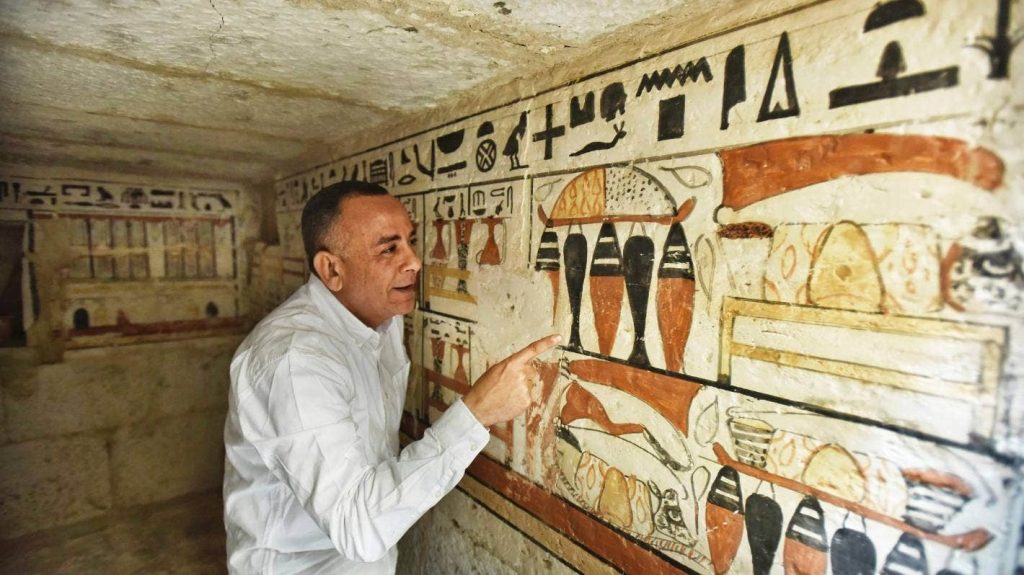


Mostafa Waziri, Secretary General of the Supreme Council of Antiquities, views hieroglyphics inside a recently discovered tomb near the famed Step Pyramid, in Saqqara, south of Cairo, Egypt.
Mostafa Waziri, Secretary-General of the Supreme Council of Antiquities, views hieroglyphics inside a recently discovered tomb near the famed Step Pyramid, in Saqqara, south of Cairo, Egypt. Photo: SAYED HASSAN/AP

The second tomb, likely belonging to the wife of a person named Yart, has a rectangular shaft.

The third one belongs to a person named Bi Nafarhafayi, who held several positions including the supervisor of the Great House, the chanting priest, and the cleaner of the house.

The fourth tomb, discovered six meters underground, is for Betty, a woman responsible for the king’s makeup and dressing. She was a priestess of Hathor, the goddess of love, beauty, music, dancing, fertility, and pleasure.

The last tomb for a man named Hannu has a seven-meter-deep rectangular shaft. Hannu’s titles include supervisor of the royal palace, mayor, supervisor of the Great House, bearer of the seals of Lower Egypt, and supervisor of an orchard.

The tombs were found near the Step Pyramid of Djoser, in the Saqqara Necropolis, 24km southwest of Cairo.

Footage shared on the ministry’s social media pages showed burial shafts leading to the tombs. Walls were seen decorated with hieroglyphic inscriptions and images of sacred animals and after-life items used by ancient Egyptians.

The Saqqara site is part of a sprawling necropolis at Egypt’s ancient capital of Memphis that includes the famed Giza Pyramids as well as smaller pyramids at Abu Sir, Dahshur and Abu Ruwaysh.

The ruins of Memphis were designated a UNESCO World Heritage site in 1970s.
Related Articles

A new magnetic survey of the ancient Assyrian capital of Khorsabad has revealed a 127-room villa twice the size of the U.S. White House

26 December 2024

26 December 2024

Archaeologists in northern Iraq have conducted an extensive magnetic survey using an exhaustive magnetic survey at Khorsabad, once the ancient...

Ancient Hawaiian Petroglyphs Reappear on Oahu’s Shoreline After Years Beneath the Sand

25 July 2025

25 July 2025

A remarkable piece of Hawaii’s cultural legacy has resurfaced this month, as ancient Hawaiian petroglyphs were once again exposed along...

Archaeologists find the largest bronze beast of Sanxingdui ruins

4 September 2022

4 September 2022

The largest and only one of its kind discovered in China to date, the bronze beast was discovered by archaeologists...

A Second temple of the Second Temple period was discovered at Migdal

13 December 2021

13 December 2021

The University of Haifa reported on Sunday the discovery of a 2,000-year-old synagogue from the Second Temple era in Migdal,...

The Iremir Mound illuminates the pre-Urartian period in East Van

27 July 2021

27 July 2021

Archaeological findings unearthed in the excavations carried out at the İremir Mound in the GĂŒrpınar district of Van, in eastern...

1000-year-old Cats and Babies mummies of Turkey’s

30 March 2022

30 March 2022

Cat, baby, and adult mummies in Aksaray, which took its place in history as Cappadocia’s gateway to the west on...

Unique ancient Egyptian amulet seal discovered during archeological excavations in northern Turkey

11 November 2022

11 November 2022

During archaeological excavations in the ancient city of Amastris in the Amasra district of northern Turkey’s Bartın, an enchanted amulet...

The Lion of Venice was Made in China: : Isotopic Analyses and Stylistic Comparisons Prove it

16 September 2024

16 September 2024

Recent scientific studies have revealed that the famous bronze-winged lion above one of the two columns in Piazzetta San Marco,...

An inscription written in both runic and Latin script on a church wall in Denmark turned out to be still a legally significant promissory note

31 May 2023

31 May 2023

An inscription in both runic and Latin script on a church wall in Denmark turned out to be legally valid...

New fortification walls discovered in the ancient city of Pergamon

14 February 2022

14 February 2022

2,500-year-old fortification walls were found in the Ancient City of Pergamon (Bergama), which was included in the World Heritage List...

Digital Pathways to the Hittite World – AI Meets Ancient Anatolia

29 October 2025

29 October 2025

A groundbreaking project is opening new digital routes to the ancient world of the Hittites. Under the title “Digital Pathways...

18,000 years ago, late Pleistocene humans may have hatched and raised the “World’s Most Dangerous Bird.”

2 October 2021

2 October 2021

Researchers say the eggshell is an understudied archaeological material that has the potential to clarify past interactions between humans and...

Archaeologists have found a mysterious prehistoric site, believed to be a 6,500-year-old Stone Age cemetery, near the Arctic Circle

4 December 2023

4 December 2023

Archaeologists have found a mysterious prehistoric site believed to be a 6,500-year-old Stone Age cemetery just 50 miles (80 kilometers)...

Italian Research Team May Have Found Plato’s Burial Site in Athens

23 April 2024

23 April 2024

Graziano Ranocchia, a papyrologist at the University of Pisa, said he found Plato’s exact burial place based on papyri findings...

The first and largest astronomical observatory of the 6th century BC discovered in Egypt’s Kafr El-Sheikh

24 August 2024

24 August 2024

Archaeologists in Egypt unveiled the first and largest astronomical observatory from the 6th century BCE in the Buto Temple at...