
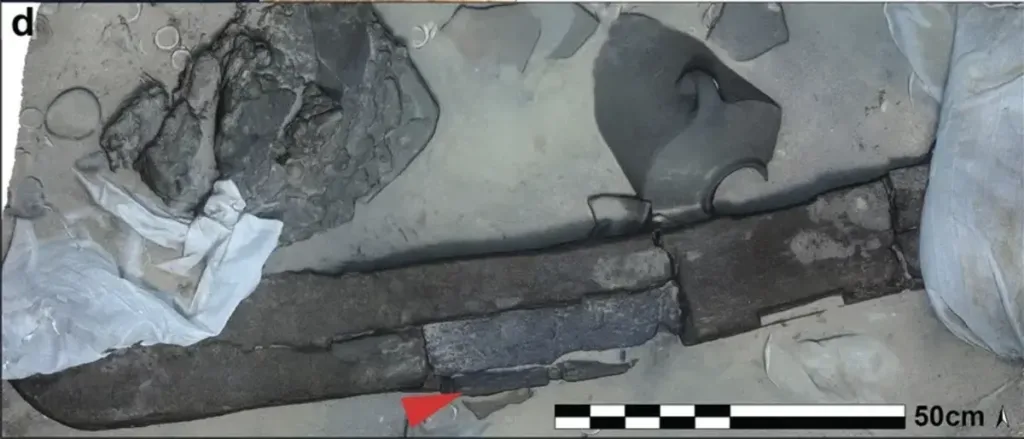
A massive wooden anchor component containing an estimated 113 kilograms of lead has revealed how Mediterranean sailors transformed maritime technology around 2,600 years ago. Found off the coast of Israel, the unusually large artifact offers new evidence of an engineering innovation that spread across the ancient Mediterranean, with important parallels along the western coast of Anatolia.
Beneath the shallow waters of the Dor Lagoon, south of Haifa, archaeologists have investigated an extraordinary survivor of ancient maritime engineering. Measuring approximately 2.2 meters in its original length and weighing an estimated 150 kilograms, the oak-and-lead anchor stock is the largest example of its kind documented in the eastern Mediterranean.
Although first discovered during underwater investigations in the 1990s, the artifact has now been studied in connection with a previously unidentified Iron Age cargo. New research published in the Journal of Maritime Archaeology places it in the late seventh or early sixth century BCE, making it one of the earliest known examples of this technology.
The findings suggest that Mediterranean sailors were already experimenting with sophisticated composite anchors centuries before such designs became widespread.
A Giant Anchor Beneath the Mediterranean
The anchor was originally discovered during underwater surveys conducted by the University of Haifa and Texas A&M University in 1994–1995. At the time, researchers associated it with the Persian period, but its precise historical context remained uncertain. Because of its fragile condition, the wooden component was protected with sandbags and left on the seabed.
Recent excavations by the University of Haifa and the University of California, San Diego, relocated the artifact and investigated the surrounding deposits. Archaeologists identified an associated cargo containing at least 15 basket-handled amphorae, four Phoenician-type amphorae, three thin-walled bowls and nine pieces of unworked iron weighing nearly 70 kilograms.
Organic material recovered from the cargo, including grape seeds, resin and an oak twig embedded in an iron bloom, provided evidence for a more precise chronology. Radiocarbon dates from the associated materials supported a late seventh- to early sixth-century BCE date, substantially earlier than the artifact’s initial attribution.
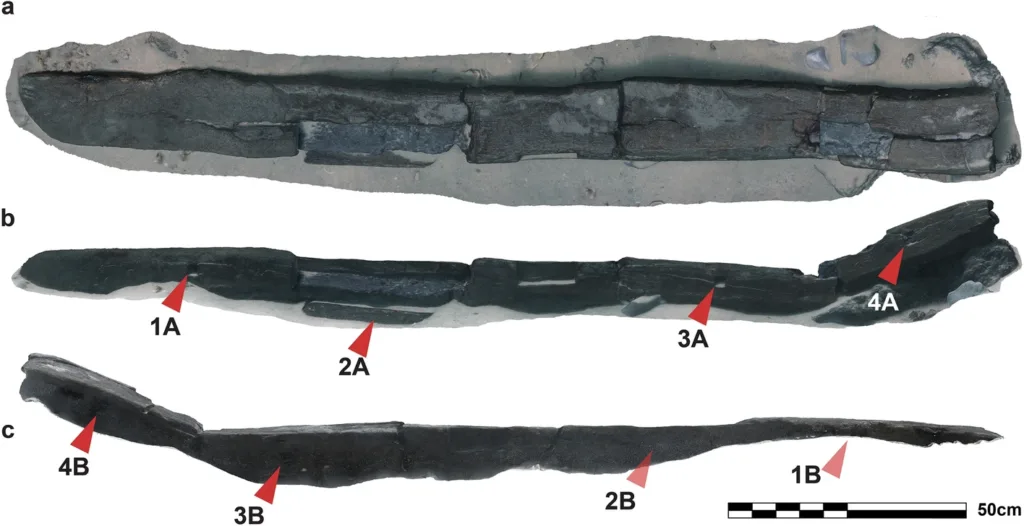
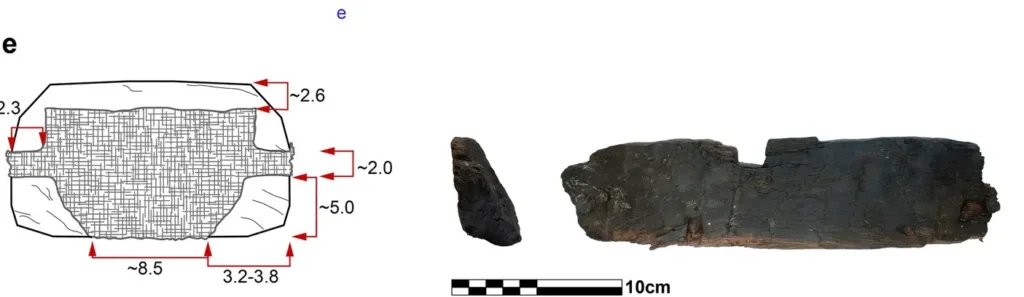
The wooden stock itself was fashioned from oak and originally measured approximately 2.2 meters long, 16 centimeters wide, and 10 centimeters thick. Researchers estimate that the four lead cores inside it weighed approximately 113 kilograms, bringing the complete stock’s weight to roughly 150 kilograms.
The stock was the weighted crosspiece of a larger two-armed wooden anchor, rather than the entire device. Its size suggests that it belonged to a substantial vessel, although no surviving ship timbers have yet established the dimensions of the ship.
How Ancient Engineers Locked Lead Inside Wood
The most remarkable feature of the Dor anchor is not simply its weight but the engineering used to secure the metal inside its wooden structure.
Ancient carpenters created four trapezoidal cavities within the oak stock, using chisels and adzes to shape the timber. Molten lead was poured into these cavities, forming heavy internal cores that helped the anchor maintain the correct orientation when deployed.
However, the builders also developed a secondary mechanism to prevent the lead from slipping out. Eight small square openings, distributed along the two sides of the stock, allowed molten metal to form projections that locked the internal weights into position.
These projections, known as casting bolts, provided a mechanical connection between the lead and the surrounding wood. The design is particularly important because similar fastening methods had previously been proposed for ancient anchors without surviving wooden components.
Researchers also identified an unusually complex joint where the horizontal stock connected to the anchor’s main wooden shaft. The carefully carved recesses suggest that the builders employed advanced woodworking techniques to strengthen the assembly.
Together, these construction details offer rare physical evidence of how early Mediterranean shipbuilders combined different materials to improve the performance of their equipment.
Ancient Anchors from Anatolia Reveal a Changing Technology
The discovery has important parallels with archaeological finds along the western coast of Anatolia, where some of the Mediterranean’s earliest surviving composite wooden anchors have been identified.
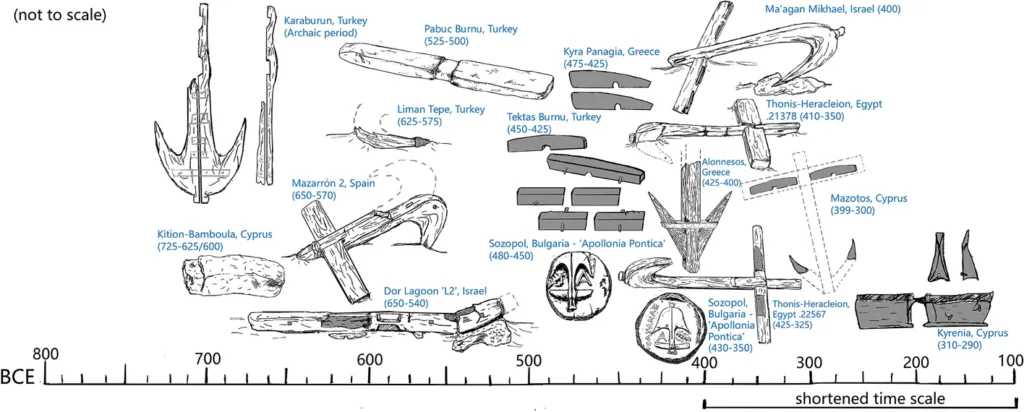
Two ancient anchors recovered near Karaburun in İzmir Province provide particularly valuable comparisons. Their wooden components suggest that they were originally fitted with stone stocks weighing approximately 200–240 kilograms, considerably heavier than the lead-filled stock from Dor.
The Karaburun anchors also demonstrate that wood-and-stone designs continued to be used during the period when sailors were beginning to adopt lead-filled alternatives. Their broad radiocarbon ranges overlap the centuries in which the Dor anchor was manufactured.
Other examples from Anatolia help trace the development of this technology. At Klazomenai’s ancient harbor of Liman Tepe, archaeologists identified a wooden anchor component dating to around 600 BCE, while the Pabuç Burnu shipwreck preserved a stone stock from the sixth century BCE.
The later Tektaş Burnu shipwreck, dated to approximately 450–425 BCE, yielded lead elements belonging to two composite anchors. Their construction provides another point of comparison with the fastening system observed at Dor.
These finds indicate that the transition from stone-weighted anchors to wooden structures containing lead was not an abrupt replacement. Both designs remained in use for generations, suggesting that maritime communities adopted new technologies at different rates.
Why Sailors Began Replacing Stone with Lead
Heavy stone anchors could secure vessels, but their considerable weight created difficulties for crews attempting to lower, retrieve or maneuver them. Wooden composite anchors introduced arms capable of gripping the seabed more effectively, reducing the need for extremely heavy stone weights.
Lead-filled wooden stocks further refined the design by concentrating weight within a shaped timber. The Dor example demonstrates that this approach was already technically sophisticated by the late seventh or early sixth century BCE.
The researchers also examined representations of anchors on ancient coins from Apollonia Pontica, on the Black Sea coast of present-day Bulgaria. Some early coins depict curved anchor stocks, while later examples show straighter, rectangular forms that may reflect the growing use of wood-and-lead construction.
Although coin imagery cannot establish technological chronology on its own, the changing representations are consistent with developments documented through archaeological finds.
The study also shows that similar composite-anchor technologies appeared in widely separated parts of the Mediterranean. Early examples from Dor and Mazarrón in Spain suggest that practical maritime innovations could spread across considerable distances, even among vessels engaged primarily in regional trade.
Rather than representing an isolated invention, the Dor anchor documents a period when Mediterranean seafarers were gradually transforming the equipment that made increasingly complex maritime commerce possible.
Johnson, K., Levy, T.E., Runjajić, M. et al. Stone to Lead: The Anchor from the Dor L2 Cargo and the Chronology of Composite Anchors from the 7th‒4th Centuries BCE. J Mari Arch 21, 53 (2026). https://doi.org/10.1007/s11457-026-09542-1
