26 January 2026 The Future is the Product of the Past

1400-Year-Old Folding Chair Found in a Woman’s Grave in Germany

In Steinsfeld, in the German state of Ansbach, archaeologists have unearthed a 1,400-year-old folding chair from an early medieval woman’s grave.

The surprise find was made in Endsee, part of the municipality of Steinsfeld (Ansbach district). The discovery was announced by the Bavarian State Office for Monument Protection on Monday, August 29, 2022.

Only the second such early Middle Ages piece to be discovered in Germany, the folding chair was made of iron and is extremely rare.

The folding chair measures approximately 70 x 45 centimeters (28 by 18 inches) and is believed to date from the end of the 6th century.
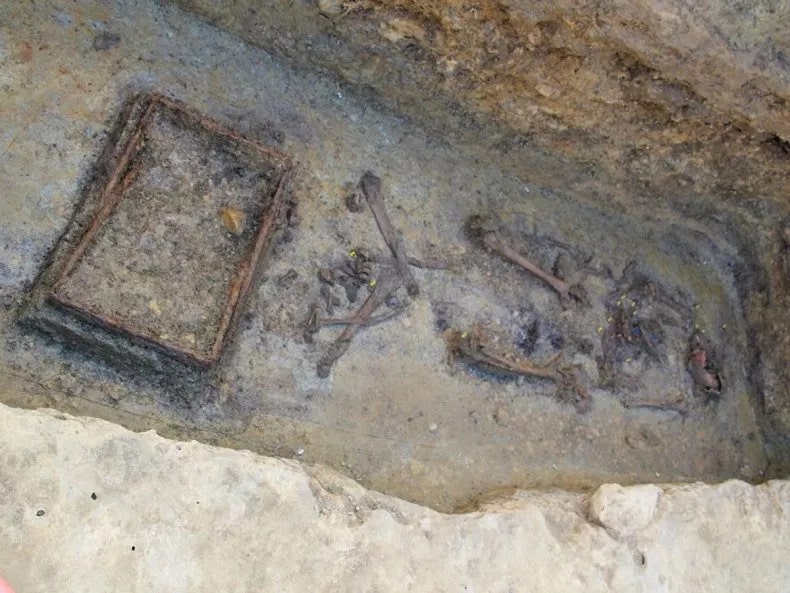
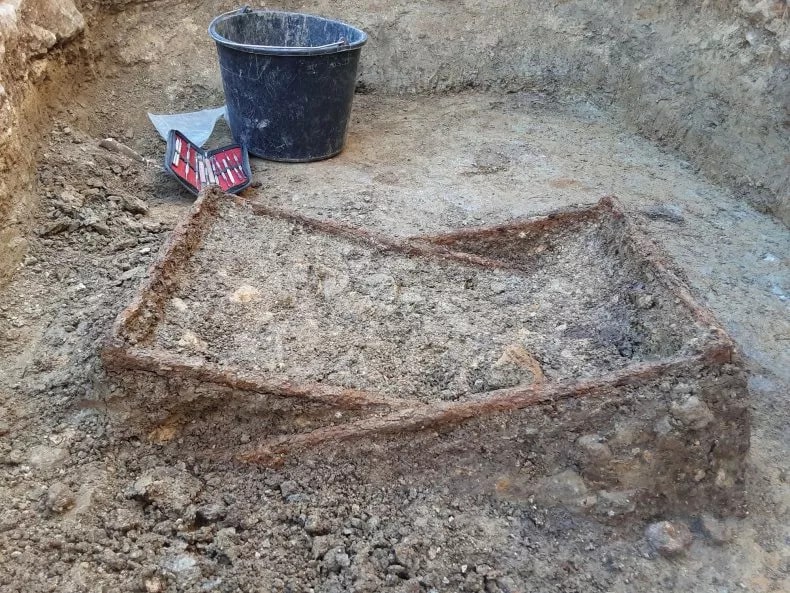
An approximately 1,400-year-old iron folding chair was found by archaeologists in a woman's grave in Middle Franconia, Germany. The chair has been underground at a depth of around 6.5 feet. Photo: BLFD
An approximately 1,400-year-old iron folding chair was found by archaeologists in a woman’s grave in Middle Franconia, Germany. The chair has been underground at a depth of around 6.5 feet. Photo: BLFD

According to the first anthropological assessment, the deceased was a woman who died between the ages of 40 and 50. The experts believe that the chair was buried with the deceased woman, as a grave good.


📣 Our WhatsApp channel is now LIVE! Stay up-to-date with the latest news and updates, just click here to follow us on WhatsApp and never miss a thing!!


She wore a string of small multi-colored glass beads around her neck. On her belt was a hanger with, among other things, a brooch with two bows, an almandine disk brooch, a large millefiori bead, and a spindle whorl. An animal bone lay next to the folding chair placed at the feet of the deceased woman.

Wooden paneling remnants point to a closed burial chamber. The archaeologists discovered a man’s grave next to the woman’s grave, in an almost parallel arrangement and west-east alignment. A full set of weapons (lance, shield, spade) and leg combs were given to the deceased, in addition to a bronze buckled waist belt and belt pouch.
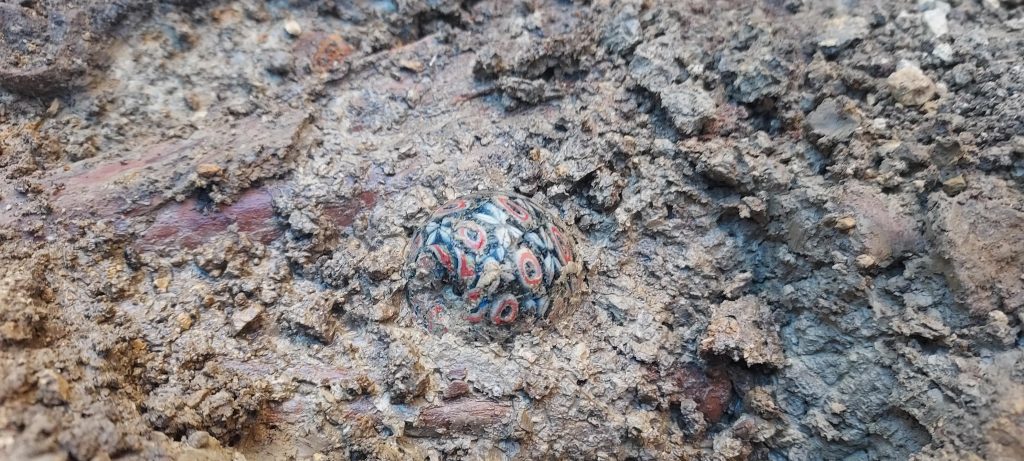
The millefiori pearl of the belt hanger. Photo: BLFD

The Bavarian State Department for the Protection of Monuments (BLfD) said in the press release: “About two meters [6.5 feet] below ground level, an excavation team in Endsee in central Franconia uncovered a grave measuring around 1.3 by 2.7 meters [4.26 by 8.85 feet], in which there was an iron frame that soon turned out to be a folding chair.

“This find, which at first glance seems so modern, is an absolute rarity and of the greatest cultural-historical interest, because it gives an insight into the burial equipment of prominent sections of the population and into the early use of furniture,” said Professor Mathias Pfeil, BLfD curator general.

Restorers are now examining the folding chair, which was recovered as a block, in the restoration workshops of the Bavarian State Office for Monument Preservation near Bamberg, and will gradually uncover it.

“Burial objects like this folding chair are extremely rare,” the official said in a statement. For this reason, they are interpreted as “special gifts” in studies and indicate that the deceased held a higher position or held a higher social rank. According to the government office, 29 early medieval tombs with folding chairs were found all over Europe – only six of them made of iron.

Related Articles

Alone Against Time: The 3,000-Year-Old Last Hittite Monument of Western Anatolia Awaits Rescue

8 July 2025

8 July 2025

Carved into the cliffs of western Anatolia over three thousand years ago, the Karabel Rock Monument is the last surviving...

4750-year-old Megalithic Stone Plaza Discovered in the High Andes of Peru

15 February 2024

15 February 2024

Two anthropology professors from the University of Wyoming have discovered a prehistoric plaza high in the Andes, known as Callacpuma...

Vase for holy oil used by ‘hidden Christians’ in Japan

24 May 2023

24 May 2023

After the family that had passed it down through the generations permitted the artifact to be examined, a relic from...

Venice of the Pacific: The mysterious Micronesian ruins of Nan Madol

12 July 2022

12 July 2022

Sometimes art and architecture challenge our perceptions of what was formerly thought to be feasible and what our forefathers were...

The world’s oldest wine discovered in liquid form was found in a Roman tomb in Spain

18 June 2024

18 June 2024

Archaeologists discovered an urn with a reddish liquid in a family mausoleum dating to the 1st century AD in the...

Mosaics found in Türkiye’s Sinop belong to dining room of a wealthy family

24 June 2023

24 June 2023

The pebble mosaics unearthed during the excavation of a building complex in the province of Sinop on Turkey’s Black Sea...

4,000-year-old War Memorial of Banat-Bazi in Syria

28 May 2021

28 May 2021

Archaeologists have identified a memorial monument built before 2300 BC in the Banat-Bazi region in Syria. Known as the “White...

Lost Medieval Synagogue Unearthed: Foundations of a Major Jewish Center Rediscovered in Southern Germany

14 September 2025

14 September 2025

Archaeologists have uncovered the long-lost remains of one of the most important medieval Jewish centers in southern Germany. Excavations at...

A new study shows that the cave paintings at Cueva Ardales are the work of Neanderthals

21 August 2021

21 August 2021

A study of pigments used in murals in the Cueva Ardales caves in southern Spain has revealed that Neanderthals, long...

Kent Archaeological Society purchased an Anglo-Saxon hoard ahead of a London auction

1 November 2022

1 November 2022

The Kent Archaeological Society has bought a large collection of Anglo-Saxon artifacts from the sixth and seventh centuries known as...

6th-Century BC Houses and Earthquake Evidence Discovered in Davti Blur, an Urartian Fortress City in Armenia

28 January 2025

28 January 2025

An Armenian-Polish archaeological team has uncovered remnants of 6th-century BC houses, a cremation cemetery, and signs of a significant earthquake...

Unearthing the Epic: New Finds Bolster Links to Legendary Trojan War

8 July 2025

8 July 2025

The legendary Trojan War, long enshrined in myth and Homeric epic, may be moving closer to historical validation as archaeologists...

Scientists Find Aztec ‘Death Whistles’ do Weird Things to the Listeners’ Brains

18 November 2024

18 November 2024

New research reveals that one of the Aztecs’ most chilling artefacts, clay death whistles, which resemble a human skull and...

Archaeologists uncover 4,000-year-old earliest large-scale Archaic fish-trapping facility recorded in ancient Mesoamerica

28 November 2024

28 November 2024

Archaeologists, using drones and Google Earth imagery, have discovered a 4,000-year-old network of earthen canals in what is now Belize...

Ancient Humans Used Indigo Plant 34,000 Years Ago: First Evidence of Non-Food Plant Processing Found in Georgia

3 September 2025

3 September 2025

34,000-year-old indigo plant residues found in Georgia’s Dzudzuana Cave reveal that prehistoric humans processed plants for more than just food....