16 April 2026 The Future is the Product of the Past

The Kyrgyz epic ‘Manas’ manuscripts were included in the UNESCO Memory of the World

Manuscripts of the Kyrgyz epic “Manas” by narrator Sagymbay Orozbakov have been inscribed on the UNESCO Memory of the World International Register. This is Kyrgyzstan‘s first nomination in the Memory of the World program.

On 8 June 2023, the President of the Kyrgyz Republic Sadyr Japarov, received the UNESCO Director-General Audrey Azoulay, who arrived in the country on an official visit.

This documentary heritage is the manuscript of the epic “Manas” told by narrator Sagymbay Orozbakov. The epic Manas is a trilogy, “a biographical cycle of three generations of heroes, Manas, his son Semetei and grandson Seitek.

The epic “Manas” is a documentary heritage of the Kyrgyz people, their national pride, identity, and historical memory, traditionally delivered in an exclusively oral way. The recording of the epic “Manas”, made from 1922 to 1926, was the first specially planned and organized in the country.

The choice to record Sagymbay Orozbakov’s version was conditioned by his popularity among the people, his knowledge of the epic “Manas” in all completeness, his high artistry, and his outstanding level of performance. In a group of narrators, he is believed to be the best and identified as the “classical”. His version of the epic is still considered the fullest and most artily valuable.


📣 Our WhatsApp channel is now LIVE! Stay up-to-date with the latest news and updates, just click here to follow us on WhatsApp and never miss a thing!!
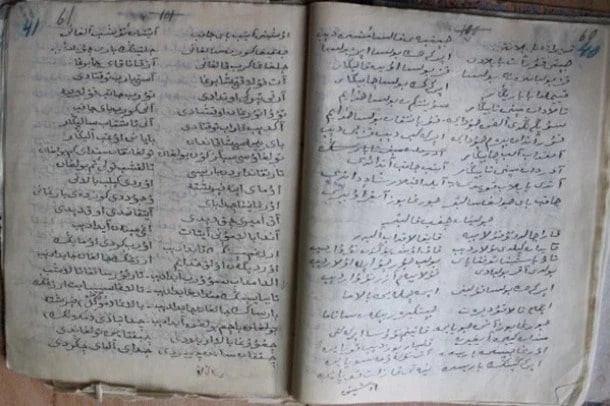


Photo: UNESCO

Recording of the epic was significant and timely as it was the period of transition of the Kyrgyz people from a nomadic way of life to the settled which posed a threat of the disappearance of the oral transmitting of the epic heritage. Therefore, the recording of the epic was vital and necessary to transfer the oral narration to paper and to give the second breath of life to it in book form.

The manuscript consists of 10 handwritten books. In a group of narrators, Sagymbay Orozbakov believed to be the best and identified as the “classical”. His version of the epic is still considered as the fullest and artily valuable.

The monumental epic Manas is the most treasured expression of the national heritage of the Kyrgyz people. Composed and sung entirely in oral form by various singers throughout the centuries, Manas is regarded as the epitome of oral creativity. Although as yet not widely known, Manas is considered to be one of the greatest examples of epic poetry. As nomads, the Kyrgyz had no written language. However, they excelled in oral composition, which they artistically employed in their traditional poetry and epic songs.

Cover Photo: UNESCO / President.kg (CC BY 3.0 IGO)
Related Articles

2,500-Year-Old Pre-Roman Iron Age Settlement Discovered in Hüllhorst, Germany During Fire Station Construction

3 March 2026

3 March 2026

A remarkable archaeological discovery has been made in Hüllhorst (Minden-Lübbecke district), where construction work for a new fire station has...

Are There Stone Age Megastructures on the Baltic Sea Floor?

11 June 2025

11 June 2025

The western Baltic Sea may conceal far more prehistoric cultural heritage than previously believed — including monumental underwater structures created...

Lost Anglo-Saxon Royal Seal of Edward the Confessor Rediscovered After 40 Years in Paris

14 April 2026

14 April 2026

A rare royal seal belonging to Edward the Confessor, the last Anglo-Saxon king of England, has been rediscovered in Paris...

New Study Reveals Ancient Secrets of the 3,600-year-old Nebra Sky Disc

2 December 2024

2 December 2024

Discovered in 1999 in Germany, the Nebra Sky Disc is the oldest known depiction of the cosmos. A recent examination...

The excavations in Selinunte, Italy, which has the largest Agora in the Ancient World, “The results have gone well beyond expectations”

29 July 2022

29 July 2022

In the Selinunte, one of the most important archaeological sites of the Greek period in Italy, the outlines of the...

Jordan’s mysterious ancient wall “Khatt Shebib”

22 October 2022

22 October 2022

The accomplishments of ancient civilizations are typically woefully underappreciated because we stereotype them as primitives who only wore loincloths, and...

Archaeologists identify three new Roman camps in Arabia

27 April 2023

27 April 2023

Through remote sensing analysis, archaeologists have identified three new Roman fortified camps throughout northern Arabia. Their study, released today in...

1.8-million-year-old ‘human tooth’ discovered in Georgia

9 September 2022

9 September 2022

An ancient human tooth discovered by archaeologists in Georgia dates back 1.8 million years, firmly establishing the area as the...

8000-year-old unique “fish-figure” small home tool found in Turkey

20 October 2021

20 October 2021

During this year’s excavations in the Yeşilova and Yassıtepe mounds in İzmir, a unique “fish-figure” small home tool was found....

New Huge Viking-age boat grave discovered by Radar in Norway

12 April 2022

12 April 2022

Archaeologists have located a boat grave from the Viking Age near Øyesletta in Norway during a ground-penetrating radar (GPR) survey....

Colossal Assyrian Winged Bull Unearthed in Iraq: Largest Ever at Six Meters

21 September 2025

21 September 2025

Iraq’s cultural authorities have revealed a discovery that could redefine the scale of Assyrian art: a six-meter-tall winged bull, or...

1800-year-old marble inscription found in Turkey’s Aigai excavations deciphered

2 October 2022

2 October 2022

The 1800-year-old inscription, consisting of 3 pieces of marble, found in the excavations in the ancient city of Aigai in...

First Four-Wheeled Chariots Found in Iron Age Britain Near Queen Cartimandua’s Capital

19 March 2026

19 March 2026

First four-wheeled chariots discovered in Iron Age Britain at Melsonby, revealing elite power, ritual destruction, and continental connections near Stanwick....

14,000 years old vessels made by Hunter-gatherers in Japan

1 May 2022

1 May 2022

The Late Pleistocene inhabitants of Tanegashima Island were making pottery about 14,000 years ago. In the Jomon period, people obtained...

Researchers use AI to read words on ancient Herculaneum scroll burned by Vesuvius

13 October 2023

13 October 2023

Researchers used artificial intelligence to extract the first word from one of the first texts in a charred scroll from...