
22 December 2025 The Future is the Product of the Past

India Discovers Its Largest Ancient Circular Labyrinth Linked to Roman Trade Routes

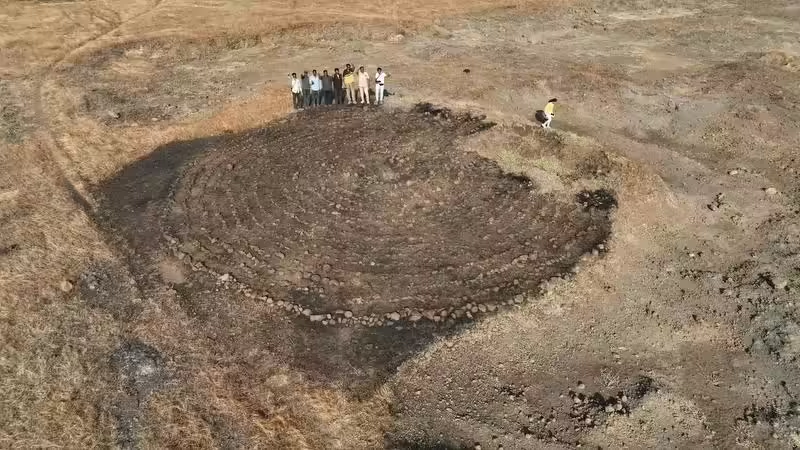
Archaeologists in India have uncovered the country’s largest known ancient circular labyrinth, a remarkable stone structure believed to have guided Roman merchants traveling across the subcontinent nearly 2,000 years ago. The discovery sheds new light on the scale of Indo-Roman trade and the sophisticated navigation systems used in ancient times.

The labyrinth was found in the Boramani grasslands of Solapur district, Maharashtra, an area better known today for wildlife conservation than archaeology. Measuring approximately 50 by 50 feet (15 × 15 meters), the structure consists of 15 concentric stone circles, making it the largest circular labyrinth ever discovered in India.

The find was reported by Sachin Patil, an archaeologist from Deccan College in Pune, and was first covered by The Times of India. According to Patil, the labyrinth likely served as a navigational landmark for Roman traders moving inland from India’s western coast toward major commercial hubs.

Evidence of Thriving Indo-Roman Trade

Patil believes the labyrinth points to intense trade activity between the ancient city of Ter (modern-day Dharashiv district) and the Roman Empire during the early centuries of the Common Era. Roman merchants are known to have exchanged gold, wine, glassware, and gemstones for Indian spices, silk, indigo, and textiles, commodities that were highly prized in Mediterranean markets.

“This region was part of a vast and active commercial corridor,” Patil explained. “Such labyrinths were likely used as orientation points along long-distance trade routes.”


📣 Our WhatsApp channel is now LIVE! Stay up-to-date with the latest news and updates, just click here to follow us on WhatsApp and never miss a thing!!


The discovery aligns with historical records, including the Periplus of the Erythraean Sea, a Greco-Roman travel guide describing trade routes linking India with the Roman world.

International Scholarly Attention

The labyrinth has drawn global interest and will be formally documented in Caerdroia, a UK-based academic journal dedicated to labyrinth studies, in an upcoming issue. Jeff Saward, a leading international authority on labyrinths and editor of Caerdroia, described the find as exceptional.

“While this is a classical-style labyrinth, the spiral at its center is distinctly Indian,” Saward noted. “This feature, often referred to as Chakravyuha, reflects local cultural adaptation. It is undoubtedly the largest stone labyrinth of its type in India.”

Until now, the largest circular labyrinth known in the country had only 11 rings. Although the Boramani structure is second in overall area—after a 17-square-meter labyrinth in Gedimedu, Tamil Nadu—it remains the largest circular example ever recorded.
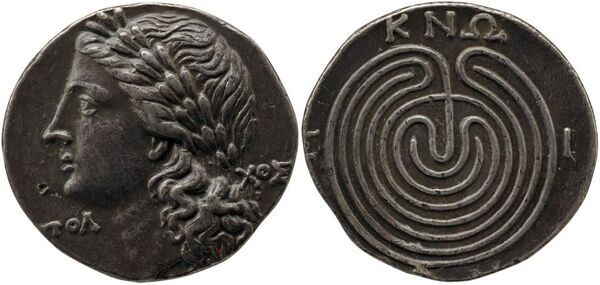
Ancient Knossos (Crete) Tetradrachm Coin, Standard Circulation, 110–67 BC, Attic Drachm (4) Credit: Trustees of the British Museum
Head of Apollo left, Reverse Circular labyrinth. Ancient Knossos (Crete) Tetradrachm Coin, Standard Circulation, 110–67 BC, Attic Drachm (4) Credit: Trustees of the British Museum

A Broader Archaeological Context

According to P. D. Sabale, head of the archaeology department at Deccan College, the discovery reinforces earlier evidence that this entire region—including Kolhapur, Karad, and Ter—was a major center of international trade.

Past excavations in nearby Brahmapuri (1945) uncovered a statue of the Greco-Roman sea god Poseidon and a polished bronze mirror, further supporting Roman presence. Similar labyrinths found in Sangli, Satara, and Kolhapur suggest the existence of a continuous trade route sometimes described as a western Indian “Silk Road.”

From Wildlife Survey to Major Discovery

Interestingly, the labyrinth was first noticed by members of the Nature Conservation Circle, a non-governmental organization monitoring populations of the Great Indian Bustard and the Indian wolf in the Boramani grasslands. Recognizing the unusual stone pattern, they documented the site and alerted archaeologists.

On-site examination revealed that the labyrinth is constructed from small stone blocks, with soil layers between the rings several centimeters thick—evidence that the structure remained undisturbed for centuries. Patil also noted similarities between the design and labyrinths depicted on Cretan coins from the 1st to 3rd centuries CE, strengthening the link to the Greco-Roman world.

More Than Navigation

Beyond their practical use, labyrinths have long held symbolic and spiritual significance across cultures. In India, they are often associated with fertility, cosmic order, and meditation, suggesting the Boramani labyrinth may have served multiple purposes.

With further study planned, this extraordinary discovery promises to deepen our understanding of ancient globalization and India’s central role in early international trade networks.

Cover Image Credit: India’s Largest Ancient Circular Labyrinth. Sachin Patil

Related Articles

Ancient Hawaiian Petroglyphs Reappear on Oahu’s Shoreline After Years Beneath the Sand

25 July 2025

25 July 2025

A remarkable piece of Hawaii’s cultural legacy has resurfaced this month, as ancient Hawaiian petroglyphs were once again exposed along...

Research Uncovers a Long-Isolated North African Human Lineage in the Central Sahara from Over 7,000 Years Ago

4 April 2025

4 April 2025

A recent study conducted by a team of researchers from the Max Planck Institute for Evolutionary Anthropology, including senior author...

Britain’s first Roman funerary bed is discovered in central London after 2,000 years

7 February 2024

7 February 2024

Archaeologists excavating a construction site in London have unearthed the first Roman “flat-packed” funerary furniture – a fully intact Roman...

12 tombs with Beautiful Decorations and Carved Bricks from the period of Kublai Khan, the grandson of Genghis Khan, found in China

22 May 2023

22 May 2023

China has a rich history. In addition to the fossil records from the Paleolithic Period, the country has witnessed the...

Scientists have discovered an ancient cemetery of flying reptiles roaming the Atacama desert of Chile 100 million years ago

7 April 2022

7 April 2022

In Chile, an unusual cemetery has been discovered that contains the well-preserved remains of prehistoric flying reptiles that flew over...

“Unprecedented” Phoenician necropolis found in southern Spain

28 April 2022

28 April 2022

A 4th or 5th-century B.C Phoenician necropolis has been found at Osuna in Southern Spain. A well-preserved underground limestone vault...

A well-preserved lion mosaic discovered in the Ancient City of Prusias ad Hypium

16 November 2023

16 November 2023

Archaeologists found a lion mosaic during excavations carried out in the Ancient City of Prusias ad Hypium. Excavations have been...

A 5,000-year-old large house has been discovered in China’s Yangshao Village

7 December 2022

7 December 2022

Henan Provincial Institute of Cultural Heritage and Archaeology archaeologists have excavated the ruins of house foundations dating back more than...

Colossae Ancient City Excavation Works Begin

8 September 2021

8 September 2021

Excavations of the ancient city of Colossae, located in the Honaz district of Denizli province in western Turkey, are starting...

A Roman tomb where magical nails were used to fend off the ‘restless dead’ has been discovered in Türkiye

15 March 2023

15 March 2023

In the ancient city of Sagalassos in southwestern Türkiye, archaeologists have identified an unusual burial practice from the early Roman...

Unique tombs wrapped in high-quality fabrics and painted bodies were discovered at monumental temple in Peru

11 March 2023

11 March 2023

Unique tombs wrapped in high-quality fabrics and painted bodies were discovered at the monumental temple in Peru. Located on the...

Maya Salt-Making Compound Found Preserved Underwater in Belize Reveals Secrets of “Invisible Sites”

19 October 2025

19 October 2025

The discovery of a Maya salt-making compound preserved beneath the mangrove peat of southern Belize is transforming our understanding of...

A 2,000-year-old Roman grave belonging to soldier Flaccus unearthed in Netherlands

9 December 2024

9 December 2024

Archaeologists have uncovered a 2,000-year-old grave from the Roman settlement in Heerlen, Netherlands. The latest analysis has shown that it...

Archaeologists unearth 6,000-year-old two monumental mounds containing wooden grave chambers in Germany

16 March 2024

16 March 2024

Archaeologists from the State Office for Heritage Management and Archaeology Saxony-Anhalt (LDA) have uncovered a significant Neolithic burial landscape on...

Archaeologists Uncover a 2,500-Year-Old Monumental Solstice Sanctuary in Spain

24 September 2025

24 September 2025

In the hills near the Andalusian town of Jódar, Spain, archaeologists have uncovered a monumental solstice sanctuary where the sun...

Comments
Leave a Reply

Your email address will not be published. Required fields are marked *