2 March 2026 The Future is the Product of the Past

Egypt discovers five 4,000-year-old ancient tombs in Saqqara necropolis

The Egyptian Ministry of Tourism and Antiquities announced recently the discovery of five 4,000-year-old ancient tombs in the Saqqara archaeological sites southwest of Cairo.

“The Egyptian archaeological mission uncovered five tombs about 100 meters northwest of the Merenre Pyramid in southern Saqqara,” the ministry said in a statement.

According to Mostafa Waziri, the head of Egypt’s Supreme Council of Antiquities, the five tombs — all of which are in good condition — belonged to senior royal officials.

The tombs contain finds and objects dating back to the end of the Old Kingdom spanning from 2686 BC to 2181 BC and the beginning of the First Intermediate Period spanning from 2181 BC to 2055 BC.

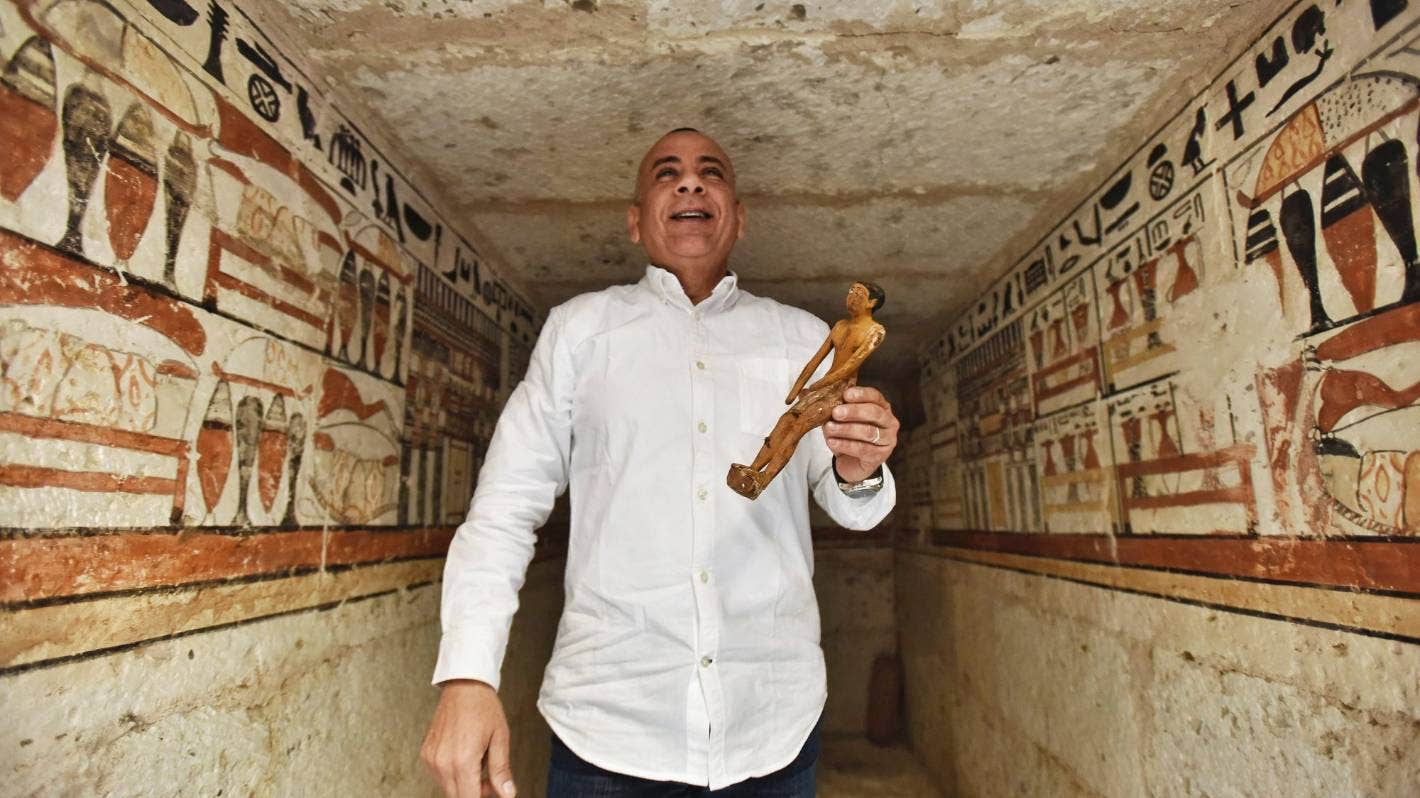
The Ministry of Tourism and Antiquities said one of the tombs belonged to a top official named Iry. A limestone sarcophagus and colorful decorations were found in the tomb. This tomb has a shaft that leads to a burial chamber whose walls portray a funeral with offering tables, the facade of a palace, and seven oil pots.


📣 Our WhatsApp channel is now LIVE! Stay up-to-date with the latest news and updates, just click here to follow us on WhatsApp and never miss a thing!!
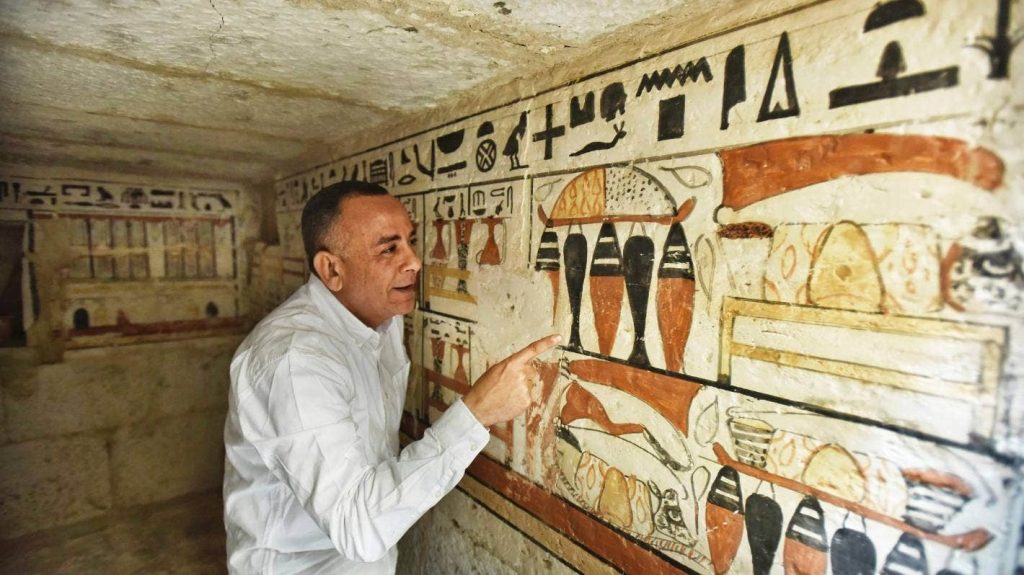


Mostafa Waziri, Secretary General of the Supreme Council of Antiquities, views hieroglyphics inside a recently discovered tomb near the famed Step Pyramid, in Saqqara, south of Cairo, Egypt.
Mostafa Waziri, Secretary-General of the Supreme Council of Antiquities, views hieroglyphics inside a recently discovered tomb near the famed Step Pyramid, in Saqqara, south of Cairo, Egypt. Photo: SAYED HASSAN/AP

The second tomb, likely belonging to the wife of a person named Yart, has a rectangular shaft.

The third one belongs to a person named Bi Nafarhafayi, who held several positions including the supervisor of the Great House, the chanting priest, and the cleaner of the house.

The fourth tomb, discovered six meters underground, is for Betty, a woman responsible for the king’s makeup and dressing. She was a priestess of Hathor, the goddess of love, beauty, music, dancing, fertility, and pleasure.

The last tomb for a man named Hannu has a seven-meter-deep rectangular shaft. Hannu’s titles include supervisor of the royal palace, mayor, supervisor of the Great House, bearer of the seals of Lower Egypt, and supervisor of an orchard.

The tombs were found near the Step Pyramid of Djoser, in the Saqqara Necropolis, 24km southwest of Cairo.

Footage shared on the ministry’s social media pages showed burial shafts leading to the tombs. Walls were seen decorated with hieroglyphic inscriptions and images of sacred animals and after-life items used by ancient Egyptians.

The Saqqara site is part of a sprawling necropolis at Egypt’s ancient capital of Memphis that includes the famed Giza Pyramids as well as smaller pyramids at Abu Sir, Dahshur and Abu Ruwaysh.

The ruins of Memphis were designated a UNESCO World Heritage site in 1970s.
Related Articles

Africa May not be Where the First Pre-Human First Appeared

22 March 2021

22 March 2021

According to one opinion: About 2 million years ago, our first ancestors moved north from their hometown and left Africa....

A Circular Structure Linked to the Cult of Kukulcán Discovered in Mexico

2 November 2023

2 November 2023

A team of researchers with the Mexican National Institute of Anthropology and History (INAH) has unearthed the remains of a...

Ancient ceremonial chariot found in Pompeii

27 February 2021

27 February 2021

The Archaeological Park announced that a gorgeous Roman chariot was found “almost intact” near Pompeii, where it was buried, calling...

The Oldest Known Carvel-Built Shipwreck in the Nordic Region Found

6 March 2025

6 March 2025

Maritime archaeologists from the Museum of Wrecks (Vrak) in Stockholm have made a groundbreaking discovery off the coast of Sweden:...

Mass graves of Crusaders killed in the 13th century have been discovered in Lebanon

17 September 2021

17 September 2021

From 1096 to 1291, waves of Europeans took up arms and marched into the Middle East. They hope to “take...

Trier University’s Digital Coin Cabinet is Now Accessible

19 February 2024

19 February 2024

Historical coins are much more than just pieces of jewelry for collections and exhibitions and are of particular interest for...

Researchers Define the Borders of El Argar, the First State-Society in the Iberian Peninsula

18 March 2025

18 March 2025

Recent research conducted by scholars from the Autonomous University of Barcelona (UAB) and the Max Planck Institute for Social Anthropology...

A 2000-year-old bronze military diploma was discovered in Turkey’s Perre ancient city

2 January 2022

2 January 2022

During excavations in the ancient city of Perre, located in the southeastern Turkish province of Adiyaman, archaeologists uncovered a bronze...

Byzantine monk chained with iron rings unearthed near Jerusalem

4 January 2023

4 January 2023

A skeleton chained with iron rings was discovered at Khirbat el-Masani, about four kilometers northwest of Jerusalem, along the ancient...

The mystery of the silver bracelets of Queen Hetepheres in her celebrated tomb at Giza solved

2 June 2023

2 June 2023

The discovery of silver bracelets in the tomb of Queen Hetepheres I, wife of Pharaoh Snofru and mother of Pharaoh...

India’s Longest Iron Age Spears Found in Tamil Nadu: One Measures 2.5 Meters

28 January 2026

28 January 2026

Archaeologists in southern India have uncovered what is now believed to be the longest Iron Age iron spear ever found...

A Jewel Worthy of a Duke: The Medieval Treasure Unearthed from the Moat

28 November 2025

28 November 2025

A remarkable archaeological discovery from the moat of Castle Kolno in Poland is offering fresh insight into medieval aristocratic culture...

Excavations at the site in the coastal city of São Luís, Brazil uncovered thousands of artifacts left by ancient peoples up to 9,000 years ago

4 February 2024

4 February 2024

Archaeologists unearthed 43 human skeletons and more than 100,000 artifacts at an excavation site in the coastal city of São...

Anatolia’s First Phoenician Find: Human-Faced Glass Beads and Baby Jar Burials Unearthed

30 December 2025

30 December 2025

Archaeological excavations at Oluz Höyük in Amasya, north-central Türkiye, have revealed rare evidence of Phoenician presence deep inside Anatolia, including...

A Gold Belt Weighing 432 Grams Unearthed During Excavations in Ani Ruins is on Display

2 July 2024

2 July 2024

The gold belt discovered 22 years ago during excavations in the ancient city of Ani, often referred to as the...