1 February 2026 The Future is the Product of the Past

1-meter tall bronze statue found in China’s Sanxingdui Ruins-Video

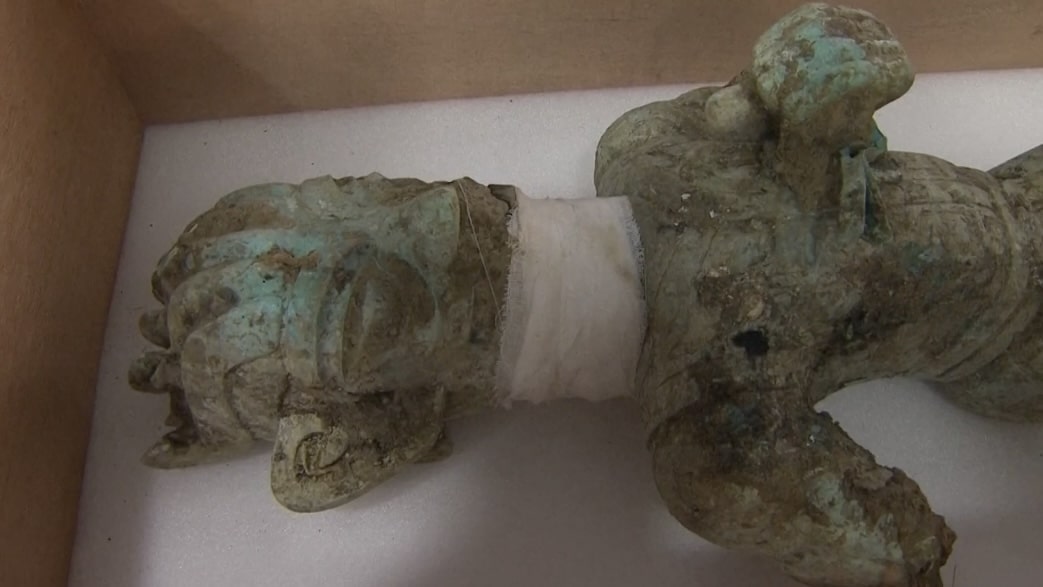
Chinese archaeologists have discovered a 1-meter tall bronze statue at the site of ancient Sanxingdui ruins site in southwest China’s Sichuan Province.

The Sichuan Provincial Cultural Relics and Archaeology Research Institute held a press conference at the Sanxingdui Museum on Monday to announce the results of archaeological excavation at the Sanxingdui site, a major project of “Archaeological China.”

The sacrificial area of the ruins is basically confirmed. The Shang Dynasty(1600 BC-1046 BC) relics distributed in the sacrificial area are all related to sacrificial activities, covering an area of nearly 13,000 square meters.

The sacrificial area includes the No. 1 pit, the No. 2 pit excavated in 1986, and the six pits newly discovered between 2020 and 2022. The eight pits are surrounded by rectangular trenches, small circular, and rectangular sacrificial pits, as well as trenches in the south and buildings in the northwest.

A large bronze figurine was unearthed from the Sanxingdui Ruins, along with other relics, as archaeologists continue excavations on the No. 7 and No. 8 sacrificial pits at the site revered as one of the greatest archaeological finds of the 20th century.


📣 Our WhatsApp channel is now LIVE! Stay up-to-date with the latest news and updates, just click here to follow us on WhatsApp and never miss a thing!!


So far, around 13,000 items buried for more than 3,000 years have been unearthed from the six pits.

Archaeologists are currently at a crucial stage of excavation with pits 7 and 8. The bronze figure is the only large intact human figurine retrieved from No. 8, which has unveiled more buried treasures.

The standing bronze figure is about one meter tall, physically strong in arms and legs, and dresses in ancient traditional attire. The figure appears to be holding thin bronze ware and carries a lei  (an ancient wine vessel), an ancient wine container, and ceremonial ware.

A bronze altar was discovered in a sacrificial pit last weekend. According to CGTN‘s news, the Bronze altar is about a meter high and is decorated with mythical creatures. There are also important finds in another pit where large amounts of bronze fragments and jade items were found.
Related Articles

One of the World’s Oldest Streets Unearthed at Canhasan 3 in Türkiye, Dating Back 9,750 Years

26 August 2025

26 August 2025

Nearly 10,000 years ago, long before the rise of cities, a community in central Anatolia was already experimenting with new...

A 2,500-Year-Old Mysterious Idol Discovered in the Ancient Urartian Fortress in Armenia

13 October 2025

13 October 2025

Archaeologists in Armenia have discovered a 2,500-year-old mysterious idol carved from volcanic tuff inside the ancient Urartian fortress of Argishtikhinili,...

Medieval Masterpiece: Rare Jesus Christ Relief from Ani Ruins Unveiled After 130 Years

14 August 2025

14 August 2025

A significant archaeological artifact depicting Jesus Christ has been put on public display for the first time at the Kars...

A new study reveals more than one person was buried in a tomb where the famous Nestor’s Cup was found

6 October 2021

6 October 2021

The Tomb of Nestor’s Cup, a burial that contained one of the oldest known Greek inscriptions, was more crowded than...

A Remarkable Underground City Discovered Beneath Historic Yazd Homes in Central Iran

26 January 2025

26 January 2025

A remarkable ‘underground city’ was discovered under five historical houses in the ancient town of Abarkuh in Yazd province in...

An important discovery in Haltern: Mini temples and sacrificial pit discovered in Roman military encampment

16 November 2023

16 November 2023

Archaeologists from the Westphalia-Lippe Regional Association (LWL) have found remains of the foundations of two mini Roman temples and a...

Unique 7,700-year-old figurines were discovered in Ulucak Mound, one of the oldest settlements in Western Anatolia

6 October 2023

6 October 2023

Ulucak Mound (Ulucak Höyük), one of the oldest neolithic settlements dating back to 6800 BC, male and female figurines evaluated...

A new study attributes Japanese, Korean and Turkish languages all to a common ancestor in northeastern China

11 November 2021

11 November 2021

According to a new study, modern languages ranging from Japanese and Korean to Turkish and Mongolian may have had a...

2,000-year-old unique luxury Roman villa with “underfloor heating” found in Germany

3 November 2022

3 November 2022

A luxury Roman villa with a thermal bath and underfloor heating has been unearthed in Kempten, Bavaria, one of the...

How Evolutionary Biology Is Reshaping Our Understanding of the New Testament: The Case of the Missing ‘Son of God

5 August 2025

5 August 2025

In the remote wilderness of Egypt’s Sinai Peninsula, a forgotten room revealed one of the most significant biblical manuscript discoveries...

Have We Found Moses’ Signature? Ancient Inscriptions in Egypt May Hold the First Written Link to the Bible

29 July 2025

29 July 2025

Mysterious Proto-Sinaitic inscriptions may point to Moses and Joseph as historical figures, sparking global scholarly controversy. A groundbreaking proto-thesis by...

A 2,500-year-old Slate Tablet Containing Paleo-Hispanic Alphabet Found

15 June 2024

15 June 2024

Experts analyzing the symbols on a 2,500-year-old tablet recently discovered in Spain have uncovered a mysterious ancient alphabet. According to...

Anatolia’s largest olive oil factory unearthed

14 January 2022

14 January 2022

A Roman-era olive oil factory has been unearthed during excavations in the İskenderun district of Hatay. It has been reported...

Researchers found evidence of the use of medicinal herbs in the Grotte des Pigeons Cave in Morocco dating back 15,000 years

5 November 2024

5 November 2024

Morocco’s National Institute of Archaeology and Heritage has announced an important discovery that will enhance our understanding of ancient healing...

3D Scans reveal details of ‘unusual’ Roman burial ritual

6 June 2023

6 June 2023

Archaeologists at the University of York, have used 3D scans to study the Roman burial practice of pouring liquid gypsum...