18 March 2026 The Future is the Product of the Past

Archaeologists found 5 unique sculptures representing the Kakatiya art style in Siddipet

13th-century statues were found near a temple tank in the Siddipet district in the northern province of Telangana, India.

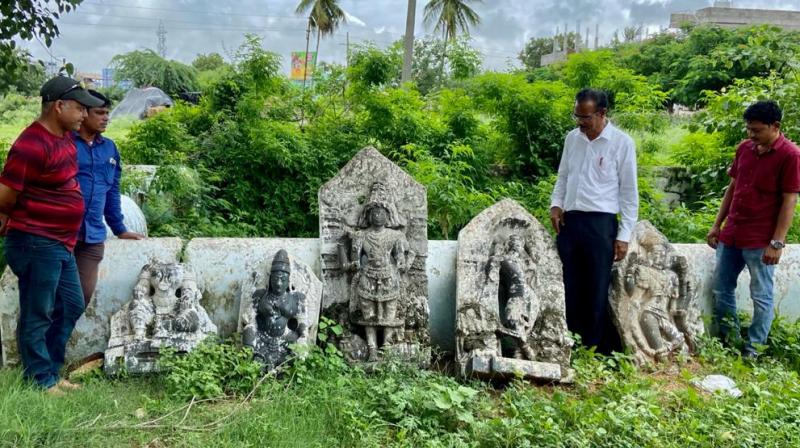
On Sunday, representatives of the New Telangana History Group (NTHG), led by Sriramoju Haragopal, discovered a cluster of 13th-century statues in disrepair beside a temple tank in Duddeda village, Siddipet district.

After finding five sculptures from the Kakatiya era, NTHG members Ahobilam Karunakar, Samaleti Mahesh, and Md. Naseeruddin informed Dr. E. Siva Nagireddy, archaeologist and chief executive officer of The Cultural Centre.

Dr. Nagireddy went to Duddeda village based on information from NTHG members and revealed that the five sculptures – two Devi statues and three sculptures of Chennakesava, Venugopala, and Bhairava – were from the 13th and 14th centuries and represented the Kakatiya style of art.

He described the Chennakesava sculpture as a masterwork of Kakatiya art, with exuberant ornamentation and traditional iconography, as well as the Venugopala and Bhairava statues.


📣 Our WhatsApp channel is now LIVE! Stay up-to-date with the latest news and updates, just click here to follow us on WhatsApp and never miss a thing!!


Dr. Nagireddy said there was an extensive list of inscriptions by Kakatiya Prataparudra, dated back to 1296 AD. Based on the inscription found on the sculptures, he said those sculptures were part of fine workmanship belonging to the flourishing phase of the Kakatiya art in the 13th and 14th centuries. (Deccan Chronicle)

Dr. Nagireddy informed the local people about the historical significance of the sculptures, which were testaments to the Kakatiya sculptor’s ability.

He urged the authorities to save the sculptures for posterity by relocating them within the temple premises ensuring their safety and protection.
Related Articles

2,000-Year-Old Hellenistic Tomb Discovered Under Collapsed Port Road in Northern Cyprus

24 June 2025

24 June 2025

A routine alert about a collapsed road at Gazimağusa Port in Northern Cyprus has led to a remarkable archaeological breakthrough....

2-Meter-Long Stone Block Found at 12,000-Year-Old Boncuklu Tarla Site in Southeastern Türkiye

18 December 2024

18 December 2024

A remarkable 2-meter by 20-centimeter processed stone block was discovered during the archaeological excavations at Boncuklu Tarla (Beaded Field), which...

7,500-Year-Old Stone Seal Discovered at Tadım Höyük in Türkiye

2 January 2026

2 January 2026

Archaeologists working at Tadım Castle and Höyük in Elazığ, eastern Türkiye, have uncovered a stone seal believed to be around...

2,700-year-old Military Roman Port Found in Parion, Türkiye

18 July 2024

18 July 2024

Underwater studies in Parion, a 2,700-year-old port city from the Roman Empire in Kemer village of Biga district of Çanakkale...

3,000-Year-Old Hazelnut Shells Discovered in the Sacred Hittite City of Nerik

30 July 2024

30 July 2024

In the sacred Hittite city of Nerik, located in the northern Vezirköprü district of Samsun province in the Central Black...

Drought unveils sunken basilica in Turkey

14 October 2022

14 October 2022

The sunken basilica remains discovered in 2014 became visible as a result of Lake Iznik’s water withdrawal. Climate change is...

A beautiful Medieval key discovered in Claverham village, UK

11 October 2023

11 October 2023

Earlier this year the Kemble fieldwork team from Cotswold Archaeology undertook a small excavation for Newland Homes on the edge...

Lost Medieval Swedish Heraldic Stone and Rare Dagger Unearthed in Vyborg’s Sewer System

20 November 2025

20 November 2025

Archaeologists in Vyborg, Russia have uncovered two remarkable artifacts that reshape the city’s connection to its medieval and post-medieval past....

Mesopotamian bricks reveal the strength of Earth’s ancient magnetic field

19 December 2023

19 December 2023

Ancient Mesopotamian bricks reveal the details of a curious strengthening of the Earth’s magnetic field, according to a new study...

Climate and Archaic humans caused the extinction of giant camels that lived in Mongolia 27,000 years ago, a study says

3 April 2022

3 April 2022

Camelus knoblochi, a species of giant two-humped camel, survived in Mongolia alongside modern humans—and perhaps Neanderthals and Denisovans—until about 27,000...

A new study provides the earliest evidence of rice harvesting, dating to as early as 10,000 years ago

8 December 2022

8 December 2022

A new study of stone tools from southern China reveals the earliest evidence of rice harvesting, dating back 10,000 years....

Amateur divers discover ‘enormously valuable’ hoard of Roman coins

27 September 2021

27 September 2021

Two amateur free divers have found one of the largest collections of Roman coins in Europe off the east coast of Spain. Luis Lens...

New Research Reveals How Londoners Used Death Data to Survive the Great Plague

20 February 2026

20 February 2026

New University of Portsmouth research reveals how Samuel Pepys used the 1665 Bills of Mortality to navigate the Great Plague...

The Iremir Mound illuminates the pre-Urartian period in East Van

27 July 2021

27 July 2021

Archaeological findings unearthed in the excavations carried out at the İremir Mound in the Gürpınar district of Van, in eastern...

A 1,100-year-old lead amulet of Bulgarian soldiers sieges Constantinople found

31 March 2023

31 March 2023

A lead plate amulet bearing an inscription in Cyrillic dating from the times of Tsar Simeon the Great was discovered...