16 December 2025 The Future is the Product of the Past

A Medieval Barbican and a Network of Passages Uncovered in Western Slovakia’s town of Trenčín

A medieval barbican (fortified outpost or fortified gateway), and a network of passages that acted as a sewerage system have been uncovered in western Slovakia’s town of Trenčín. At the time, the site would have been part of the Kingdom of Hungary.

The discovery, made during a revitalization project of the city’s pedestrian zone, and the remnants of the city’s medieval castle system, which shed new light on its defensive structures, are well-preserved, reports My Trenčín.

Archaeologist Drahoslav Hulínek, head of the excavation on Sládkovičova Street said that the discovery will allow researchers to reconstruct the plan for the town’s early fortifications.

“A bridge spanned the moat, leading to an entrance portal,” Hulínek said. “The walls extended on either side towards the gate, which featured another tower-like structure—its remains are visible on the floor plan,” he explained.

From the beginning of Sládkovičova Street, where a tower and moat once stood, the barbican, a crucial defensive feature, extended.


📣 Our WhatsApp channel is now LIVE! Stay up-to-date with the latest news and updates, just click here to follow us on WhatsApp and never miss a thing!!



Photo: Maroš Buchel

The structure is one of the most important pre-castle fortifications in the former Kingdom of Hungary, demonstrating the strategic significance of Trenčín during the Middle Ages. The barbican is associated with King Sigismund of Luxembourg, a devout Catholic who ruled during the Hussite raids, a string of battles and military expeditions in Central Europe in the early 15th century that were named for Jan Hus, a Czech reformer who opposed the Catholic Church.

The barbican’s walls were not the only thing discovered during the excavation. They also discovered a system of underground passageways and tunnels that were mainly used as a medieval sewer system.

Archaeologists have discovered significant quantities of late medieval pottery and glass dating from the medieval to the modern period. Remains of houses dating from the 15th to the 19th century were also found.

The main phase of the research has been completed. Once a busy street with homes up until the 1970s, the location now provides a unique window into Trenčín’s past.

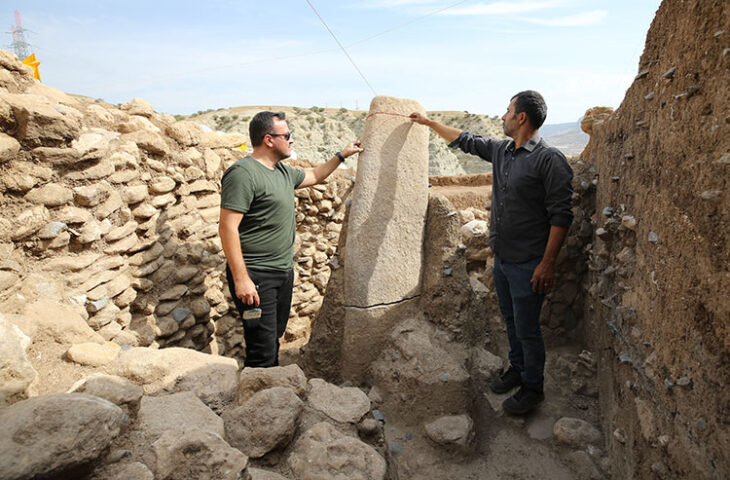
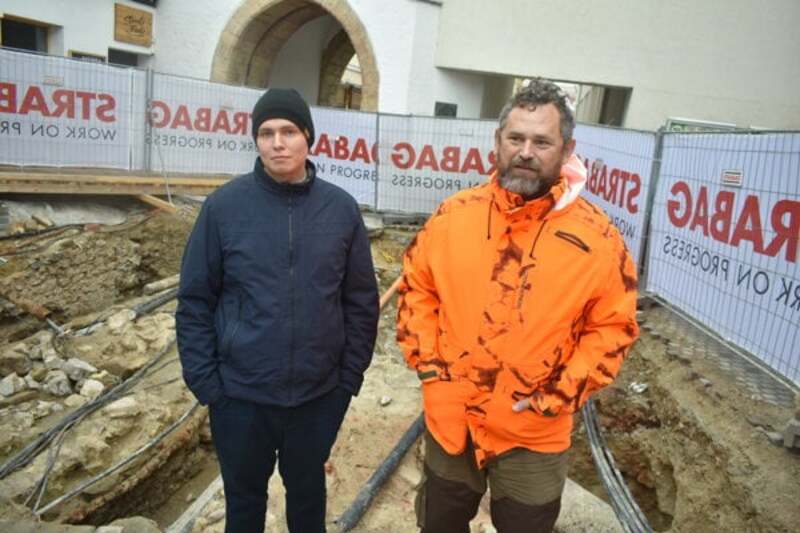
Cover Image Credit: Archaeologists Alexej Skutin and Drahoslav Hulínek during excavations on Sládkovičova Street. Photo: MAROŠ BUCHEL

Related Articles

Slavic settlement and burial ground with two unusual graves discovered in Saxony-Anhalt

7 August 2024

7 August 2024

Archaeologists from the State Office for Monument Preservation and Archaeology (LDA) of Saxony-Anhalt have uncovered a wealth of medieval treasures,...

A unique gold brooch talisman with inscriptions in Latin and Hebrew was found in the UK

19 February 2022

19 February 2022

A Medieval gold annular brooch with prayerful inscriptions has been discovered in the parish of Manningford in Wiltshire, in the...

New Neolithic structure unearthed at Tas-Silġ in Malta

8 October 2021

8 October 2021

Archaeologists excavating at Tas-Silġ in Marsaxlokk have discovered the remains of another Neolithic structure, Heritage Malta said. The discovery substantially...

New research determines portable toilets of the ancient Roman world

11 February 2022

11 February 2022

New research published today reveals how archeologists can determine when a pot was used by Romans as a portable toilet,...

14,000-year-old settlement discovered in western Turkey

26 November 2021

26 November 2021

During the rescue excavation carried out in a cave in Dikili, İzmir, in western Turkey, 14 thousand-year-old stone tools and...

First direct evidence of drug use as part of Bronze Age ritual ceremonies in Europe

6 April 2023

6 April 2023

An analysis of human hair strands recovered from a burial site in Menorca, Spain, reveals that ancient human civilizations used...

Spectacular 222-gram Gold Necklace Unearthed in Poland, Possibly of Goth Origin

10 August 2025

10 August 2025

A spectacular archaeological find has emerged from the forests near Kalisz, Poland — a massive bent gold necklace weighing an...

China’s 4300-Year-Old Ancient Pyramids

26 March 2021

26 March 2021

Shaanxi Province in Northwest China is famous for its rich archaeological treasures. Among the many sites discovered in Shaanxi, the...

Archaeologists Uncover Asini’s Hidden Ancient Port Beneath the Waves of Greece

11 March 2025

11 March 2025

An international team of underwater archaeologists has made a groundbreaking discovery at the submerged site of Asini, near Tolo in...

Elamite clay tablet discovered 4500 years old, in southwest Iran

4 December 2021

4 December 2021

A clay tablet, estimated to be from the Elam period, about 4500 years old, was recently discovered in southwestern Iran....

Philippines Cagayan Cave Art 3500 Years Old

29 June 2021

29 June 2021

A depiction depicting a human-like figure on a cave wall in Penablanca town, Cagayan province, is Southeast Asia’s first directly...

A stunning fresco depicting Helen of Troy is revealed during excavations at the ancient Roman city

11 April 2024

11 April 2024

Archeologists have uncovered remarkably preserved ‘fresco’ paintings on a wall in the banqueting room of a large house along Via...

Ancient Curse Tablets Reveal Dark Spiritual Practices in the Roman Empire – and Their Echo in the Bible

17 June 2025

17 June 2025

New Research Connects Ritual Cursing to the Book of Revelation From jealous lovers to petty thieves, people in the ancient...

Roman gilded silver fragment uncovered in Norfolk baffles researchers

27 March 2023

27 March 2023

In Norfolk, a metal detector uncovered an ancient Roman fragment made of gilded silver. The piece was clearly a part...

5,000-Year-Old “Human-Faced” Pottery Fragment Unearthed in Gökhöyük, Konya, Türkiye

17 September 2025

17 September 2025

Archaeologists working in central Türkiye have unearthed a remarkable pottery fragment depicting a human face, dating back nearly 5,000 years....