11 December 2025 The Future is the Product of the Past

Amateur makes ‘Gold Find of the Century’ in Norway

A Norwegian 51-year-old Erlend Bore out walking on doctors’ advice unearthed rare 6th-century gold jewellery using a newly bought metal detector, a discovery that archaeologists said on Thursday was Norway’s “gold find of the century.

It turned out to be nine pendants, three rings, and 10 gold pearls in what was described as the country’s gold find of the century.

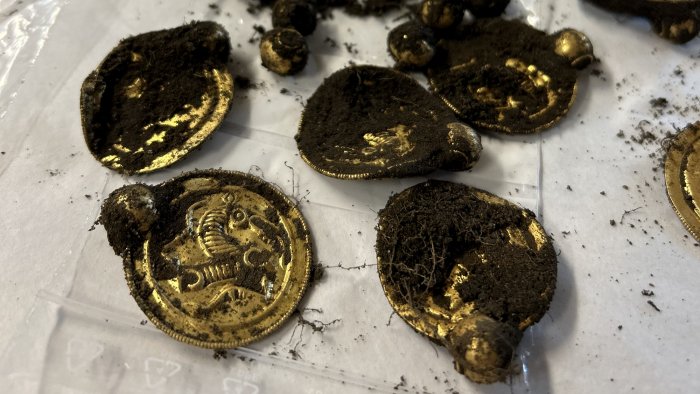
Archaeologists say the find is unique because of the design on the medallions — a type of horse from Norse mythology.

The rare find was made this summer on the southern island of Rennesoey, near the city of Stavanger.

As a child, Erlend Bore wanted to be an archaeologist. So when his physiotherapist told him he must move more instead of sitting on the couch, he bought a metal detector and searched for archaeological objects, just as a hobby.


📣 Our WhatsApp channel is now LIVE! Stay up-to-date with the latest news and updates, just click here to follow us on WhatsApp and never miss a thing!!
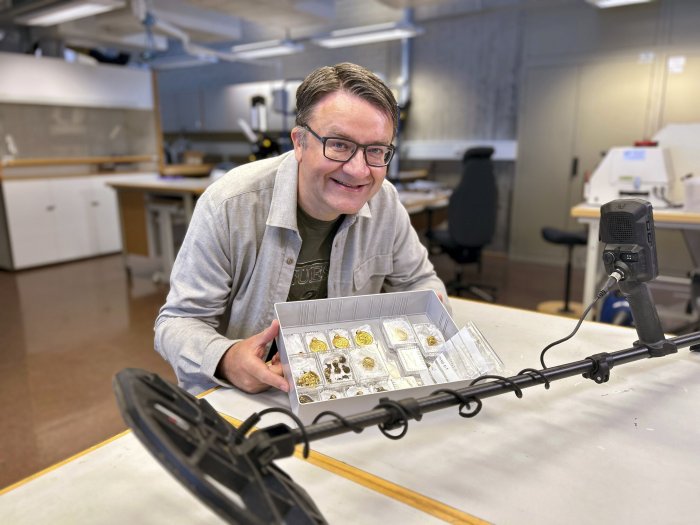


Erlend Bore with the gold treasure he found on Rennesøy in Stavanger. PHOTO: ERIK WAAGE / NRK

“At first I thought it was chocolate coins or Captain Sabertooth coins,” said Erlend Bore, referring to a fictional Norwegian pirate.

“It was totally unreal.”

The jewels, which weigh a little more than 100 grams, were discovered to date from around 500 AD.

Associate Professor Håkon Reiersen with the museum said the gold pendants—flat, thin, single-sided gold medals called bracteates—date from around A.D. 500, the so-called Migration Period in Norway, which runs between 400 and about 550 when there were widespread migrations in Europe.
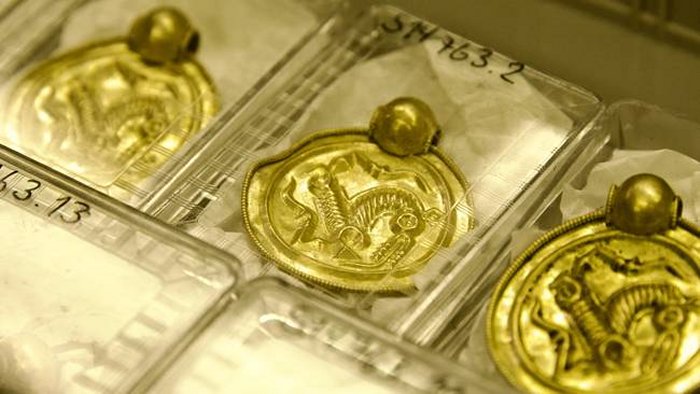
The gold treasure is well preserved and has several small details. The gold pendants have a horse engraved in the middle. PHOTO: ERIK WAAGE / NRK

The pendants and gold pearls were part of “a very showy necklace” that had been made by skilled jewelers and was worn by society’s most powerful, said Reiersen.

“It’s the gold find of the century in Norway,” said Ole Madsen, the head of the University of Stavanger’s Museum of Archaeology.

“To find that much gold all at once is extremely unusual.”
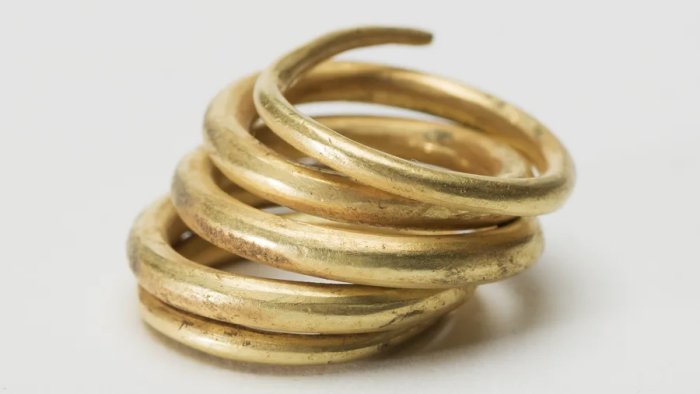
Among the finds were three rings. PHOTO: ANNETTE GRÆSLI ØVRELID / ARCHAEOLOGICAL MUSEUM, UIS

The most recent comparable find in Norway dates back to the 19th century.

“Given the location of the discovery and what we know from other similar finds, this is probably a matter of either hidden valuables or an offering to the gods during dramatic times,” Professor Hakon Reiersen said.
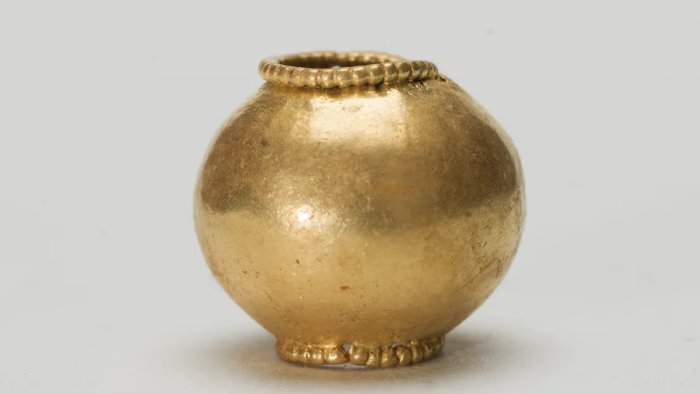
PHOTO: ANNETTE GRÆSLI ØVRELID / ARCHAEOLOGICAL MUSEUM, UIS

In line with Norwegian law, both Bore and the landowner will receive a reward although the sum has not yet been determined.

Cover Photo: ANNIKEN CELINE BERGER / ARCHAEOLOGICAL MUSEUM, UIS
Related Articles

A bronze tablet from 2000 years ago proves that Greek was spoken in Anatolia and that a multicultural life existed ‘Anisa tablet’

12 April 2024

12 April 2024

The Anisa bronze tablet proves that Greek was used in Anatolia 2000 years ago and that a multicultural life existed....

Rock Ship of Masuda, Japan’s mysterious monolith

17 April 2023

17 April 2023

Located in the Takaichi District of Nara Prefecture, Japan, the village of Asuka is famous for its mysterious stones. The...

An Ampulla was discovered for the first time in the ancient city of Dara, Turkey

11 January 2022

11 January 2022

An ampulla was found for the first time in the ancient city of Dara, located in the province of Mardin...

Two Durham Archaeology Students, One from Türkiye, Earn Prestigious Awards for Research on Ancient Lycia

26 July 2025

26 July 2025

In a remarkable achievement for Anatolian studies, two Durham University-affiliated archaeology students have received prestigious awards for their research on...

First Trilobite Fossil Amulet from Roman Early Empire (1st–3rd Century CE) Found in Spain

22 July 2025

22 July 2025

In a discovery that may reshape our understanding of how ancient Romans perceived the natural world, archaeologists have uncovered a...

A 130,000-year-old Stingray Sand Sculpture on South Africa’s Coast May Be the World’s Oldest Animal Art

4 April 2024

4 April 2024

Analyzing this object, which at first glance looks like a symmetrical rock, the research team speculated that it could be...

Researchers have unveiled text concealed beneath an intricate decorative layer of gold leaf on a page of the famous Blue Qur’an

19 November 2024

19 November 2024

Using multispectral imaging techniques, researchers from the Zayed National Museum have uncovered text hidden beneath an intricate layer of gold...

The Ancient City of Kilistra, Cappadocia of Konya’s

1 February 2021

1 February 2021

When we talk about fairy chimneys, churches and underground cities, the first place that comes to mind is Cappadocia between...

The famous archaeologist says he will announce the discovery of the mummy of Queen Nefertiti, one of Egyptology’s main riddles, next month

14 September 2022

14 September 2022

On December 9, 2021, Egypt’s archaeological mission, headed by renowned Egyptologist and former Antiquities Minister Zahi Hawass, resumed its search...

A New Hypothesis Tries to Explain What Triggers People’s Big Brains

14 March 2021

14 March 2021

The big brain is the decisive feature of our species. Not only are they the most complex organs in the...

Lucky Metal-Detector Find Uncovers 800-Year-Old Gilded Bronze Jesus Statue in Norway

17 November 2025

17 November 2025

A metal detectorist in Åndalsnes has uncovered an 800-year-old gilded bronze Christ figure just beneath the surface of a ploughed...

Ancient Latin texts written on papyrus reveal new information about the Roman world

11 January 2023

11 January 2023

Researchers funded by the European Union have deciphered ancient Latin texts written on papyrus. This work could reveal a lot...

A new chapter in the Hittite world is revealed by painted hieroglyphs discovered in the Hattusa Yerkapı tunnel

30 April 2024

30 April 2024

The painted hieroglyphs discovered in 2022 in the Yerkapı Tunnel in Hattusa, the capital of the Hittites, one of the...

Stone Age Loved to Dance to the Rhythm of the Elk Tooth Rattles

4 June 2021

4 June 2021

Thousands of years ago, people danced frequently and to the rhythm. This is the conclusion of the discovery of elk...

More than 56400 Cultural Goods Seized in Operation Pandora V

11 May 2021

11 May 2021

Operation Pandora V, aimed at preventing the illegal trade of cultural goods, has been one of the most successful operations...