
13 February 2026 The Future is the Product of the Past

5,500-Year-Old Blade Workshop Unearthed Near Biblical Gath Reveals

In a groundbreaking archaeological discovery, Israeli researchers have unearthed a 5,500-year-old flint blade workshop near Kiryat Gat, southern Israel—the first of its kind ever found in the region. Announced by the Israel Antiquities Authority (IAA), the Early Bronze Age site sheds new light on the technological ingenuity and social complexity of ancient Canaanite civilization.

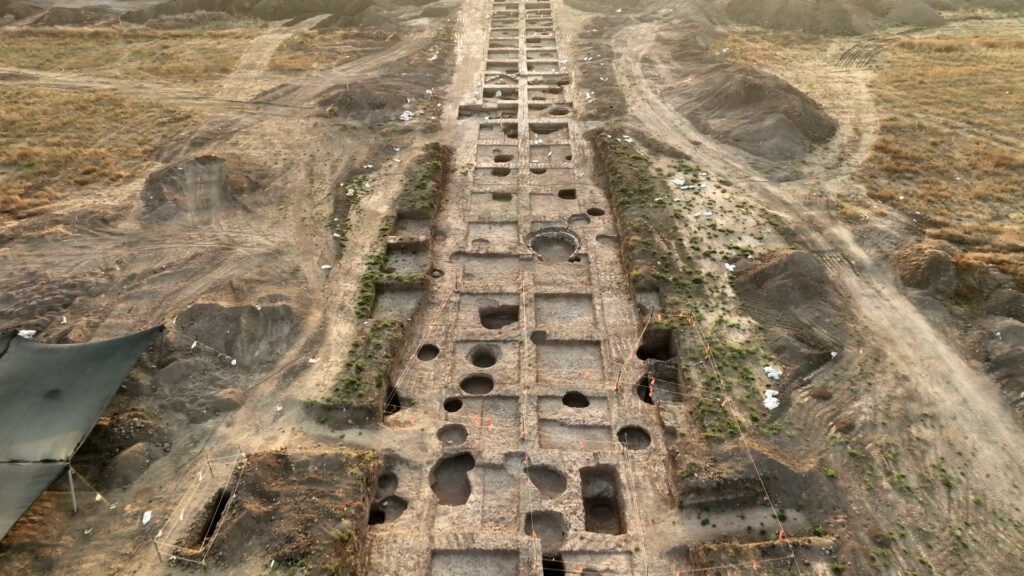
The excavation, carried out at the Naḥal Qomem site—also referred to as Gat-Govrin or Zeita—revealed a full-scale production center where highly skilled craftsmen manufactured long, razor-sharp flint blades. This prehistoric workshop marks a major milestone in understanding the early development of urban society and professional specialization in the Levant.

Sophisticated Technology Before the Age of Metal

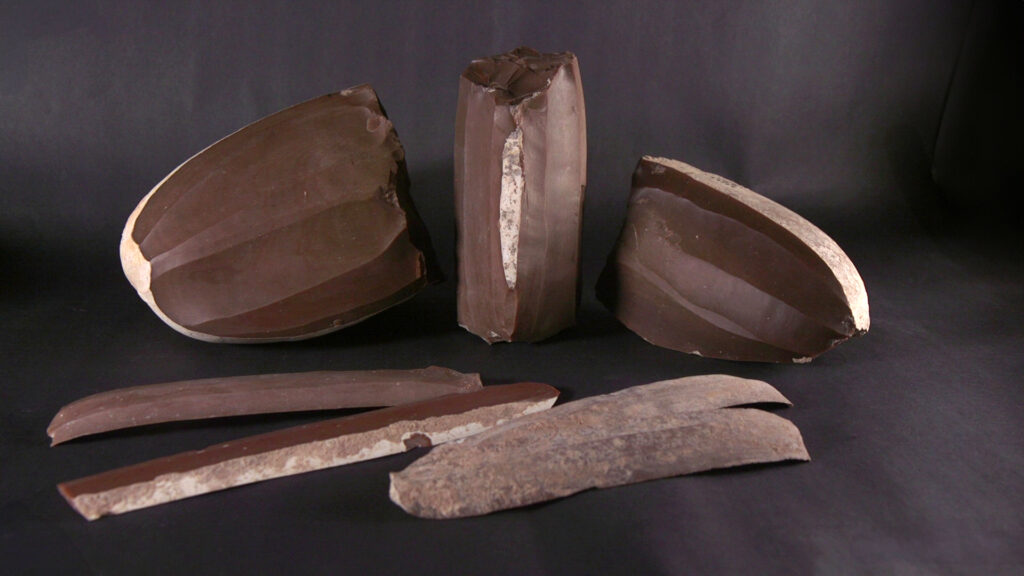
Archaeologists uncovered large flint cores, from which uniform blades were skillfully removed using a complex pressure-flaking technique. Evidence suggests the use of a mechanical device, similar to a lever or crane, allowing precise control during blade production—an astonishing feat for the period, when metal tools had yet to dominate.

“These blades were not random creations,” said Dr. Jacob Vardi and Dudu Biton of the IAA. “Their production demanded an extremely high level of skill. Only exceptional individuals could manufacture them. This was a professional, industrial process.”

Used for harvesting, butchering, and cutting, the blades represent the height of stone tool engineering. They predate widespread metal usage, showing that early societies had already developed advanced alternatives to iron or bronze weapons.


📣 Our WhatsApp channel is now LIVE! Stay up-to-date with the latest news and updates, just click here to follow us on WhatsApp and never miss a thing!!


The flint blades created in the ancient workshop. Credit: Emil Aladjem, Israel Antiquities Authority.

Economic Center and Trade Network

Unlike scattered remnants typical of prehistoric sites, this workshop was fully intact. The presence of both finished blades and the rare cores they came from suggests a centralized, organized operation. Interestingly, waste fragments—or debitage—were notably absent, likely removed to protect the craft’s specialized knowledge.

“This was not just a workshop; it was a regional distribution center,” said excavation co-directors Dr. Martin David Pasternak, Shira Lifshitz, and Dr. Nathan Ben-Ari. “Blades produced here were likely exported across the Levant.”

The workshop was part of a vast, complex settlement occupied continuously from the Chalcolithic period into the Early Bronze Age. Spanning over half a kilometer, the site included hundreds of subterranean pits lined with mud bricks, used for storage, habitation, workshops, and ritual practices—clear signs of early urban planning.
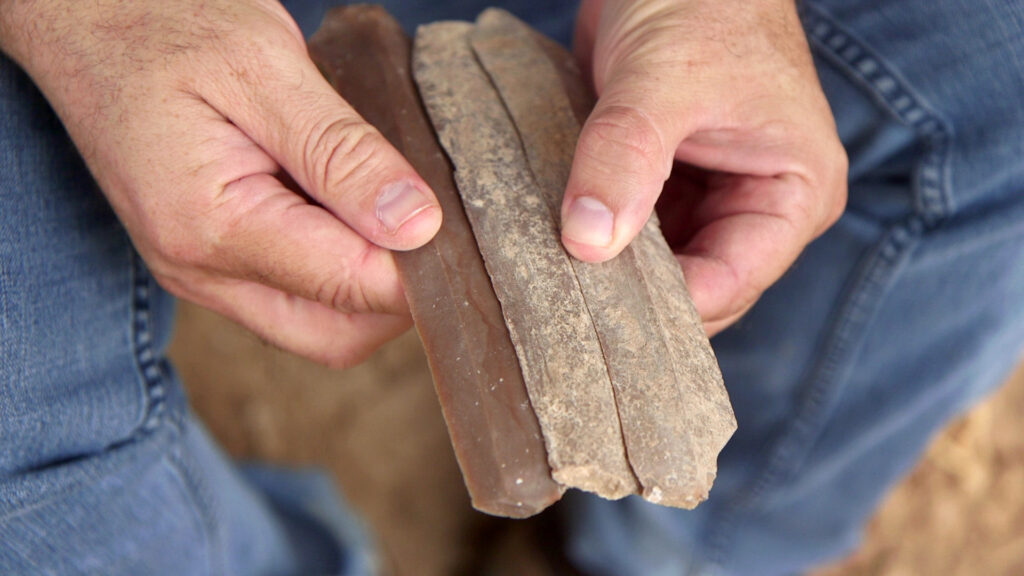
The flint blades created in the ancient workshop. Credit: Emil Aladjem, Israel Antiquities Authority.

Biblical Context: Near the Land of Goliath

The site’s location adds an extra layer of historical intrigue. Modern-day Kiryat Gat, where the excavation took place, lies near the biblical city of Gath—home of the Philistine warrior Goliath. In the Bible, Gath features prominently in the stories of David, King Saul, and the Israelite-Philistine conflict.

During King Saul’s time, according to the Book of Samuel, Israelites lacked access to iron weapons, which were monopolized by the Philistines. Ironically, thousands of years earlier, the ancestors of this region had mastered flint technology capable of producing lethal, precision tools—long before metalworking became widespread.

A New Chapter in Early Civilization

The discovery deepens our understanding of how early humans organized society, managed resources, and developed specialized industries. It also challenges prior assumptions about technological advancement during the Early Bronze Age.

“This is one of the most significant prehistoric discoveries in southern Israel,” the excavation team noted. “It shows that the foundations of urbanization and professional economy were laid much earlier than previously believed.”

Artifacts from the workshop—including the rare flint cores and finished blades—will go on public display this summer at the Jay and Jeanie Schottenstein National Campus for the Archaeology of Israel in Jerusalem.

As archaeologists continue to explore the ancient landscape near biblical Gath, each new discovery helps bridge the gap between scripture and science—offering fresh insights into human innovation, resilience, and the dawn of civilization.

Israel Antiquities Authority

Cover Image Credit: Emil Aladjem, Israel Antiquities Authority

Related Articles

Medieval Weapon Chest Found on Sunken Medieval Flagship Gribshunden

20 April 2024

20 April 2024

An extensive exploration of the wreck of the royal flagship Gribshunden has unearthed a trove of new findings: new insights...

Largest Known Collection of Ancient Rus’ Glass Bracelets Found in Ukraine — A Merchant’s Lost Treasure

3 January 2026

3 January 2026

Archaeologists in western Ukraine have announced one of the most remarkable archaeological discoveries in recent decades — an unprecedented cache...

Yale Archaeologist discovered an “arcade” of rock-cut ancient mancala game boards in Kenya

2 February 2024

2 February 2024

Veronica Waweru, a Yale University archaeologist conducting fieldwork in Kenya, discovered an “arcade” of ancient Mancala game boards carved into...

Ancient winery site uncovered in China’s Hebei

5 January 2022

5 January 2022

In northern China’s Hebei region, an ancient winery going back 400 years to the late Ming and early Qing Dynasties...

Unique Bronze Box Depicting a Roman Temple Unearthed in the Canabae of Legio V Macedonica at Turda, Romania

7 October 2025

7 October 2025

Archaeologists uncover a luxurious Roman domus and a one-of-a-kind bronze box in the civilian quarter of Legio V Macedonica at...

A Roman sarcophagus containing two skeletons was found in Bath, England

29 June 2021

29 June 2021

Stone walls, a Roman sarcophagus, and a cremation burial have been unearthed in a renovation project at the Bathwick Roman...

More than 1,300 prehistoric burial mounds in western Azerbaijan systematically surveyed for the first time

2 January 2025

2 January 2025

Over 1,300 archaeological sites in Azerbaijan were systematically surveyed and documented in two field campaigns in 2021 and 2023 by...

1400-Year-Old Folding Chair Found in a Woman’s Grave in Germany

30 August 2022

30 August 2022

In Steinsfeld, in the German state of Ansbach, archaeologists have unearthed a 1,400-year-old folding chair from an early medieval woman’s...

AI Unlocks Ancient Secrets: Dead Sea Scrolls May Be Centuries Older Than Previously Thought

8 June 2025

8 June 2025

New research blends cutting-edge artificial intelligence with advanced radiocarbon dating and offers a transformative perspective on the origins of the...

Rare Roman Legionary Helmet Looted from Serbia Appears in U.S. Auction

23 October 2025

23 October 2025

Rare Roman legionary helmet sparks international debate over cultural heritage and illicit antiquities trade A rare Roman legionary helmet of...

A unique tomb decorated with amber was discovered near Petrozavodsk

26 August 2021

26 August 2021

According to a press release from the Petrozavodsk State University a unique tomb was discovered on the western shore of...

Medieval ship found off the west coast of Sweden

5 February 2022

5 February 2022

A previously undiscovered wreck has been found outside of Fjällbacka on the Swedish west coast. Analysis of wood samples shows...

A 7,800-Year-Old Massive Stone Wall Discovered Beneath the Sea off the Coast of France

13 December 2025

13 December 2025

Several meters beneath the restless waters off western France, archaeologists have uncovered the remains of a monumental stone construction that...

Rare Sassanid-era Inscription on Loyalty and Justice Unearthed in Marvdasht, Southern Iran

11 June 2025

11 June 2025

A rare Sassanid-era inscription has been unearthed in the historic region of Marvdasht, located in Iran’s Fars province, revealing deep...

3,000-Year-Old Public Building Unearthed at Sogmatar: A New Chapter in the Sacred City of the Moon God

14 October 2025

14 October 2025

In a discovery that deepens our understanding of ancient Mesopotamian spiritual and civic life, archaeologists working under Türkiye’s “Heritage for...