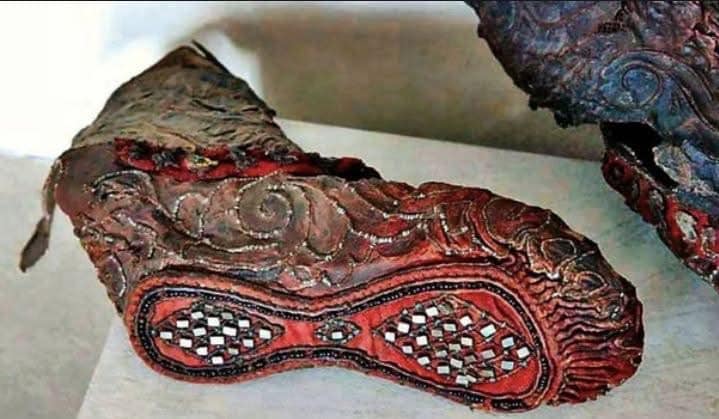
An extraordinary archaeological discovery from the Altai Mountains continues to fascinate historians, archaeologists, and history enthusiasts around the globe. A remarkably preserved 2,300-year-old leather boot believed to belong to a woman of the ancient Saka culture has become one of the most talked-about artifacts from the Eurasian steppe. The unique find provides rare insight into the craftsmanship, fashion, and social life of nomadic peoples who once roamed the region.
Discovery in the Pazyryk Burial Mounds
The ancient boot was discovered during archaeological expeditions in the mid-20th century in the mountainous Altai region of Central Asia. Researchers found it inside one of the famous Pazyryk kurgans—large burial mounds built by nomadic tribes of the Saka and related cultures.
These kurgans were complex burial structures. Archaeologists uncovered deep pits containing wooden chambers where the deceased were laid to rest alongside their belongings. Items typically included jewelry, weapons, clothing, horse equipment, and even preserved food.
After the burial ceremony, the chamber was sealed with layers of stone and soil. Over time, water seeped into the mound and froze due to the region’s harsh climate. This created a natural ice chamber that preserved organic materials for thousands of years.
Permafrost: Nature’s Time Capsule
One of the main reasons the boot survived in such exceptional condition is the permafrost environment of the Altai Mountains. In most climates, materials like leather, textiles, and wood decompose within decades. However, in frozen conditions they can remain intact for millennia.
📣 Our WhatsApp channel is now LIVE! Stay up-to-date with the latest news and updates, just click here to follow us on WhatsApp and never miss a thing!!
The frozen burial chamber effectively acted as a natural freezer, protecting the boot’s shape, color, and decorative elements. Because organic artifacts from ancient periods rarely survive so well, the find is considered extremely valuable to archaeologists studying ancient Eurasian cultures.
Stunning Craftsmanship and Decoration
The boot itself reveals impressive artistry. Made from soft red leather, it features intricate decorative elements that highlight the sophisticated craftsmanship of the Saka people.
Researchers noted that the footwear is decorated with black beads, pyrite crystals, metallic foil, and glass beads arranged in elaborate patterns. One of the most unusual features is the sole of the boot, which is also decorated with geometric designs made from pyrite and dark beads.
Decoration on the sole of ancient footwear is rare, which has sparked curiosity among historians. Some experts believe this design may have held symbolic or social meaning.
A Symbol of Status?
According to several researchers, the decorated sole may have been meant to be seen by others. Nomadic communities often sat on the ground or knelt around campfires, meaning the bottom of the shoe could be visible to people nearby.
Because of this, historians suggest the ornamentation may have served as a status symbol, indicating the wearer belonged to a high social class within the tribe.
Everyday Footwear or Burial Item?
Scholars remain divided about whether the boot was used in daily life or made specifically for burial rituals.
One theory proposes that it belonged to a woman of high status, possibly a member of the tribal elite. Another hypothesis suggests the boot may have been created solely for funerary purposes, which could explain its almost perfect condition and the minimal wear on the sole.
Today, the remarkable artifact is preserved in the collection of the State Hermitage Museum, one of the world’s largest and most famous museums. The boot is considered one of the most iconic objects connected with the Pazyryk culture.
Cover Image Credit: Kyrgyz American Foundation via Facebook