
For generations, the Viking Age has been framed as beginning in the late 8th century, marked by the raid on Lindisfarne in 793. But new archaeological interpretations suggest that the roots of Viking-style seafaring power may stretch back five centuries earlier — deep into the Roman Iron Age.
According to reporting by Science Norway, archaeologist Frans-Arne Stylegar argues that organized naval forces along Norway’s southern and western coasts were already active between AD 180 and 540. If correct, this would mean that something resembling Viking maritime warfare was underway as early as the 3rd century.
Massive Boathouses Along the North Sea Coast
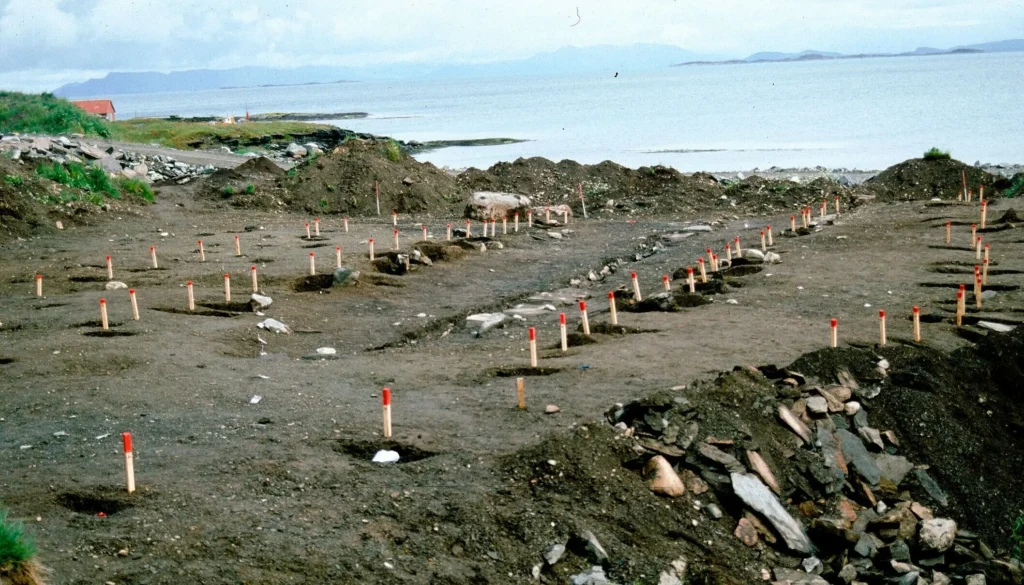
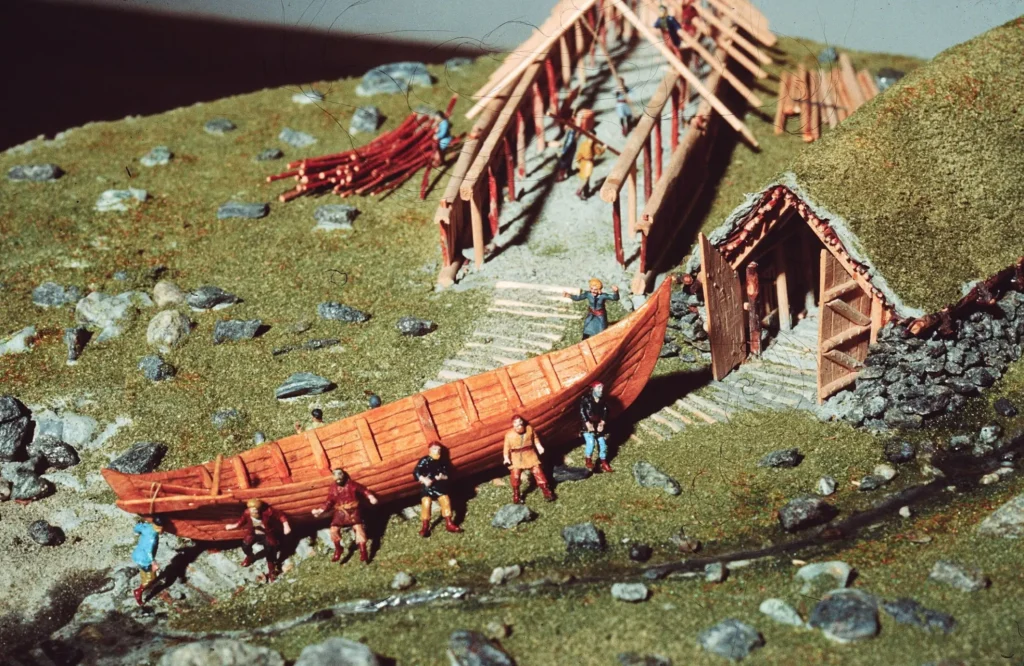
Across coastal Norway facing the North Sea and Skagerrak, archaeologists have documented large clusters of Iron Age boathouses — some exceeding 20 meters in length. These structures, dated to roughly AD 180–540, predate the Viking Age by several centuries.
Traditionally, such buildings were interpreted as markers of local military rivalries among regional chieftains. However, Stylegar believes this explanation is too narrow.
The scale of the boathouses suggests vessels far larger than ordinary fishing boats. Their clustered arrangement resembles organized naval stations rather than scattered local facilities. As reported by Science Norway, Stylegar argues that these sites must be understood within a broader North Sea geopolitical framework — not merely as evidence of domestic conflict.
The question, he asks, is straightforward: why would Iron Age communities require so many large ships and crews unless they were operating beyond local waters?
Roman Military Influence on the Norwegian Coast
A central pillar of the hypothesis involves contact with the Roman Empire. During the late 2nd and 3rd centuries, Scandinavians are known to have served as mercenaries in Roman forces. Archaeologist Dagfinn Skre, also cited by Science Norway, has proposed that participation in Roman military campaigns significantly reshaped Scandinavian society after around AD 180.
Stylegar extends this argument to naval expertise. He suggests that men from coastal Norway may have served specifically in the Roman navy, gaining firsthand knowledge of fleet organization and maritime logistics at Roman naval bases in Britain and Gaul.
Upon returning home, they could have adapted this knowledge to Scandinavian conditions. The structural parallels between Roman naval architecture and Norwegian boathouse clusters are, in his view, too striking to ignore.
If so, Roman engineering and naval strategy may have indirectly influenced the development of early northern sea power.
Latin Texts and the “Saxons” of the North Sea
Roman sources from the 4th and 5th centuries describe piracy in the North Sea and English Channel. These texts often attribute the raids to “Saxons.” However, the term may not refer strictly to people from what later became Saxony in northern Germany.
Instead, several historians argue that “Saxons” functioned as a broader label for Germanic sea warriors. The name likely derives from the sax, a distinctive short sword used by Germanic fighters.
As summarized by Science Norway, Stylegar considers it plausible that some of these so-called Saxon pirates originated from coastal Norway. If correct, Roman-era North Sea raids could represent an early phase of the maritime raiding culture later associated with Vikings.
This interpretation does not claim that Vikings existed in the 3rd century in a cultural sense. Rather, it suggests that the structural foundations of Viking sea warfare may have been laid much earlier than traditionally believed.
The Nydam Ship: A Tangible Clue
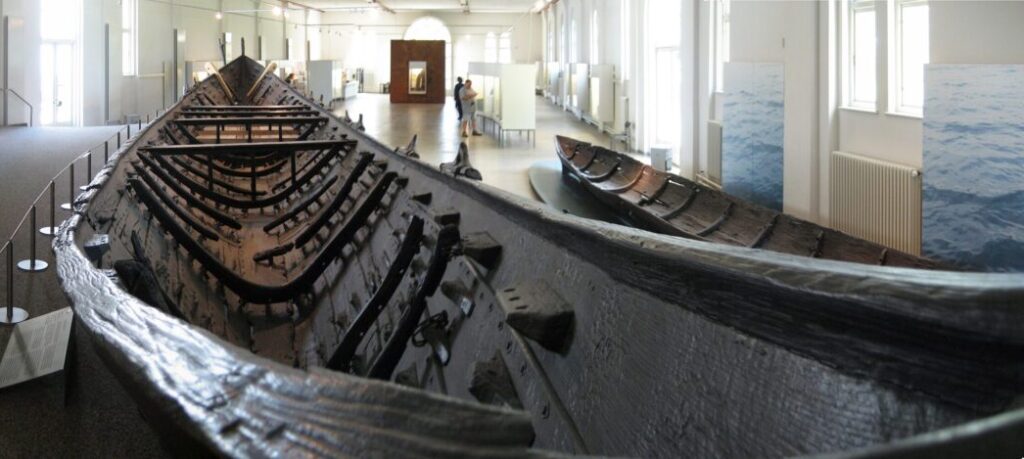
No preserved ships from this period have yet been discovered in Norway. However, a crucial comparative find exists in Denmark. Discovered in the 19th century in Nydam Mose bog in southern Jutland, the Nydam Ship was built around AD 320. Constructed from oak and measuring approximately 23 meters long, it could accommodate around 45 men, including 36 rowers.
The vessel was likely deposited as a war trophy in a ritual context. Hundreds of weapons — swords, spears, shields — were recovered alongside it, as well as runic inscriptions naming individuals such as Sikijar and Wagagastiz.
While found in Denmark, the ship type may represent a broader North Sea naval tradition. Stylegar proposes that similar vessels could have been stationed in the large Norwegian boathouses.
If so, the Nydam Ship may offer a rare glimpse into the maritime capabilities that prefigured Viking longships.
Spangereid: An Ancient Canal and Naval Strategy
One of the most intriguing elements of the hypothesis centers on Spangereid, near Norway’s southernmost point at Lindesnes. Here, a narrow isthmus separates the North Sea coast from interior fjord systems.
Archaeological surveys have identified an elongated depression crossing the isthmus — potentially the remains of an artificial canal. A 2001 investigation concluded that the feature was unlikely to be natural. Pollen analyses suggest excavation activity more than a thousand years old.
If confirmed as a canal, it would have allowed ships to bypass hazardous coastal waters and provided dual escape routes from a protected harbor. Such strategic design recalls Roman military harbor engineering.
The combination of clustered boathouses and a possible canal at Spangereid suggests organized naval planning on a sophisticated scale. Rather than a loose collection of chieftains, this may represent what historians call a thalassocracy — a sea-based power structure dependent on fleet control rather than territorial kingdoms.
Classical examples include Athens and Carthage. Stylegar suggests that a similar model may have existed along Norway’s coasts centuries before the Viking Age.
Rethinking the Origins of the Viking Age
The Viking Age did not emerge from a vacuum. Medieval sagas mention sækonungr, or “sea kings,” who operated independently along the Norwegian coast before the formation of centralized kingdoms.
The Roman Iron Age naval installations now under discussion may represent an even earlier stage in that trajectory.
As Science Norway reports, Stylegar cautiously raises a provocative question: should historians reconsider whether the Viking Age, at least in maritime terms, began as early as the 3rd century?
The evidence does not rewrite chronology overnight. Yet the scale of the boathouses, the possible Roman naval influence, the North Sea piracy described in Latin texts, and parallels with the Nydam Ship collectively suggest that the foundations of Viking seafaring dominance were laid long before the famous raids of the 8th century.
If future excavations confirm the existence of a Roman-era canal at Spangereid, the case for an organized early Scandinavian sea power will grow stronger.
The Vikings may not have appeared suddenly — they may have inherited a maritime system already centuries in the making.
Cover Image Credit: The pegs mark the post holes of two large boathouses on Rennesøy, north of Stavanger. Jan G. Auestad / Museum of Archaeology in Stavanger
