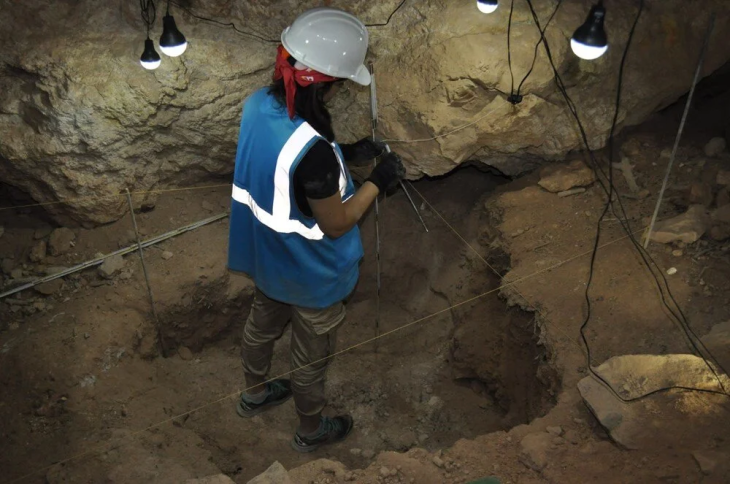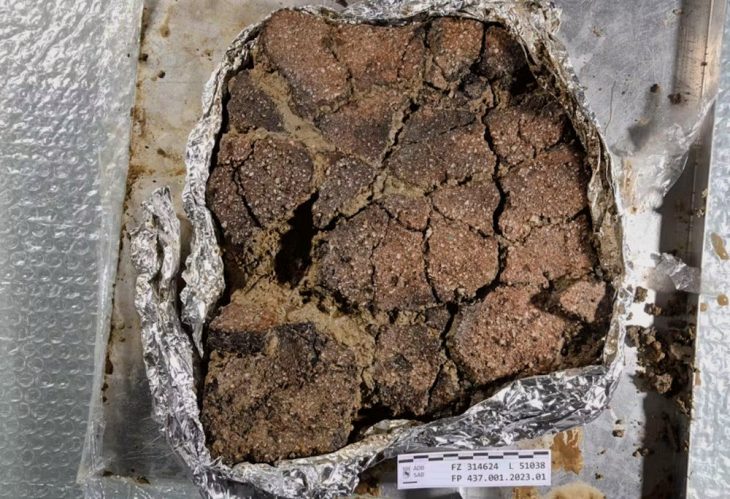
A groundbreaking interdisciplinary investigation led by researchers from institutions including Leiden University has uncovered compelling evidence of gender- and age-selective mass violence in prehistoric Europe. Published in Nature Human Behaviour, the study sheds new light on how deliberate killings of women and children were used as a strategy to destabilize communities and assert power during the Early Iron Age.
At the center of this research lies one of Europe’s largest prehistoric mass graves, discovered at Gomolava in northern Serbia, within the Carpathian Basin. The findings reveal a chilling episode of systematic violence that occurred approximately 2,800 years ago—an event that reshapes our understanding of conflict, social organization, and structural violence in later European prehistory.
A Mass Grave Unlike Any Other in Prehistoric Europe
Excavations at Gomolava uncovered the remains of 77 individuals buried together in a carefully constructed pit. Bioarchaeological analysis determined that nearly all of the victims were women and children. Of the individuals whose biological sex could be determined, more than 70 percent were female, and over half were juveniles aged between one and twelve years.
This demographic profile is highly unusual in European prehistory. Unlike earlier prehistoric massacres that show more balanced male-female ratios, the Gomolava grave exhibits a striking demographic bias. The researchers argue that this pattern is unlikely to be accidental. Instead, it indicates deliberate, selective violence targeting those central to lineage continuity and community resilience.
Evidence of Brutal and Systematic Killing
Advanced osteological and imaging analyses revealed clear signs of violent deaths. Many victims suffered peri-mortem injuries—unhealed trauma inflicted at or near the time of death—primarily to the head. Blunt force trauma, sharp force injuries, and projectile wounds were recorded, suggesting a combination of close-range attacks and attempts to flee.
📣 Our WhatsApp channel is now LIVE! Stay up-to-date with the latest news and updates, just click here to follow us on WhatsApp and never miss a thing!!
Computed tomography (CT) scans and histotaphonomic analyses indicate that the bodies were buried shortly after death, suggesting that the massacre took place nearby. At least 20 percent of individuals show direct skeletal evidence of violence, though researchers note the true number was likely higher, as not all forms of lethal trauma leave marks on bone.
Importantly, earlier interpretations had suggested a pandemic as the cause of death. However, pathogen DNA screening found no evidence of infectious disease. Instead, the cumulative data clearly point to coordinated lethal violence.
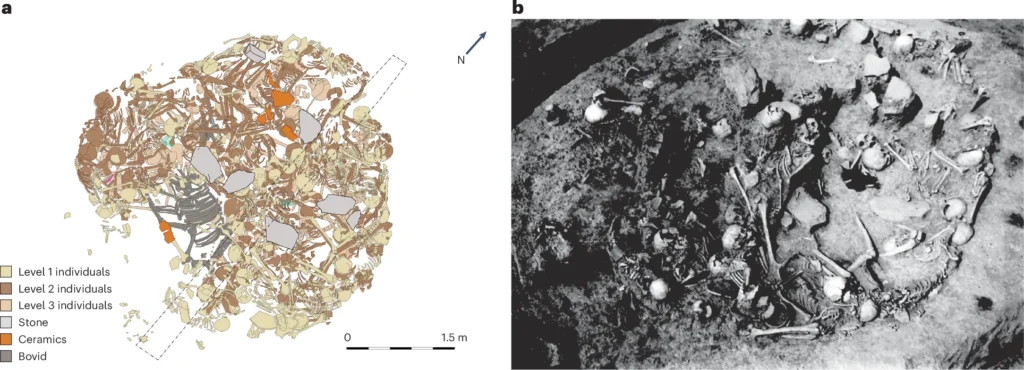
(a) Burial layout showing the position of human remains and associated artefacts in Gomolava Mass Grave 2 (illustration by S.N., based on Tasić 1972). (b) Archival photograph of the Gomolava mass grave excavation, courtesy of the Museum of Vojvodina. The original image did not include a measurement scale. Credit: Fibiger, L. (2026), Nat Hum Behav
Innovative Interdisciplinary Research Unlocks New Insights
The research team employed an innovative combination of osteology, CT scanning, radiocarbon dating, ancient DNA analysis, and isotopic studies to reconstruct both the violent event and the broader social context.
Jason E. Laffoon, an archaeologist at Leiden University and co-author of the study, emphasized the importance of this interdisciplinary approach:
“This study exemplifies the power of innovative interdisciplinary research to provide completely new insights into the complex dynamics of mass violence and public commemoration. The findings have broader potential for improving our understanding of the diverse manifestations of structural violence not only in the archaeological record but also in the present day.”
Genetic analysis revealed that the majority of individuals buried together were not closely related. With only one identified first-degree family group—a mother and her two daughters—the grave does not represent a single extended family or small settlement. Instead, the victims appear to have been drawn from a wider regional population.
Isotopic data further support this conclusion. Strontium isotope ratios show that many individuals grew up in different locations, some tens of kilometers away, and one possibly from even farther afield. Carbon and nitrogen isotopes indicate varied diets, suggesting diverse subsistence practices and origins across multiple communities.
Collectively, the data indicate that this was not a localized household tragedy but a cross-regional episode of organized violence.
A Turbulent Post-Bronze Age Landscape
The massacre likely occurred during a period of significant upheaval in the ninth century BCE, following the collapse of major Bronze Age socio-political networks. Communities across the South Pannonian Plain were resettling landscapes, reoccupying fortified tells, and establishing new enclosed settlements.
Gomolava itself was a long-inhabited tell site with deep ancestral significance. Positioned near the River Sava, it lay at the crossroads of competing cultural traditions and economic networks. Archaeological evidence shows increasing mobility, shifting lifeways, and tensionsbetween sedentary and more mobile pastoralist groups.
The researchers argue that the killings at Gomolava formed part of broader systemic conflict involving multiple communities. Rather than an indiscriminate massacre, the event appears to have been a strategic act aimed at fracturing regional social networks.
Associate Professor Hannes Schroeder of the University of Copenhagen, senior author of the study, explains:
“Systematically targeting women and children is a strategy aimed at breaking lineages and weakening community resilience.”
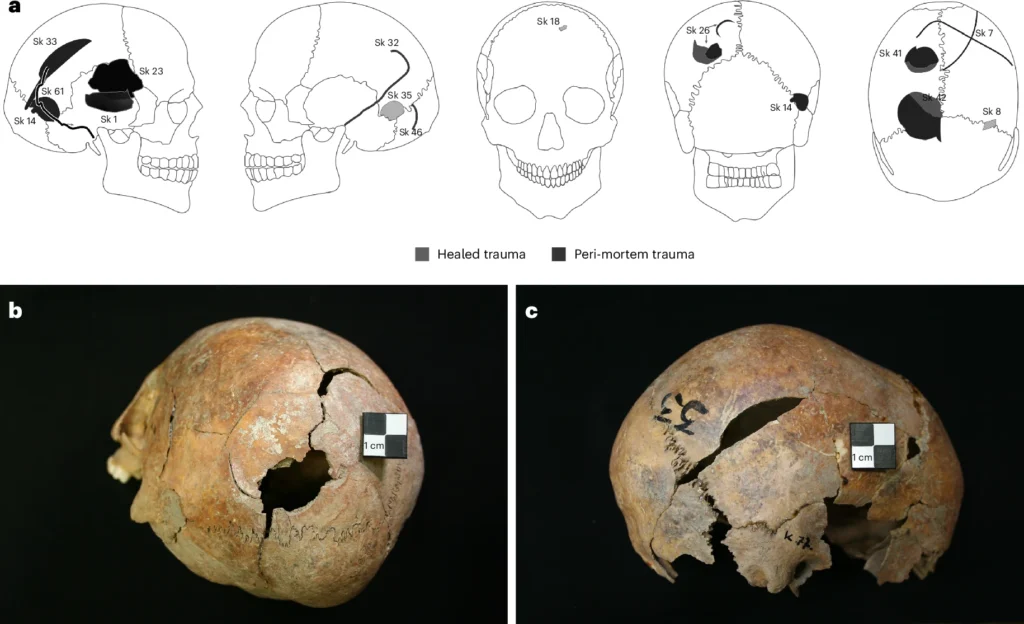
a–c, Distribution and examples of cranial injuries recorded at Gomolava (a), including Sk26 in posterior-lateral view (b) and Sk33 in right-lateral view (c); both individuals had sustained extensive peri-mortem injuries. In both cases, the primary impact site is clearly recognizable as a void with missing bone, with secondary fractures radiating from the impact site (drawings by S.N.). Credit: Fibiger, L. (2026), Nat Hum Behav
Commemoration, Symbolism, and Structural Violence
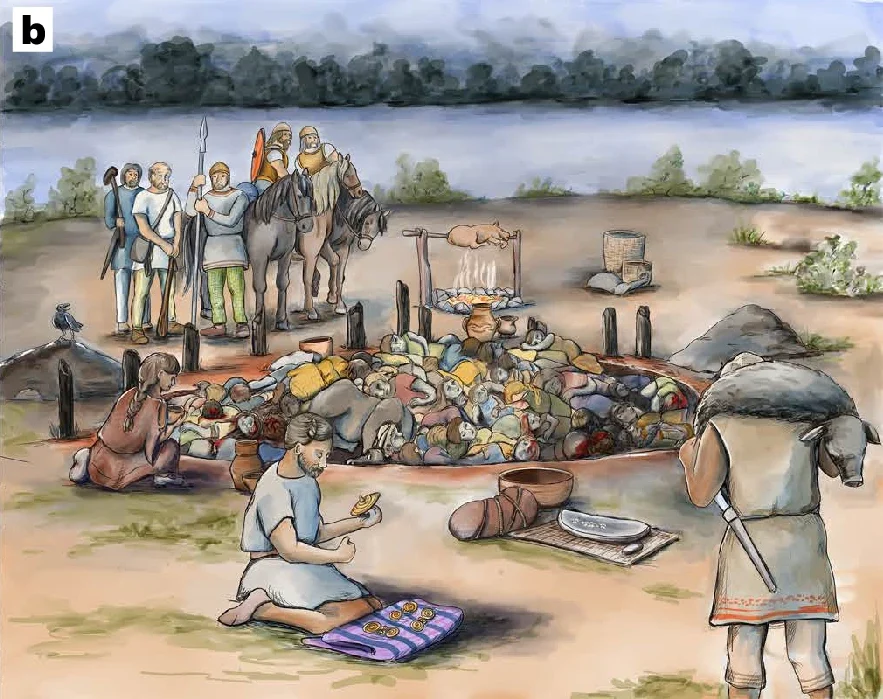
Despite the brutality of the killings, the burial itself was carefully staged. The pit measured approximately 2.9 meters in diameter and contained personal ornaments, ceramic vessels, and the remains of up to 100 animals. An intact young cow was placed at the bottom of the grave, and burnt cereal grains and broken grinding stones were deposited above the human remains.
Such structured deposition suggests that this was not a hurried disposal of bodies but a curated commemorative event. The scale of resource investment—food, livestock, crafted objects—points to deliberate memorialization.
The researchers interpret this as a symbolic act embedded within the political landscape. The targeting of women and children—key social and economic actors—represented not merely physical elimination but genealogical disruption. By severing kinship links and fragmenting networks, perpetrators could rebalance power relations and assert territorial dominance.
The Gomolava mass grave therefore provides rare archaeological evidence for selective, instrumental violence as a strategy of social transformation in prehistoric Europe. It also broadens scholarly discussions of structural violence, showing how demographic targeting can function as a calculated tool of political reordering.
A New Perspective on Prehistoric Conflict
Beyond documenting a single tragedy, the findings fundamentally reshape our understanding of violence in the Early Iron Age. Earlier prehistoric mass graves in Europe often reflect indiscriminate killing. Gomolava, by contrast, reveals demographic selectivity, cross-regional population involvement, and ritualized commemoration.
By integrating biomolecular science with traditional archaeology, the study highlights how modern analytical techniques can uncover complex patterns of social upheaval buried for millennia.
As Dr. Laffoon notes, the implications extend beyond archaeology: understanding the diverse manifestations of structural violence in the past can illuminate similar dynamics in contemporary societies.
The full study, “A large mass grave from the Early Iron Age indicates selective violence towards women and children in the Carpathian Basin,” is available in Nature Human Behaviour.
Fibiger, L., Iraeta-Orbegozo, M., Koledin, J. et al. A large mass grave from the Early Iron Age indicates selective violence towards women and children in the Carpathian Basin. Nat Hum Behav (2026). https://doi.org/10.1038/s41562-025-02399-9
Cover Image Credit: Reconstruction of the burial event at Gomolava by S.N. Credit: Fibiger, L. (2026), Nat Hum Behav