A newly analyzed medieval inscription from Preslav sheds light on the cultural and linguistic crossroads of the early Bulgarian state, revealing a remarkable blend of Byzantine, Slavic and Altaic traditions.
A recently published academic study has brought renewed attention to a remarkable archaeological artifact: the Mostič Inscription, an early medieval funerary stone discovered in northeastern Bulgaria. The research offers a fresh interpretation of the text, highlighting how the inscription reflects the complex linguistic and cultural interactions that shaped the medieval Balkans.
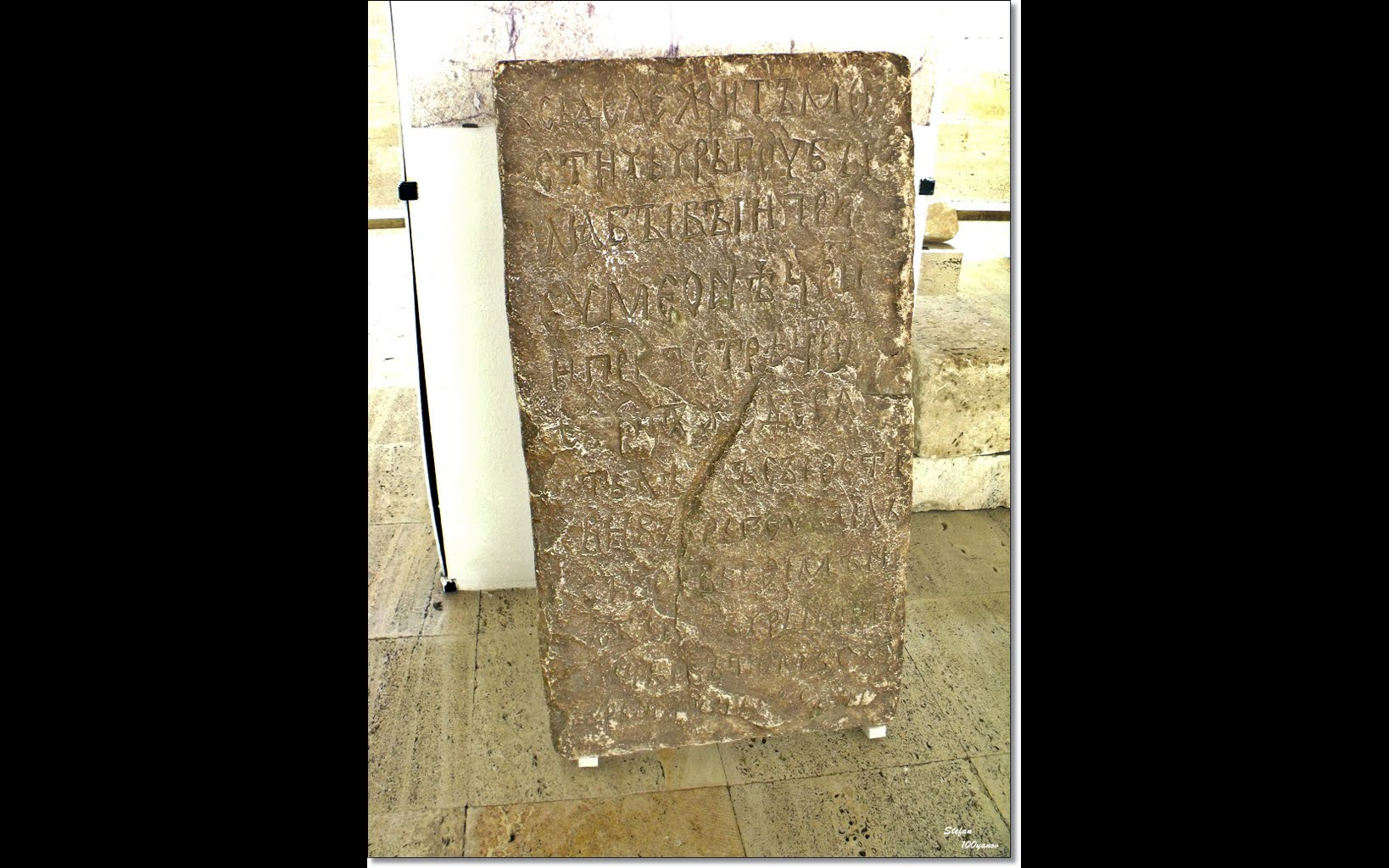
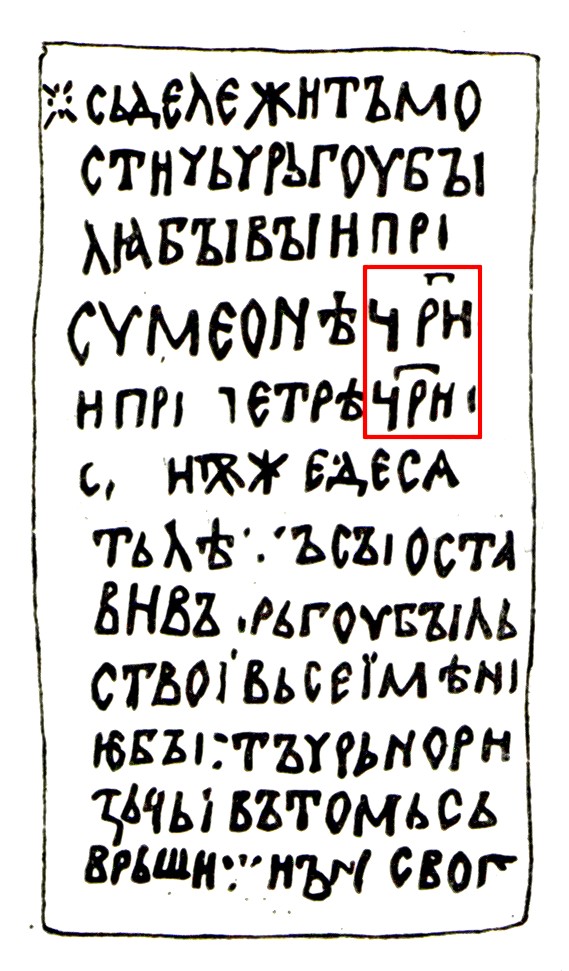
The study examines a limestone funerary stele found in 1952 in the ruins of a church in the Selište area of Preslav, one of the most important political and cultural centers of the First Bulgarian Empire. Today the artifact is preserved in the Archaeological Museum in Sofia. Unlike most early Bulgarian inscriptions, which were primarily written in Greek, this monument stands out for being written in the Old Church Slavonic alphabet while displaying strong linguistic influence from Middle Greek traditions.
A Window into the Multilingual World of the Early Balkans
Historians and linguists consider the written heritage of the Eastern Roman (Byzantine) Empire to be essential for understanding the political, religious and linguistic transformations of the medieval world. In this context, Old Bulgarian inscriptions—especially tombstones and commemorative monuments—serve as valuable historical records.
The Mostič inscription represents one of the most distinctive examples of this tradition. According to the new analysis, the monument commemorates Mostič, a high-ranking official who served during the reigns of Bulgarian rulers Simeon and Peter.
📣 Our WhatsApp channel is now LIVE! Stay up-to-date with the latest news and updates, just click here to follow us on WhatsApp and never miss a thing!!
The text begins with a phrase meaning “Here lies Mostič,” a formula commonly used in early Christian Greek and Latin funerary inscriptions. This similarity suggests that the inscription follows established Christian epigraphic traditions that were widespread across the Byzantine world.
However, the inscription quickly reveals unique features that distinguish it from other monuments of the period.
A High Official Who Became a Monk
One of the most striking aspects of the inscription is the life story it records. The text states that Mostič held the title “črьgou bъlʲlʲu,” a Slavic transcription of an Altaic administrative title known from Byzantine sources as Itzirgou Boilas. This title likely referred to a senior official or high-ranking military-administrative figure within the early Bulgarian state.
According to the inscription, Mostič served under the rulers Simeon and Peter but later made a dramatic decision. At the age of eighty, he abandoned his position and his wealth and entered monastic life.
The text describes him as becoming a “črьnorizьcь,” literally meaning “the one who wears black.” In Old Church Slavonic terminology, this phrase refers to a monk, reflecting the tradition of black monastic garments in Eastern Christianity.
After retreating from worldly life, Mostič eventually died, with the inscription concluding in a formula similar to those found in Christian funerary texts meaning “he completed his life.”
Linguistic Evidence of Cultural Interaction
The linguistic structure of the inscription offers extraordinary insight into cultural contact during the early medieval period.
Researchers found that the vocabulary of the inscription can be divided into three main linguistic layers:
About 60% Old Church Slavonic vocabulary
Around 20% Greek-Christian religious terminology
Approximately 20% Altaic or Proto-Bulgar titles and personal names
This combination demonstrates the multicultural environment of the early Bulgarian state. While the primary language of the text is Slavic, the presence of Greek terminology reflects the influence of Byzantine Christianity, and the Altaic titles point to the Turkic roots of the early Bulgar ruling elite.
Such linguistic layering makes the inscription a rare example of how political authority, religious culture and language intersected in the medieval Balkans.
A Rare Use of the Old Church Slavonic Alphabet
Another important feature of the monument is its script. Most early Bulgarian stone inscriptions were written primarily in Greek, but the Mostič stele was carved using the Old Church Slavonic alphabet, making it a significant example of the growing role of Slavic literacy during the Christianization of Bulgaria.
This shift reflects a broader transformation that occurred during the 9th and 10th centuries, when Slavic language and writing began to replace Greek as a literary and administrative medium in parts of the Bulgarian Empire.
The inscription therefore captures a pivotal moment in cultural history: the transition from a predominantly Byzantine Greek written culture to a Slavic Christian literary tradition.
A Key Artifact for Understanding Medieval Bulgaria
Beyond its linguistic value, the Mostič inscription also sheds light on social and political life in medieval Bulgaria. The narrative of a high-ranking official abandoning power to become a monk illustrates the growing prestige of monastic life in Christian society.
This phenomenon was not uncommon among the medieval elite. Members of the aristocracy sometimes renounced worldly positions late in life to enter monasteries, seeking spiritual redemption or retirement from political affairs.
The Mostič inscription thus offers more than a simple epitaph. It provides a snapshot of a society in transition—politically, culturally and spiritually.
A Hybrid Cultural Document
Scholars now consider the inscription to be a hybrid cultural artifact, reflecting the convergence of several traditions: Byzantine Christian epigraphy, Slavic language and writing, and Altaic political titles.
Such artifacts are invaluable for historians because they reveal how different cultural influences blended in the early medieval Balkans.
As researchers continue to study inscriptions like the one commemorating Mostič, they are uncovering new details about the formation of medieval Bulgarian identity and the multicultural environment of the Eastern Roman world.
Ultimately, the Mostič inscription stands as a powerful reminder that the history of the Balkans was shaped not by a single culture, but by the dynamic interaction of many.
Sayın, A. E. (2026). Orta Grekçe etkisinde eski kilise İslav alfabesiyle yazılmış bir eski Bulgar yazıtı üzerine. (On an Old Bulgarian Inscription Written in the Old Church Slavonic Alphabet Influenced by Middle Greek)Journal of Sivas Cumhuriyet University Social Sciences Institute, 2(1), 1–7.
Cover Image Credit: Public Domain