20 January 2026 The Future is the Product of the Past

Italian Art Police Seize Stolen Roman Statue

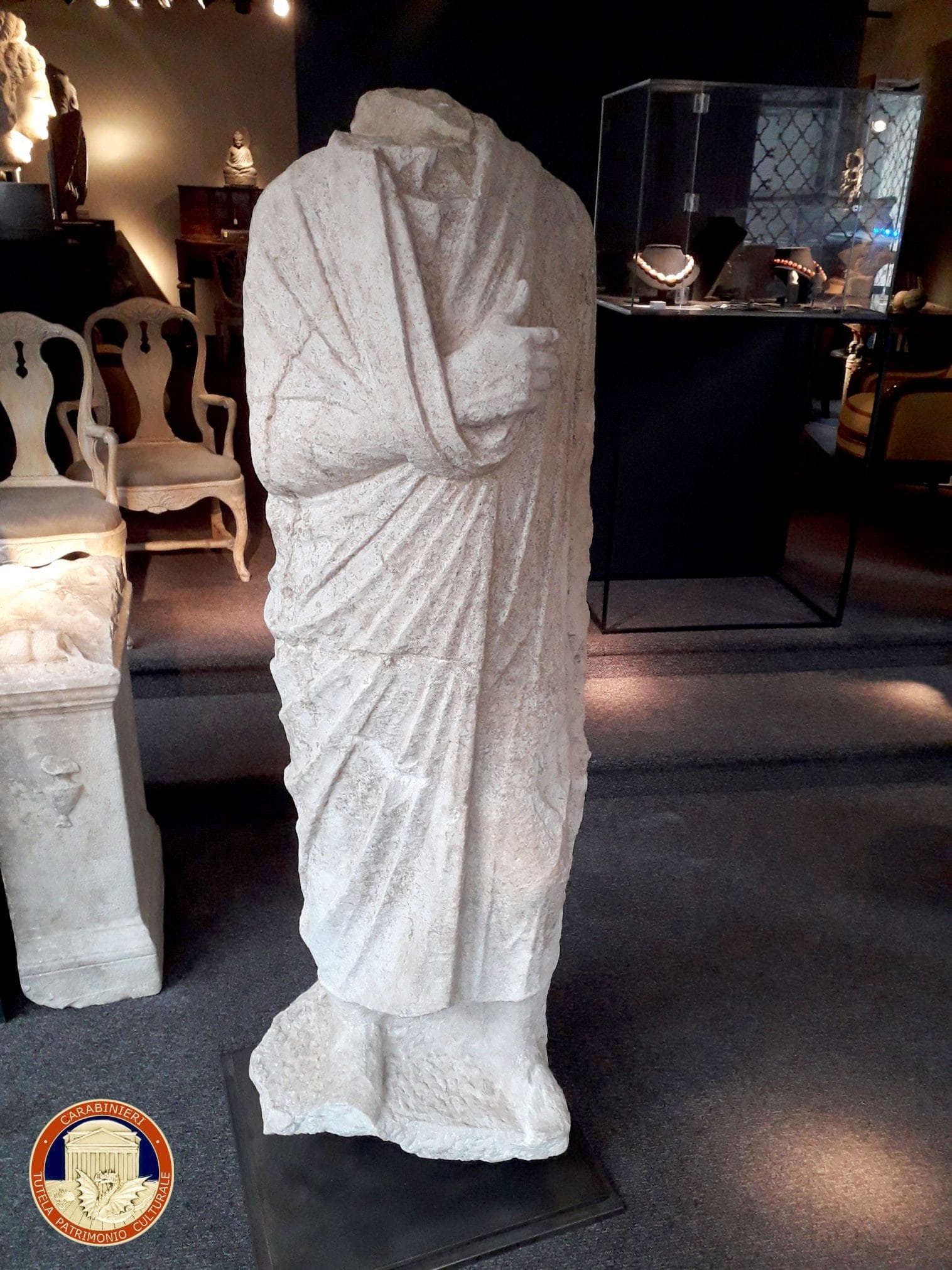
Italian police said they recovered a first-century Roman statue that was stolen in 2011 and found in an antique shop in Belgium.

The Carabinieri art team said in a statement on Monday that an Italian businessman who used a Spanish alias had been referred to the prosecutor for further investigation of the allegations he received and then exported the statue abroad.

It was stolen in November 2011 from the Villa Marini Dettina archaeological site on the outskirts of the capital Rome, the statement said.

Two members of the art squad’s archaeological unit were on assignment in Brussels when they took a walk after work in the Sablon neighborhood that is known for its antique shops. They spotted a marble statue in a shop that they suspected was from Italy and confirmed their suspicions when they cross-referenced the work with a database of known stolen antiquities, the statement said.
Carabineri
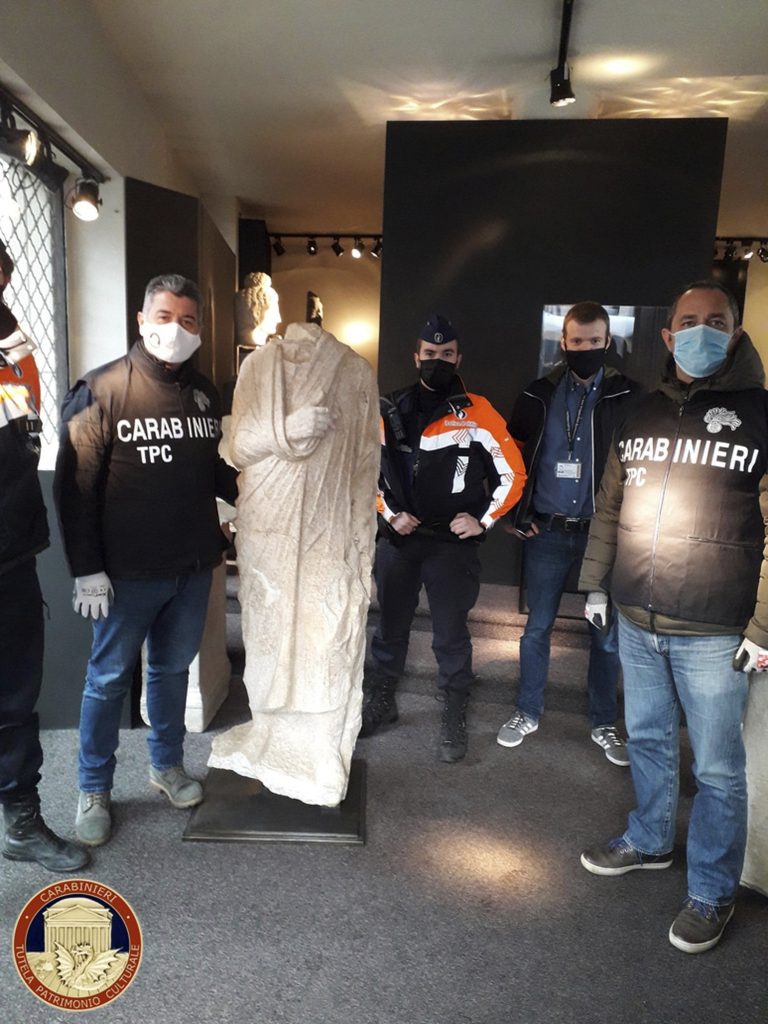
Carabinieri officers of the art squad’s archaeological unit pose with a headless Roman statue wearing a draped toga in Brussel. (Carabinieri Via AP)

The “Togatus” statue, featuring a headless Roman wearing a draped toga, has a value of 100,000 euros (around TL 970,340)


📣 Our WhatsApp channel is now LIVE! Stay up-to-date with the latest news and updates, just click here to follow us on WhatsApp and never miss a thing!!


Italy has been working for years to recover its looted artifacts.

What is toga?

A characteristic garment of ancient Rome was a roughly semicircular fabric wrapped around the shoulders and around the body. It was usually woven from white wool and was worn over a tunic.
Related Articles

Archaeologists in Israel are restoring the largest Roman Basilica in the country

6 June 2021

6 June 2021

Archaeologists in Israel are trying to rebuild a 2,000-year-old Roman-era basilica that is thought to be the country’s biggest. A...

Roman Empire’s Emerald Mines May Have mined by Nomads as Early as the 4th Century

4 March 2022

4 March 2022

New research by archaeologists from the  Universitat Autònoma de Barcelona and the University of Warsaw suggests that Roman Empire emerald...

Mystery of the 1,700-year-old Mosaic Solved: The Medallion in the Mosaic uncovered to be the Symbol of a Roman Military Unit

10 August 2024

10 August 2024

The mystery of the 1,700-year-old mosaic, which was found during excavations in Amasya province in northern Turkey 11 years ago...

The Lost Letters of Caracalla: Ten Inscribed Slabs Unearthed Beneath a Turkish Village Home

28 October 2025

28 October 2025

Archaeologists uncover ten inscribed stones believed to bear imperial letters written under Emperor Caracalla — hidden for nearly 1,800 years...

2,000-Year-Old Iron Age and Roman Treasures Found in Wales Could Point to an Unknown Roman Settlement

12 May 2023

12 May 2023

A metal detectorist found a pile of exceptionally preserved Roman and Iron Age objects buried 2,000 years ago in a...

Early Roman Aqueduct Discovered in Turkey’s Aydın Province

27 May 2021

27 May 2021

In the Kuşadasi region of western Turkey’s Aydin, archaeologists and scholars unearthed an approximately 2,000-year-old ancient Roman aqueduct. Experts believe...

A Roman tomb where magical nails were used to fend off the ‘restless dead’ has been discovered in Türkiye

15 March 2023

15 March 2023

In the ancient city of Sagalassos in southwestern Türkiye, archaeologists have identified an unusual burial practice from the early Roman...

Are the skeletons found in the restoration of the Bukoleon Palace the victims of the Crusader army massacre in Constantinople?

29 November 2021

29 November 2021

It is thought that the 7 skeletons messy found in the Bukoleon Palace excavations may be the victims of the...

Klazomenai, ceramic center of ancient period was found the first seal belonging to the city

20 November 2022

20 November 2022

A seal belonging to the city was found for the first time during excavations in the ancient city of Klazomenai...

Imperial cult temple discovered in Spello: It opens a new chapter in the Roman Empire’s transition from paganism to Christianity

6 January 2024

6 January 2024

American researchers have announced the discovery of an Imperial cult temple in Spello, Italy. The discovery was announced by Douglas...

Persian-era plaster walls were discovered during excavations at Zeyve Höyük in central Turkey

2 August 2022

2 August 2022

This year’s excavations at Porsuk-Zeyve Höyük (Zeyve Mound) near the Porsuk village of the Ulukışla district of Niğde, located in...

Roman Marching Camps Discovered in Saxony-Anhalt for the First Time

15 January 2026

15 January 2026

Archaeologists in Germany have uncovered the first confirmed Roman marching camps in Saxony-Anhalt, providing groundbreaking evidence of Roman military operations...

Marble inlay floors found in a Sunken Roman villa in Baia, the Las Vegas of the ancient world

9 April 2023

9 April 2023

Expansion of research activities in the Terme del Lacus area in the sunken Baia park, known as the ‘Las Vegas’...

Archaeologists conducting excavations at the Roman Fort of Apsaros in Georgia, found evidence of the Legion X Fretensis

27 May 2023

27 May 2023

Polish scientists discovered that Legion X Fretensis, known for its brutal suppression of Jewish uprisings, was stationed in the early...

“Last Rhodes shipwreck” of Roman period found in Turkey’s Fethiye

5 March 2022

5 March 2022

Turkish researchers, a Rhodes shipwreck from the third century A.D. was discovered in the depths of the Gulf of Fethiye...