11 January 2026 The Future is the Product of the Past

Collapsed 18th-Century Tomb Uncovers Hidden Crypt Beneath Historic Churchyard

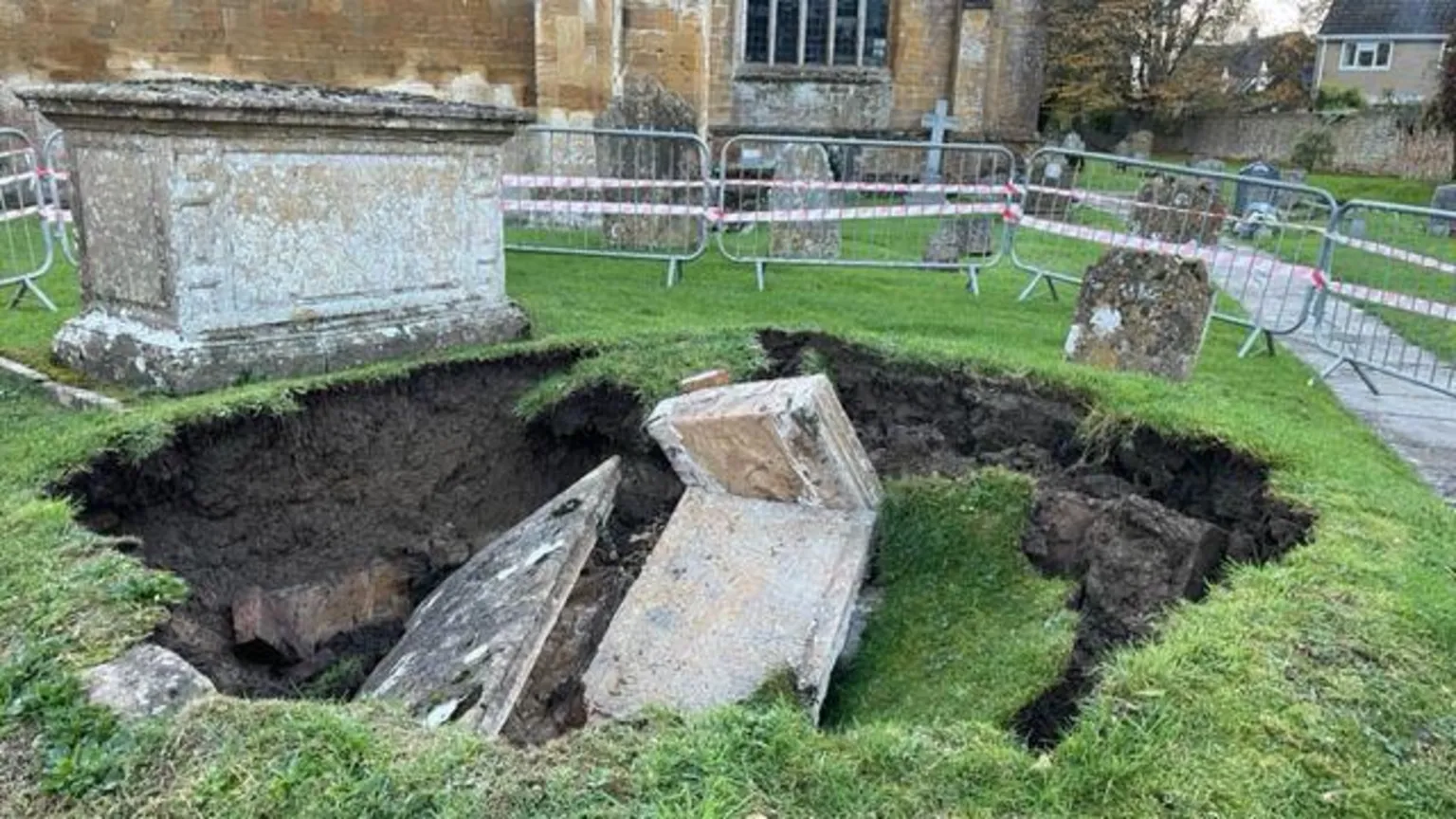
A mysterious underground crypt has been revealed after the sudden collapse of an 18th-century tomb in a centuries-old English churchyard. The incident occurred just a day before Remembrance Sunday, stunning local residents and drawing national attention.

According to BBC News, a 12-foot (3.6-meter) hole opened unexpectedly, exposing a stone crypt that had remained sealed for more than 300 years. The church and parish authorities have since cordoned off the site for safety, while experts begin assessing the extent of the damage.

Reverend Paul Fillery, who oversees the church, said the collapse was likely the result of gradual erosion. “Years of rainfall may have weakened the soil beneath the tomb,” he said. “We’ll only know for certain once surveyors complete their study.”

Centuries of History Unearthed

The newly exposed structure is thought to have been built in the early 1700s. Local historians note that the vault’s stonework was made from a rare type of limestone still found in only a few parts of England. The tomb itself, now reduced to rubble, bears no visible inscription.

“It’s both fascinating and sobering,” Rev Fillery told BBC News. “The tomb gave way quite suddenly, leaving behind what looks like a large sinkhole. We’re working with the diocese and parish council to ensure the site is safely restored and respectfully handled.”


📣 Our WhatsApp channel is now LIVE! Stay up-to-date with the latest news and updates, just click here to follow us on WhatsApp and never miss a thing!!


The church, designated as a Grade I listed building, has stood for more than seven centuries, undergoing major rebuilding during the 15th and 16th centuries. Its striking four-tiered tower, completed around 1505, is a symbol of the region’s medieval craftsmanship. Historical records also show the building was briefly occupied by Oliver Cromwell’s soldiers after the 1645 Battle of Bridgwater during the English Civil War.
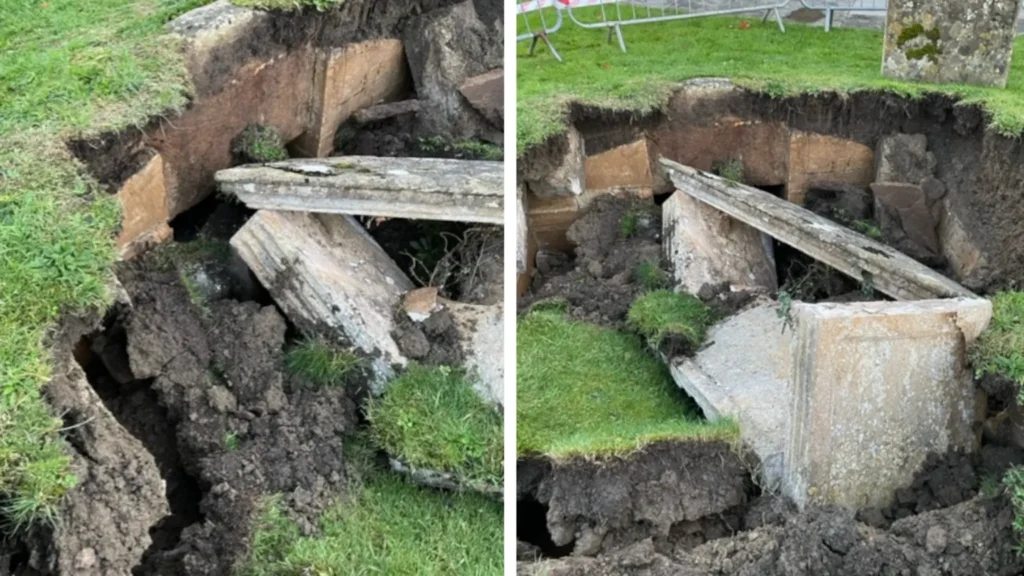
The collapse revealed the underground crypt's Ham stone walls, which today is only quarried in two active areas at Ham Hill in Somerset. Credit: All Saints Church
The collapse revealed the underground crypt’s Ham stone walls, which today is only quarried in two active areas at Ham Hill in Somerset. Credit: All Saints Church

Curiosity and Caution

Since the discovery, the fenced-off site has drawn streams of visitors eager to glimpse the opened crypt. “You don’t often see something from the 1700s resurface like this,” one onlooker told BBC News. “It’s eerie but incredible.”

Local officials, however, are urging caution. The parish council has warned that the surrounding ground may still be unstable and is working closely with the Diocese of Bath and Wells to determine the safest next steps. In an official statement, the council emphasized that “public safety and heritage preservation are our top priorities.”

An Unexpected Window Into the Past

Archaeologists believe the collapse, while unfortunate, provides a rare opportunity to study burial practices and construction techniques from the 18th century. Further excavation or restoration efforts are expected to follow once the site is fully stabilized.

As Rev Fillery reflected, “Every generation leaves something behind. This unexpected discovery reminds us how deeply history is layered beneath our feet — often waiting for the right moment to be revealed.”

Cover Image Credit: All Saints Church
Related Articles

Gladiators were mostly Vegetarians and they were fatter than you may think

6 August 2023

6 August 2023

What better epitomizes the ideal male physique than the Roman gladiator? Gladiators were the movie stars of the first century,...

Computational Analysis Points to a Non-Traditional Garden of Eden Location – Beneath the Pyramids?

30 April 2025

30 April 2025

A radical new theory proposed by a computer engineer suggests that the biblical Garden of Eden may not be in...

Evidence of a 1500-year-old Byzantine church found on the beach of Ashdod, Israel

22 February 2022

22 February 2022

Recent rain in Israel has unearthed the remains of a marble pillar dating to around 1,500 years ago on a...

Archaeologists unearthed the ruins of an imposing stoa from the Greco-Roman era in Sicily

1 April 2024

1 April 2024

Archaeologists have unearthed the ruins of an imposing stoa from the Greco-Roman period in the small village of Tripi in...

DNA Analysis Reveals Identifies the Genetic Makeup of Piceni the Most Fascinating Civilizations of Pre-Roman Italy

24 November 2024

24 November 2024

A study conducted by an international team coordinated by Sapienza University of Rome and the Italian National Research Council (CNR)...

Ancient Mythical Castle “Sörby Borg” Discovered on Swedish Island Creates Archaeological Sensation

4 August 2021

4 August 2021

A text from the early 18th century mentions the castle, which has become a bit of a legend. It has...

Outrage in Türkiye: 3,000-Year-Old Unesco Tomb in Phrygian Valley Turned Into Café

1 July 2025

1 July 2025

A 3,000-year-old rock-cut tomb located in the historical Phrygian Valley—hailed as Türkiye’s “second Cappadocia” and listed on the UNESCO World...

Archaeologists Unearth Unique and Exceptionally Preserved Roman Wooden Water Pipe in Belgium

8 May 2025

8 May 2025

Nestled in the Flanders region of Belgium, not far from the country’s capital, Brussels, the charming city of Leuven is...

Britain’s oldest decoratively piece of carved wood discovered in a layer of peat

8 June 2023

8 June 2023

A heavily notched oak timber found in a peat layer during construction work turned out to be the oldest piece...

Early Imperial cemetery in Nîmes, in the south of France

4 October 2022

4 October 2022

Inrap archaeologists excavating at Nîmes in southern France have uncovered a cemetery dating to the first to second centuries AD...

Roman camp of 10,000 people discovered in northern Portugal

2 July 2021

2 July 2021

A camp used by 10,000 Roman soldiers sent to conquer northwestern Iberia has been discovered in the Portuguese city of...

Origin of Ivory Rings Found in Elite Anglo-Saxon Burials

2 July 2023

2 July 2023

An elite class of ancient Anglo-Saxon women were buried with hundreds of ivory rings, and the origin of these ivory...

A 12.000 -year-old temple was found during excavations in Boncuklu Tarla in southeastern Turkey

21 October 2021

21 October 2021

A temple thought to be 12 thousand years old was unearthed in Boncuklu Tarla in the Ilısu Neighborhood of Dargeçit...

Unique Rock Tomb Discovered in Southeastern Türkiye’s Şanlıurfa

3 March 2025

3 March 2025

Hasan Şıldak, the governor of the city of Şanlıurfa in south-eastern Türkiye, announced on his social media account that a...

1,600-Year-Old Rare Greek Letter-Shaped Weights and Scale Found in Türkiye’s Uzuncaburç

9 July 2025

9 July 2025

Archaeologists have made a significant discovery at the ancient city of Uzuncaburç in Türkiye’s southern Mersin province — a complete...