27 February 2026 The Future is the Product of the Past

Archaeologists found 5 unique sculptures representing the Kakatiya art style in Siddipet

13th-century statues were found near a temple tank in the Siddipet district in the northern province of Telangana, India.

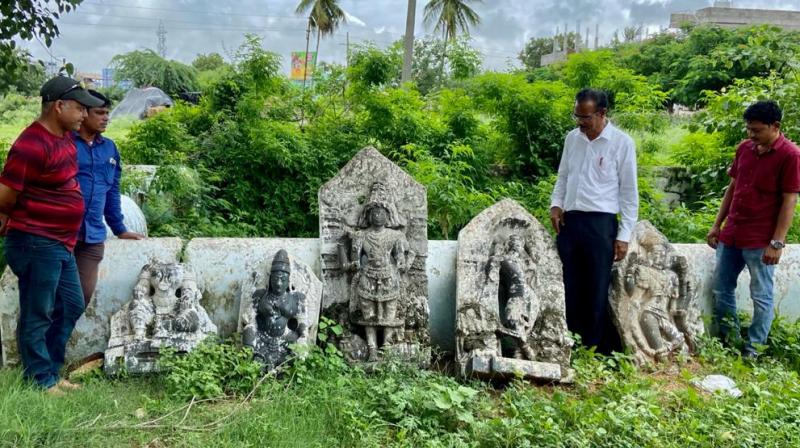
On Sunday, representatives of the New Telangana History Group (NTHG), led by Sriramoju Haragopal, discovered a cluster of 13th-century statues in disrepair beside a temple tank in Duddeda village, Siddipet district.

After finding five sculptures from the Kakatiya era, NTHG members Ahobilam Karunakar, Samaleti Mahesh, and Md. Naseeruddin informed Dr. E. Siva Nagireddy, archaeologist and chief executive officer of The Cultural Centre.

Dr. Nagireddy went to Duddeda village based on information from NTHG members and revealed that the five sculptures – two Devi statues and three sculptures of Chennakesava, Venugopala, and Bhairava – were from the 13th and 14th centuries and represented the Kakatiya style of art.

He described the Chennakesava sculpture as a masterwork of Kakatiya art, with exuberant ornamentation and traditional iconography, as well as the Venugopala and Bhairava statues.


📣 Our WhatsApp channel is now LIVE! Stay up-to-date with the latest news and updates, just click here to follow us on WhatsApp and never miss a thing!!


Dr. Nagireddy said there was an extensive list of inscriptions by Kakatiya Prataparudra, dated back to 1296 AD. Based on the inscription found on the sculptures, he said those sculptures were part of fine workmanship belonging to the flourishing phase of the Kakatiya art in the 13th and 14th centuries. (Deccan Chronicle)

Dr. Nagireddy informed the local people about the historical significance of the sculptures, which were testaments to the Kakatiya sculptor’s ability.

He urged the authorities to save the sculptures for posterity by relocating them within the temple premises ensuring their safety and protection.
Related Articles

Mass graves of Crusaders killed in the 13th century have been discovered in Lebanon

17 September 2021

17 September 2021

From 1096 to 1291, waves of Europeans took up arms and marched into the Middle East. They hope to “take...

Salvage Excavations Started in Giresun Island on Turkey’s Black Sea Coast

18 May 2021

18 May 2021

Rescue excavations are starting again on Giresun Island, where the first examples of human settlement in the Black Sea Region...

2,000‑Year‑Old “Jesus Cup” Unearthed in Alexandria: Could It Be the Earliest Material Reference to Christ?

23 September 2025

23 September 2025

A ceramic bowl discovered in Alexandria, dubbed the “Jesus Cup” and inscribed “DIA CHRSTOU O GOISTAIS”, has sparked debate: might...

In Bergama, the City of Greek Gods, the People Kept the Cult of Cybele Alive

25 August 2021

25 August 2021

The figurines of Cybele, the goddess of the fertility of Anatolia, and the presence of sanctuaries unearthed in the Ancient...

Two Durham Archaeology Students, One from Türkiye, Earn Prestigious Awards for Research on Ancient Lycia

26 July 2025

26 July 2025

In a remarkable achievement for Anatolian studies, two Durham University-affiliated archaeology students have received prestigious awards for their research on...

Angkor Wat Reopens

26 April 2021

26 April 2021

After being temporarily closed on April 7 to prevent the spread of Covid-19 to locals, Apsara National Authority and Angkor...

New Research Uncovers Earliest Evidence of Humans in Rainforests, Pushing Timeline Back 150,000 Years

3 March 2025

3 March 2025

The rainforests, as important biomes on earth, were considered uninhabited until recent history. New findings now show that humans lived...

Archaeologists reconstructing how the Assyrian army conquered the ancient Judean city of Lachish 2700 years ago

9 November 2021

9 November 2021

Archaeologists discovered how King Sennacherib’s soldiers constructed the huge siege ramp that enabled them to defeat the Lachish city 2,700...

A Life-Size Funerary High Relief Discovered in Pompeii’s Porta Sarno Necropolis

3 April 2025

3 April 2025

A research project titled “Investigating the Archaeology of Death in Pompeii,” developed by the Universitat de València in collaboration with...

A small temple discovered in the ancient city of Selinunte, one of the largest and most important ancient Greek cities in southern Italy

9 August 2024

9 August 2024

Recent excavations in the ancient Magna Graecia city of Selinunte in southwestern Sicily have revealed the presence of a new...

Rare 13th-Century Coin Hoard Discovered at Berlin’s Molkenmarkt Excavations

10 August 2025

10 August 2025

Archaeologists have uncovered a remarkable treasure dating back to the 13th century during the ongoing excavations at Molkenmarkt, the historic...

Mystery of Knaresborough Roman hoard revealed by Newcastle experts

13 January 2024

13 January 2024

Archaeologists at Newcastle University have investigated one of the most unusual late-Roman metalware ever discovered in the British Isles. Although...

A 3,600-Year-Old Bronze Minoan Dagger Discovered in Antalya Underwater Excavation

29 August 2024

29 August 2024

A bronze dagger with silver rivets that dates to the Minoan civilization approximately 3,600 years ago was discovered during an...

A 2,300-Year-Old Thracian Inscription Reveals the Man King Seuthes III Could Not Lose

24 January 2026

24 January 2026

New research sheds light on a long-standing ancient mystery, suggesting that a previously unknown figure named Epimenes may have served...

Young Maya Maize God’s Severed Head found in Palenque

4 June 2022

4 June 2022

Archaeologists from the Instituto Nacional de Antropología e Historia (INAH), an approximately 1,300-year-old sculpture of the head of the Young...