
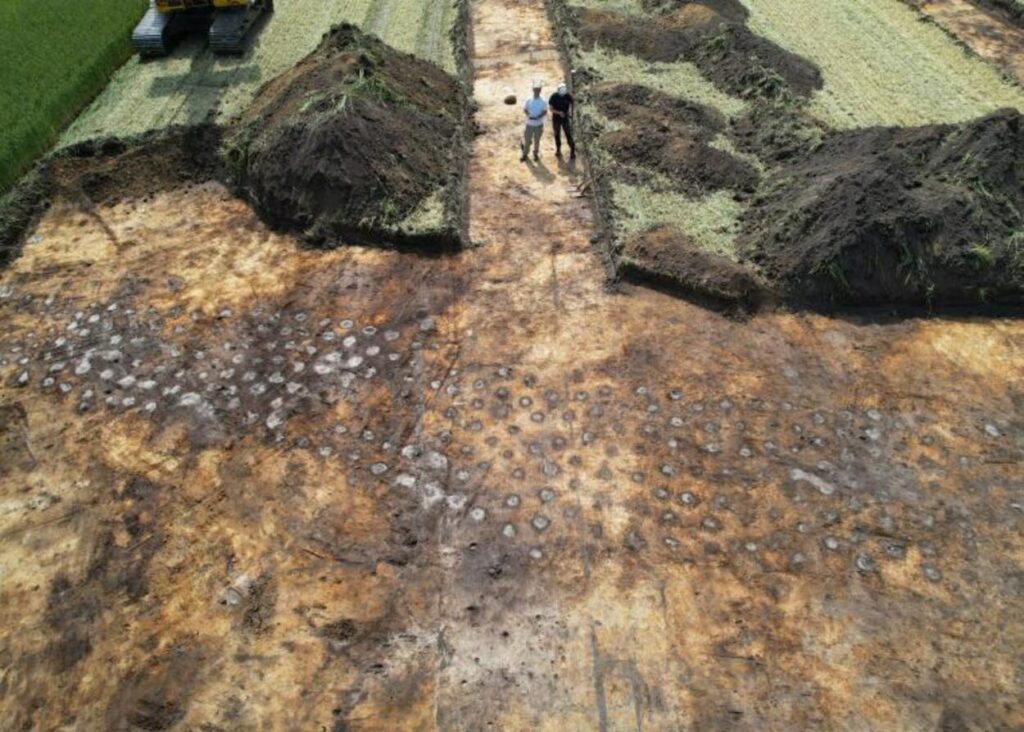
Archaeologists in western Denmark have discovered the remains of a 2,500-year-old defensive barrier that may have been built to stop an invading army. The unexpected find, uncovered along an ancient travel route in West Jutland, offers possible evidence of previously unknown conflicts during the Early Iron Age. Excavations in the same region have also revealed a 4,500-year-old battle axe buried in a Stone Age grave.
The discoveries were made by archaeologists from Museum Vest ahead of a road expansion project between Varde and Korskro. What began as a routine investigation before construction has developed into a broader examination of prehistoric settlement, burial practices, and possible military activity spanning several thousand years.
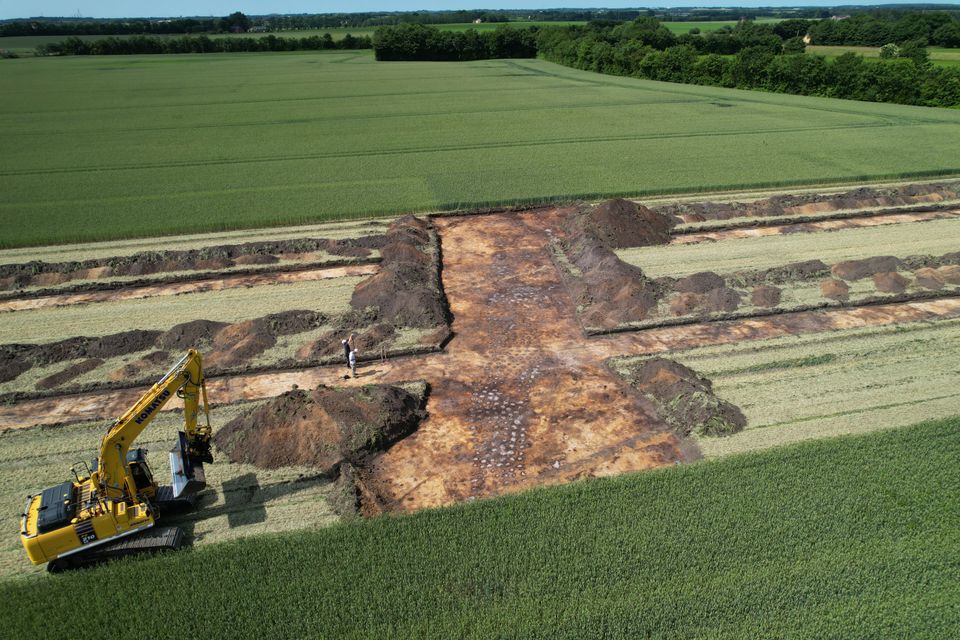
The surprising discovery was made near Schæfergårde, where excavators identified a long arrangement of closely spaced postholes beneath a field. Archaeologists believe the holes once supported pointed wooden stakes, potentially forming a palisade designed to restrict movement through the landscape.
Its location may be the most important clue to its purpose. The barrier crossed the historic Drivvejen, an ancient route that served as a major corridor through western Jutland for centuries and possibly much longer.
A 2,500-Year-Old Barrier Against an Unknown Enemy
Dating to approximately 500 BC, the structure belongs to the earliest part of the Iron Age in Denmark. According to Museum Vest archaeologist Michael Alrø Jensen, the discovery was entirely unexpected and may point to conflicts that had not previously been documented in this part of the country.
The researchers suggest that communities living in the region may have feared an army approaching from the north along Drivvejen. By constructing a barrier across the route, they could have attempted to control passage or prevent hostile groups from advancing farther south.
Archaeologists have not identified the people responsible for constructing the barrier or those it was intended to stop. Nor has the discovery established that a battle actually took place at the location.
The interpretation nevertheless raises significant questions about territorial control, movement, and organized defense in Early Iron Age western Denmark. Museum Vest plans to continue investigating the surrounding area in hopes of identifying additional sections of the posthole alignment.
A Stone Age Battle Axe Found in an Ancient Grave
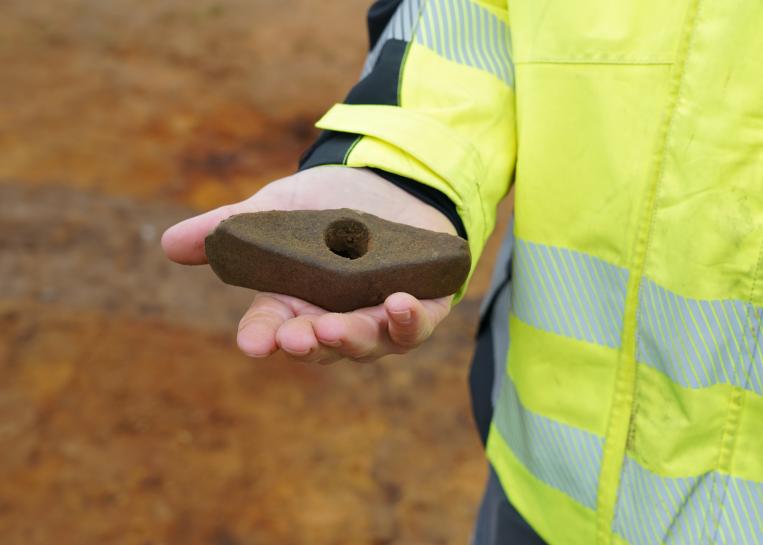
The defensive structure was not the only unexpected discovery along the road corridor. Near one of the area’s protected burial mounds, archaeologists recovered a battle axe approximately 4,500 years old from a Stone Age grave.
Researchers believe the axe was deliberately placed in the burial as a grave offering, possibly accompanying an individual associated with a warrior identity. The interpretation remains tentative, but the object provides valuable evidence of prehistoric burial customs and the significance attached to weapons.
Importantly, the battle axe predates the Iron Age defensive barrier by approximately 2,000 years. The discoveries therefore belong to separate archaeological periods and should not be interpreted as evidence of the same conflict. Instead, they illustrate the long history of human activity in this relatively small area of western Denmark.
Excavations have also identified remains of houses, farms, graves, and burial urns associated with different periods, extending from the Stone Age through the Bronze and Iron Ages and into the Viking Age.
Road Construction Reveals Thousands of Years of History
The investigations are being conducted ahead of the Danish Road Directorate’s planned expansion of Route 11 between Varde and Korskro. Because relatively few archaeological excavations had previously been carried out in the area, the findings are substantially expanding knowledge of its prehistoric development.
The remains of settlements and agricultural buildings may help researchers investigate how communities changed over time, including the transition from dispersed farmsteads toward more organized villages.
For archaeologists, the importance of the project extends beyond the individual discoveries. Finding traces of human activity from so many different periods within a limited area offers an opportunity to reconstruct a more continuous history of settlement and movement in western Jutland.
Museum Vest will continue excavations throughout the autumn, including investigations around additional burial mounds where urns have already been identified. The resulting evidence may help determine whether the Iron Age barrier formed part of a larger defensive system and clarify the broader archaeological history of the region.
