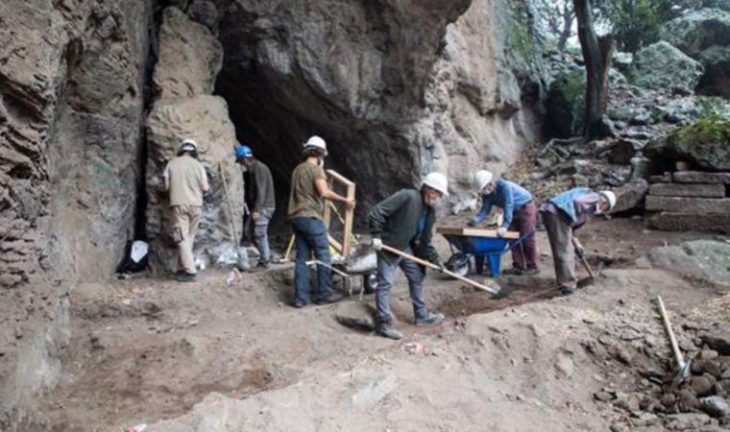
In the dry, lateritic landscapes of eastern Senegal, archaeologists have uncovered something far more revealing than a single artifact: a 2,400-year-old ironworking workshop that remained active for nearly eight centuries. The discovery, led by researchers from the University of Geneva in collaboration with Senegalese institutions, is now reshaping how scholars understand the origins and evolution of iron metallurgy in sub-Saharan Africa.
Published in the journal African Archaeological Review, the findings offer rare, high-resolution insight into a technological tradition that persisted with remarkable stability over generations.
A Workshop That Refuses to Fit Old Narratives
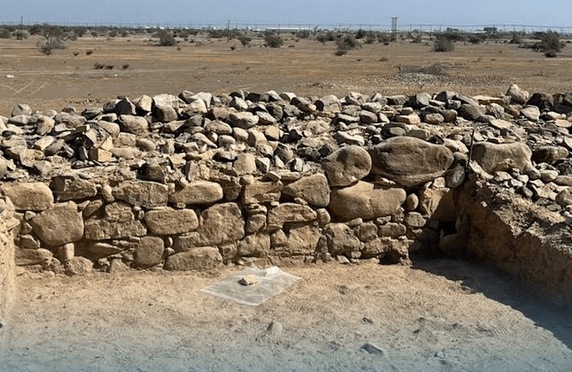
The site, known as Didé West 1 (DDW1), lies in the Falémé River valley near Senegal’s eastern border. Excavations first revealed its significance in 2018, but ongoing analysis has now confirmed that the workshop was in use from the 4th century BCE to the 4th century CE—an unusually long lifespan for a metallurgical site.
This continuity alone makes the discovery exceptional. Most ancient ironworking sites were used briefly, often for only a few generations, before being abandoned or replaced. At DDW1, however, the same location was reused, modified, and expanded over centuries.
That persistence raises a deeper question—one that has long divided archaeologists:
Did iron metallurgy in Africa emerge independently, or was it introduced from elsewhere?
📣 Our WhatsApp channel is now LIVE! Stay up-to-date with the latest news and updates, just click here to follow us on WhatsApp and never miss a thing!!
While the earliest known iron production is typically traced to Anatolia and the Caucasus during the 2nd millennium BCE, the Senegalese workshop complicates any simple diffusion model. It does not provide a definitive answer—but it does challenge long-held assumptions.
An Industrial Landscape Preserved in Layers
What sets Didé West 1 apart is not just its age, but the clarity with which its operational history can be reconstructed.
Archaeologists uncovered a dense accumulation of industrial remains, including:
Around 100 tons of slag, the waste product of iron smelting
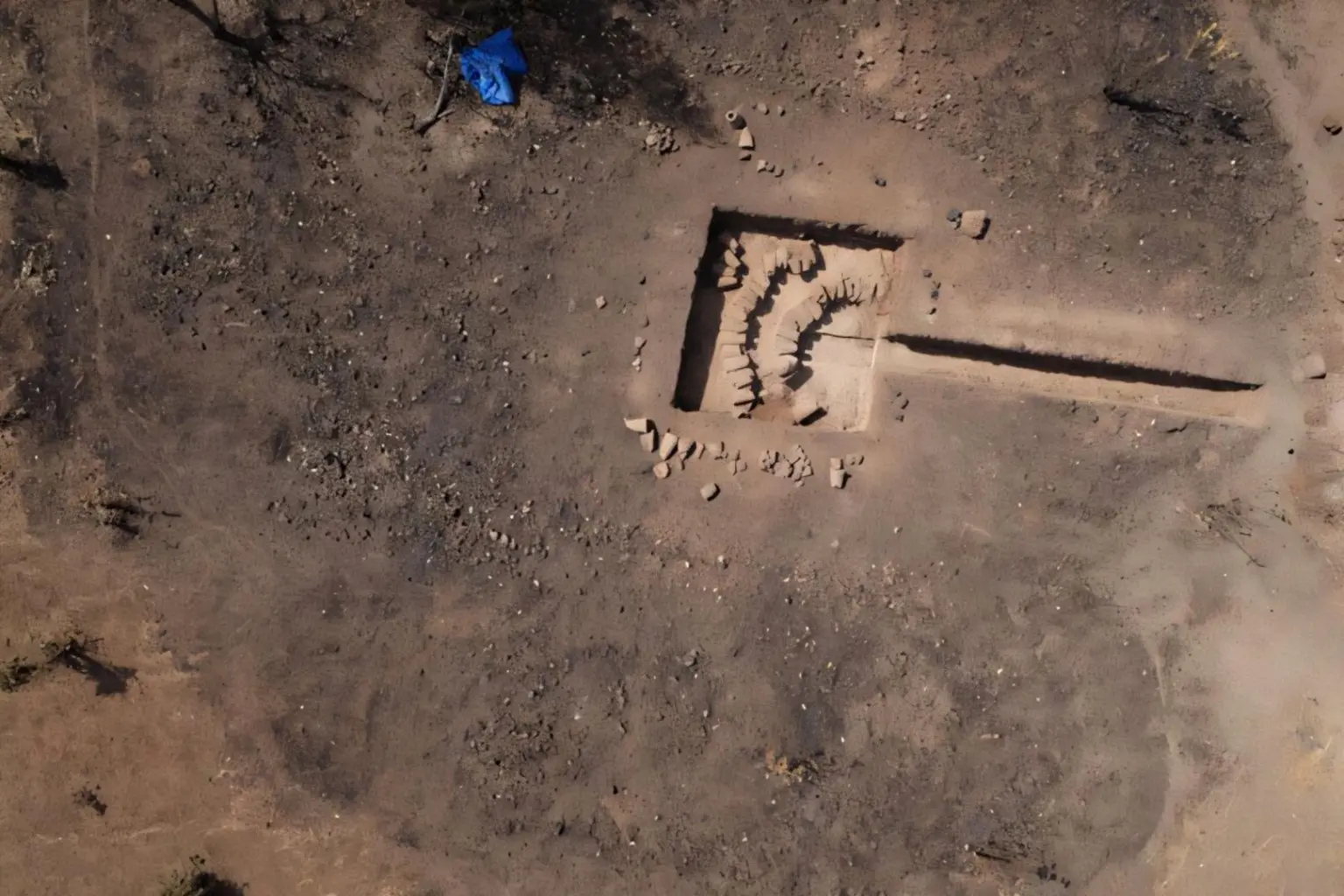
Approximately 35 circular furnace bases, each about 30 cm deep
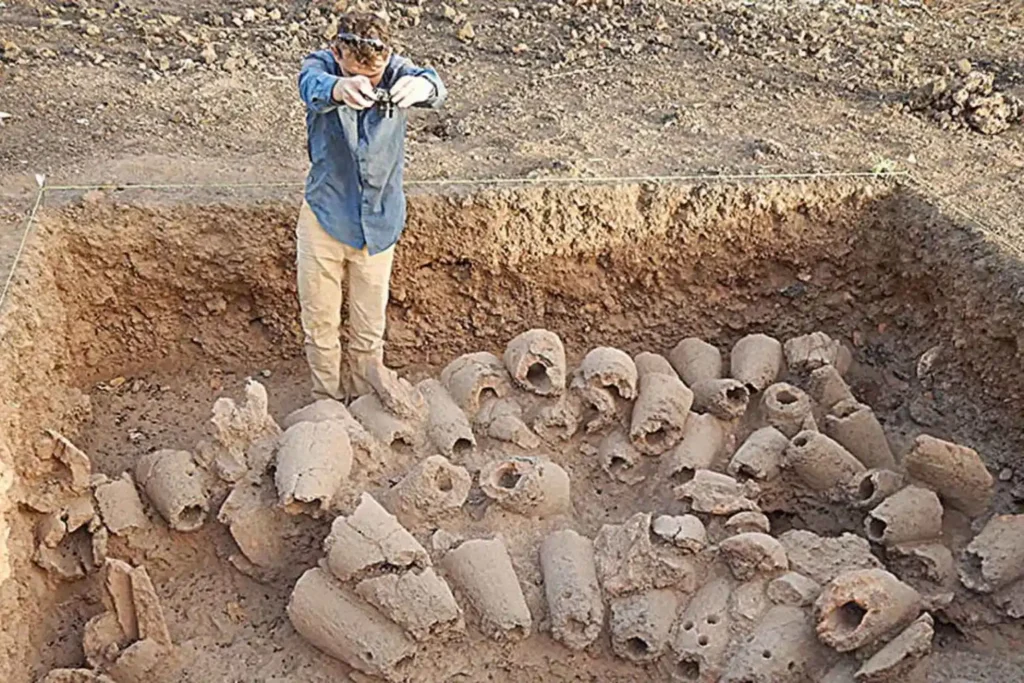
Nearly 30 clay tuyères—air pipes used to channel oxygen into furnaces
Rather than appearing as scattered fragments, these elements form a coherent and evolving production landscape. The workshop gradually shifted northward over time, as earlier phases were buried beneath new layers of slag and debris.
This spatial progression allows researchers to read the site almost like a stratified technical manual—each layer preserving a phase of activity, adaptation, and reuse.
A Distinctive Metallurgical Tradition
Detailed analysis shows that the workshop operated according to a specific technological system, identified as the FAL02 smelting tradition.
Its defining features include:
Small, circular furnaces equipped with removable chimneys
Large clay tuyères with multiple lateral perforations, designed to distribute airflow more evenly
A carefully structured furnace base incorporating organic materials
One of the most striking discoveries lies in those organic remains. Impressions preserved in the slag reveal the use of plant matter—including palm nut seeds (Borassus aethiopum)—as packing material at the base of the furnace.
This technique, not previously documented so clearly in West Africa, likely improved airflow and slag drainage during smelting. It is a subtle but highly effective innovation—evidence of practical experimentation and accumulated technical knowledge.
As lead author Mélissa Morel notes, the site’s exceptional preservation allows researchers to trace not only what was produced, but how knowledge itself was maintained and transmitted over time.
Stability Over Innovation—A Different Technological Logic
One of the most unexpected aspects of the discovery is what did not change.
Despite nearly 800 years of continuous use, the core smelting technique remained largely stable. There is no clear evidence of major technological breakthroughs or abrupt transitions. Instead, the system shows only minor adjustments—fine-tuning rather than reinvention.
This challenges a common assumption in the history of technology: that innovation is always linear and progressive.
At Didé West 1, continuity appears to have been a deliberate choice. The method worked, it suited local resources, and it met the needs of the community. In that sense, stability becomes a form of expertise rather than stagnation.
Iron for Daily Life, Not Empire
The scale of production also tells an important story. Unlike large-scale metallurgical centers tied to imperial economies, this workshop appears to have operated on a small, localized scale.
The volume of slag and the structure of the furnaces suggest production aimed primarily at meeting local needs—most likely the manufacture of agricultural tools and everyday implements.
This makes the site particularly valuable. Instead of focusing on elite objects or long-distance trade, it reveals the everyday mechanics of technology—how iron shaped farming, maintenance, and community life.
Rethinking Africa’s Role in Early Metallurgy
For decades, discussions of early iron production have often centered on regions like Anatolia, the Near East, and Europe. Sub-Saharan Africa, by contrast, has frequently been treated as a secondary or derivative zone.
Findings from Didé West 1 push firmly against that narrative.
The site demonstrates that West Africa hosted durable, technically sophisticated metallurgical traditions, grounded in local knowledge and adapted to specific environmental and cultural conditions. It also highlights how much remains unknown: only a limited number of well-dated early ironworking sites have been documented across the region.
Ongoing research in Senegal and beyond aims to fill those gaps, comparing techniques across sites and refining the chronology of African metallurgy.
A Workshop That Speaks Across Centuries
There is nothing visually spectacular about Didé West 1—no gold, no monumental architecture, no finely crafted weapons. What it offers instead is something rarer: a detailed record of work.
Furnaces dug into the ground. Clay pipes shaped by hand. Slag accumulating year after year. Subtle adjustments, repeated practices, and knowledge passed forward without interruption.
In the end, this discovery does more than add a new site to the archaeological map. It restores a missing dimension to the story of iron—one written not in imperial centers, but in workshops like this, where technology was refined quietly, persistently, and on its own terms.
Mélissa Morel et al, Evolution of an Early and Long-Lasting Iron Smelting Technique at Didé West 1, Falémé Valley, Eastern Senegal, African Archaeological Review (2026). DOI: 10.1007/s10437-026-09653-z
Cover Image Credit: Camille Ollier