
18 January 2026 The Future is the Product of the Past

1,400-Year-Old Bronze Cauldron Discovered in Pergamon’s ‘Mosaic House’

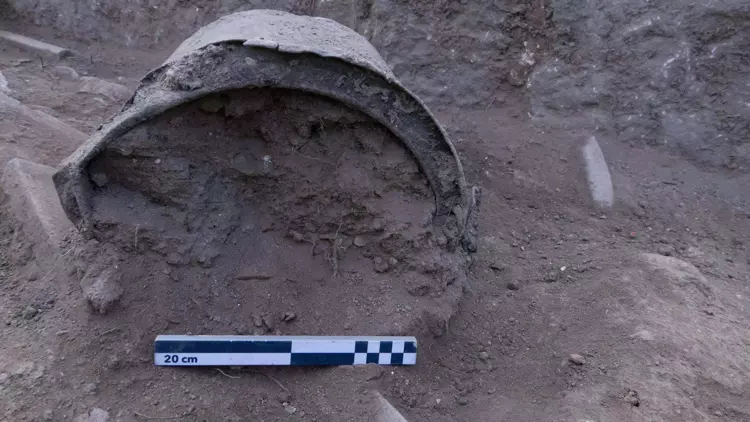
A remarkable archaeological discovery has been made in the ancient city of Pergamon (modern-day Bergama) in Turkey’s İzmir Province. Excavations at the UNESCO World Heritage-listed site revealed a 1,400-year-old bronze cauldron, found in a pool within the courtyard of the so-called “Mosaic House,” a significant Roman-era building complex.

The cauldron was unearthed in its original, undisturbed position and remains exceptionally well-preserved. After undergoing restoration and cleaning, the artifact is expected to be showcased at the Bergama Museum in the coming days, offering an unprecedented glimpse into the daily life and advanced craftsmanship of the era.

A Unique Glimpse into Roman and Byzantine Daily Life

The discovery was made near the Red Basilica (Kızıl Avlu), in an area referred to as the “Mosaic House” due to its richly decorated floors. According to Prof. Dr. Yusuf Sezgin, Head of Excavations and Chair of the Archaeology Department at Manisa Celal Bayar University, the building complex likely belonged to an influential Roman official or an important Christian cleric during the Byzantine period.

“The pool where the cauldron was found was not meant for swimming. It was likely used to collect rain or spring water for domestic purposes,” Prof. Dr. Sezgin explained. “The entire structure appears to have been abandoned in the 7th century AD, possibly due to Arab raids. Since then, it remained untouched, allowing us to discover this cauldron exactly where it was last used.”
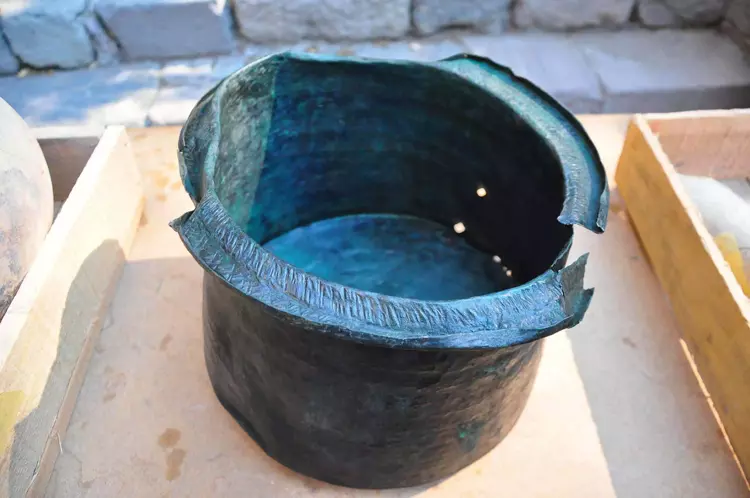
 A 1,400-year-old bronze cauldron, found in a pool within the courtyard of the so-called “Mosaic House". Credit: DHA
A 1,400-year-old bronze cauldron, found in a pool within the courtyard of the so-called “Mosaic House”. Credit: DHA

Bronze Craftsmanship Nearly Identical to Modern Techniques

Bronze was considered a valuable and expensive material in antiquity, typically reserved for special uses. Unlike the more common ceramic vessels of the time, this bronze cauldron is a rare find.


📣 Our WhatsApp channel is now LIVE! Stay up-to-date with the latest news and updates, just click here to follow us on WhatsApp and never miss a thing!!


“What’s fascinating is the manufacturing technique,” Prof. Dr. Sezgin noted. “It was crafted using a hammering method, a technique still practiced today in places like Diyarbakır and Şanlıurfa. This find proves that traditional Anatolian bronze craftsmanship has remained nearly unchanged for over a millennium.”

The cauldron may have been used to transport water from the pool to a nearby kitchen structure, supporting theories about domestic life and resource usage during the late Roman and early Byzantine periods.
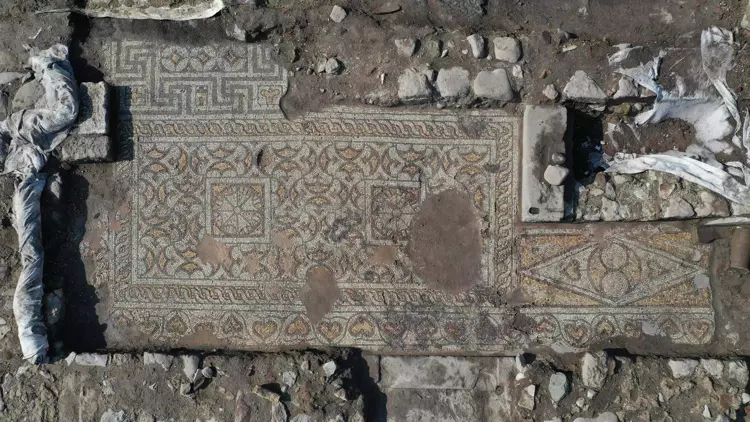
The discovery was made near the Red Basilica (Kızıl Avlu), in an area referred to as the “Mosaic House” due to its richly decorated floors. Credit: DHA

Scientific and Cultural Significance

Archaeologists emphasize the historical value of discovering the cauldron in situ. “The fact that it was found exactly in its original position, untouched for centuries, gives us direct insight into the cultural practices, technological capabilities, and daily routines of that era,” said Prof. Dr. Sezgin.

This find is part of broader excavations carried out under Turkey’s “Heritage for the Future” Project initiated by the Ministry of Culture and Tourism. The project aims to preserve and uncover the multi-layered cultural legacy of Pergamon, which includes remains from prehistoric, Hellenistic, Roman, Byzantine, Seljuk, and Ottoman periods.

Cover Image Credit: DHA

Related Articles

A Roman sarcophagus bearing the title of “Emperor’s Protector” was found for the first time in Anatolia

29 April 2022

29 April 2022

A sarcophagus carrying the title of “Emperor’s protector” was discovered in the province of Kocaeli in western Turkey. With the...

In the new images, Scotland’s biggest Pictish fort is “reconstructed.’

2 November 2021

2 November 2021

Stunning new reconstructions have revealed how Scotland’s largest known Pictish fort may have looked over one thousand years ago. Three-dimensional...

Early Anatolian Genes: Genetic Links Between Girmeler Mound and 17,000-Year-Old Pınarbaşı Skeletons

16 April 2025

16 April 2025

Recent archaeological excavations at Girmeler Mound, located near the ancient Lycian city of Tlos in southwestern Türkiye, have not only...

Turkey Adds New Sites to UNESCO World Heritage Tentative List

30 April 2021

30 April 2021

Two additional cultural objects have been added to Turkey’s World Heritage Tentative List, bringing the total number of cultural assets...

Stone-arched tunnel discovered near Achaemenid dam in southern Iran

4 February 2022

4 February 2022

A cultural heritage protection team has recently discovered a stone-arched tunnel located near an Achaemenid embankment dam in southern Iran....

1,800-Year-Old Sanctuary to Mithras discovered in Spain

8 February 2023

8 February 2023

Archaeologists excavating at Villa del Mitra in Cabra, Spain, have uncovered a sanctuary dedicated to the god Mithras, along with...

Amarna’s Hidden Chapter: From Abandoned Pharaoh’s City to Christian Monastic Hub

26 June 2025

26 June 2025

New archaeological findings have reshaped our understanding of Amarna, the once-glorious capital of ancient Egypt founded by Pharaoh Akhenaten in...

60-million-year-old Snail Fossil Found in southern Turkey

22 May 2021

22 May 2021

A snail fossil dating to the age of 60 million was found in Mersin’s Toroslar district. The snail fossil discovered...

Kevenli Castle Reveals Van’s Largest Ancient Urartian Storage Center – 76 Pithoi Marked with Cuneiform Measurements Found

7 September 2025

7 September 2025

Excavations at the ruins of Kevenli Castle in Van’s İpekyolu district have brought to light the largest known storage center...

1,400-Year-Old Ice Storage Unearthed at Baekje Fortress Reveals Ancient Korean Engineering

16 October 2025

16 October 2025

Archaeologists in South Korea have unearthed the first-ever Baekje-era ice storage facility at Busosanseong Fortress, a UNESCO World Heritage site...

Ancient Tomb of Korean Hostage Prince Found in China

21 July 2025

21 July 2025

Chinese archaeologists have uncovered the tomb of Kim Young, a hostage prince from the ancient Korean kingdom of Silla, in...

Ancient Library With Unparalleled Architecture Found in Stratonikeia, Marble City of Gladiators

24 June 2025

24 June 2025

An ancient marvel, unique in design and history, is being unearthed in the heart of southwest Türkiye. Archaeologists working in...

The migration movement that started from Siberia 30,000 years ago may have shaped Göbeklitepe

24 June 2022

24 June 2022

Professor Semih Güneri, retired faculty member from Dokuz Eylul University (DEU) Caucasus Central Asia Archeology Research Center, stated that they...

Tajik Buddha in Nirvana – the Largest in the World: 42 feet long and 9 feet high

31 December 2023

31 December 2023

In the past, while Taliban soldiers in Afghanistan destroyed two immense statues of Buddha, art historians in neighboring Tajikistan meticulously...

Scientists Ancient Landscape Not Seen For 14 Million Years Discovered Beneath Antarctic Ice

26 October 2023

26 October 2023

Researchers have uncovered an ancient landscape that remained hidden beneath the East Antarctic Ice Sheet (EAIS) for at least 14...