28 February 2026 The Future is the Product of the Past

The Rock Tombs Found by Chance in the Al-Hamidiyah Necropolis

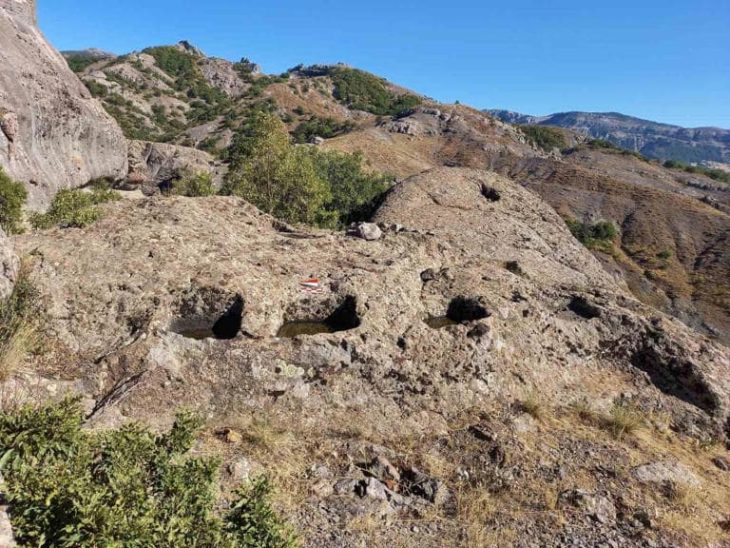
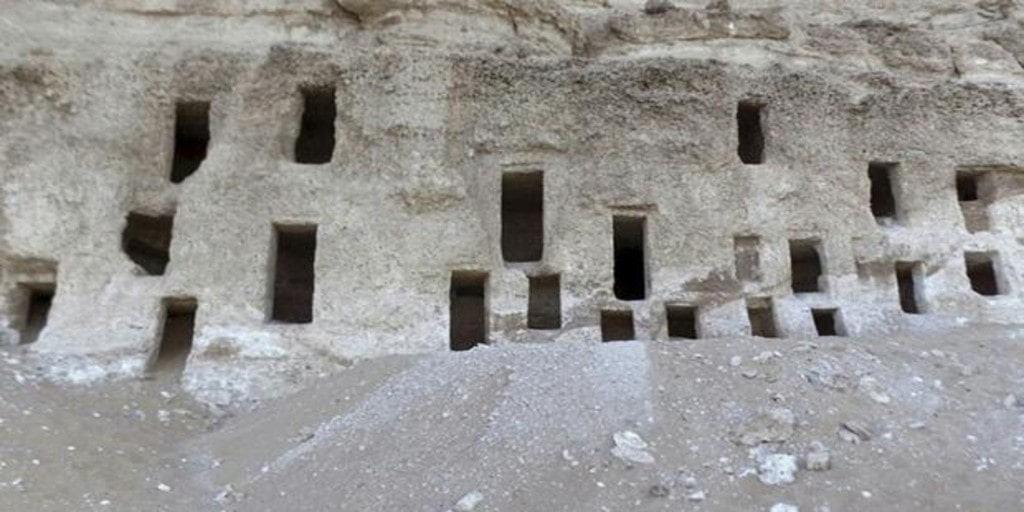
A series of rock tombs carved into the slope of a mountain have been discovered in the Al-Hamidiyah necropolis on the west bank of the Nile in southern Egypt.

Mostafa Waziri, secretary-general of the Supreme Council of Antiquities, said that the tombs have different architectural styles and are dug at several levels in the mountain. They include tombs with one or several burial shafts and some have slope corridors that end with burial shafts. These tombs extend to periods of time ranging from the end of the Old Kingdom to the end of the Ptolemaic period.

He pointed out that among the discovered tombs is a sloping tomb from the end of the Old Kingdom that consists of a false door and an entrance leading to a gallery with a burial shaft in the southeast, which was reused in later times.

These tombs were discovered by chance during the documentation and archaeological record studies in the necropolis.
Al-Hamidiyah necropolis
Al-Hamidiyah Necropolis

The ruins of hieroglyphic text and scenes showing the tomb owner performing rituals and people making offerings to the dead are engraved on the false entrance.


📣 Our WhatsApp channel is now LIVE! Stay up-to-date with the latest news and updates, just click here to follow us on WhatsApp and never miss a thing!!


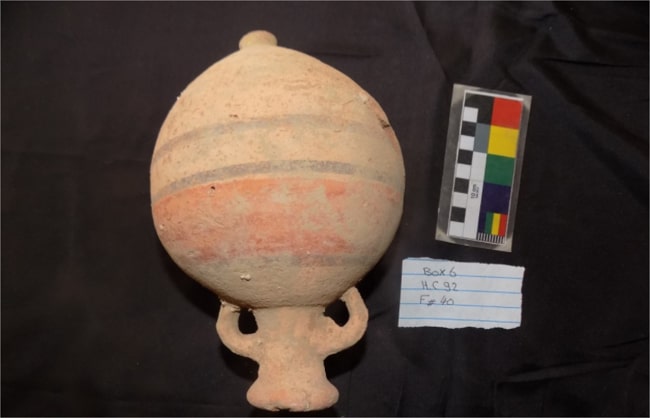
Mohamed Abdel-Badiaa, head of the Central Department of Upper Egypt Antiquities, said that the excavation work in the necropolis also resulted in the discovery of many pottery vessels, some of which were used within daily life and others for funerary purposes as miniature symbolic deposits which are known as “votive miniatures”.

Small size bowls with remnants of yellowish paint on the exterior were discovered, as well as many small-sized alabaster and pottery vessels, the remains of a circular metal mirror, human and animal bones, and several pottery fragments representing Late Period amphorae. There were also inscriptions on limestone that may be funerary plates to tomb owners dating back to the end of the Sixth Dynasty.

Within the framework of the project, more than 300 cemeteries in the area were documented. It stretches from Nag Al-Sheikhs in the south to Al-Kharandariyah in the north.

People buried here are thought to have been elites in the nearby administrative center of Akhmim. It is expected that more graves will be uncovered before the project is completed.

Source: Ahram Online
Related Articles

A large stone monument depicting the goddess Ishtar has been unearthed in the ancient Assyrian city of Nimrud

26 June 2023

26 June 2023

Archaeologists from the University of Pennsylvania Museum of Archeology and Anthropology, working with an Iraqi excavation team, have unearthed a...

A 1,000-year-old burial chariot dating back to the Liao Dynasty, founded by the nomadic Khitan discovered in Inner Mongolia

8 August 2024

8 August 2024

Archaeologists from the Institute of Cultural Relics and Archaeology of the Inner Mongolia Autonomous Region have discovered a hearse from...

Tombs of Queens of Commagene Detected

23 September 2021

23 September 2021

The graves built by Commagene King Mithritades II (36-21 BC) for his mother Isias, his sister Antiokhis, and Antiochis’s daughter...

Archaeological settlements dating back 3000 years found in Qurayat, Oman

2 October 2022

2 October 2022

Archaeological research in Oman’s Qurayat Province has revealed numerous archaeological and historical settlements, some dating back more than 3,000 years...

Archaeologists have unearthed part of Hadrian’s Aqueduct, one of the Largest Hydraulic Works of the 2nd century AD, and Extremely Rare Greek Coins

11 January 2024

11 January 2024

Archaeologists have unearthed part of Hadrian’s aqueduct, one of the largest hydraulic works of the 2nd century AD, and a...

Underneath an Illegal Excavation House, a Subterranean City Is Revealed!

25 June 2021

25 June 2021

Upon the information that illegal excavations were carried out in a house in the İscehisar district of Afyonkarahisar in western...

Carvings at Göbeklitepe could be World’s Oldest Calendar

6 August 2024

6 August 2024

Experts suggest that markings on a stone pillar at the 12,000-year-old Göbeklitepe archaeological site in Türkiye probably represent the oldest...

Bronze Age Wedge Tomb Discovered on the Dingle Peninsula maybe Even Older

22 April 2021

22 April 2021

A wedge tomb recently discovered on the Dingle Peninsula of Ireland was described by archaeologists as “quite unusual”. Wedge tombs...

One of the largest mass burial pits ever discovered in the UK has been unearthed next to Leicester Cathedral

21 November 2024

21 November 2024

While excavating the gardens of Leicester Cathedral for the future construction of a learning center, archaeologists uncovered one of the...

Archaeologists Unearth Prehistoric Fishing Evidence on the Makran Coast of Iran

20 May 2025

20 May 2025

The Makran coast, a historically rich coastal stretch along the Sea of Oman, has once again drawn archaeological attention with...

In French Necropolis 21 Roman “curse tablets” discovered including one written in the extinct Celtic language of Gaulish

18 January 2025

18 January 2025

During the excavation of an eighteenth-century hospital in north-western France by researchers from the Orléans Archaeological Service, a 2,000-year-old necropolis...

3,000-year-old skeletons of nine children were discovered in Qazvin province, Iran

29 April 2023

29 April 2023

Archaeologists from the University of Tehran have discovered the remains of children dating back 3,000 years during excavations in an...

Complex Of Early Neolithic Monuments Discovered In Herefordshire, England

22 July 2023

22 July 2023

Archaeologists discovered a remarkable complex of early Neolithic monuments while investigating the area around Dorstone Hill in Herefordshire, England. The...

King Scorpion’s Legacy: Violence, Divinity, and the Rise of the World’s First Territorial State

30 August 2025

30 August 2025

A barren desert today, the rocky landscape east of Aswan once served as the backdrop for one of history’s most...

In northern Iran, a hand-dug passageway was discovered used for military purposes during the Qajar era

1 August 2021

1 August 2021

A hand-dug underground passage dating from the Qajar era (1794-1925), once believed to have served military purposes, has been discovered...