
8 November 2025 The Future is the Product of the Past

Europe’s Oldest Blue Pigment Found in Stone Age Paint Box

Archaeologists in Germany have uncovered the earliest evidence of blue pigment ever used in Europe, rewriting our understanding of Stone Age color practices. The discovery, published in Antiquity by an international research team led by Aarhus University, reveals that humans living around 14,000 years ago ground and processed azurite, a copper-based mineral, inside a bowl-shaped stone at the riverside site of Mühlheim-Dietesheim near Frankfurt.

Until now, Europe’s Paleolithic art record seemed curiously limited to red, yellow, black, and white pigments. Blue, though widely available in nature, was conspicuously absent. According to the Independent, “virtually all palaeolithic paintings so far discovered in Europe and around the world were created mainly using red, white, yellow and black pigments.” This absence made the new find “a stunning surprise” for archaeologists.

A Stone Age Paint Box Beside the Main River

The artifact—a sandstone piece with a natural concavity—was originally unearthed during excavations in the late 1970s but re-examined with modern techniques only in 2023–2024. Advanced archaeometric analyses, including X-ray fluorescence, Fourier transform infrared spectroscopy, and multiband imaging, confirmed that the microscopic blue traces were not contamination but genuine prehistoric azurite residue.

Lead isotope studies further showed that the mineral likely came from local deposits along the River Main valley, suggesting that late Magdalenian foragers deliberately collected or mined azurite outcrops nearby. Alongside the paint box, excavations also yielded stone tools, arrowheads, and the remains of a circular tent structure, indicating a small family campsite on the riverbank.
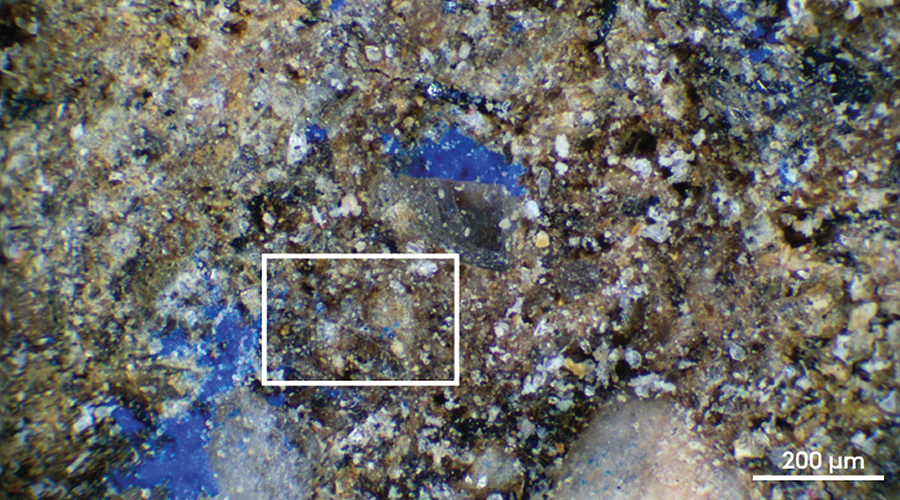

Traces of azurite found on a stone artefact from Mühlheim-Dietesheim mark the earliest use of blue pigment in Europe, likely for body decoration rather than cave art. Credit: Wisher et al. 2025 - Antiquity
Traces of azurite found on a stone artefact from Mühlheim-Dietesheim mark the earliest use of blue pigment in Europe, likely for body decoration rather than cave art. Credit: Wisher et al. 2025 – Antiquity

Why Blue Matters

Blue’s rarity in Paleolithic art has long puzzled researchers. Ochres and charcoals were abundant, while azurite was rarer and harder to process. Yet, as the Independent notes, “minerals for making blue pigments are rarer than sources for other primary colours.” This scarcity may have imbued the color with symbolic or protective power. Across many cultures, blue has been linked with the divine and believed to ward off evil spirits.


📣 Our WhatsApp channel is now LIVE! Stay up-to-date with the latest news and updates, just click here to follow us on WhatsApp and never miss a thing!!


The scientific team suggests that instead of painting cave walls, early Europeans may have reserved blue for ephemeral or personal uses—body painting, decorating clothing, or adorning ritual objects. Such uses would leave little archaeological trace, explaining why Europe’s cave art corpus lacks blue even though the mineral was available.

Comparable cases are slowly emerging elsewhere. A 2017 study revealed blue-painted Siberian figurines, while a 2024 paper documented plant processing in Georgia possibly linked to blue pigment manufacture some 33,000 years ago. Together, these findings hint that prehistoric societies experimented more widely with color than previously recognized.

Rethinking Prehistoric Aesthetics

Dr. Izzy Wisher, lead author of the Antiquity study, emphasizes that this is “only the tip of a prehistoric colour iceberg.” She explained that new atomic and molecular techniques now make it possible to detect faint, previously invisible pigments. As she told the Independent: “Our discovery of blue pigment is likely to be just the tip… we hope to eventually reveal the Stone Age world in full colour.”

The implications extend beyond art history. Pigment use is often seen as a marker of symbolic thought and cognitive complexity in early humans. The deliberate selection of azurite suggests that Final Palaeolithic communities were not only technologically adept but also engaged in subtle aesthetic and ritual behaviors that go far beyond the famous cave paintings of Lascaux or Altamira.

Europe’s First Glimpse of Blue

For now, the modest sandstone “palette” from Mühlheim-Dietesheim stands as Europe’s oldest known example of blue pigment. It challenges archaeologists to look again at overlooked artifacts in museum drawers, where similar residues may still be hiding.

The discovery highlights how new science can transform old finds. Half a century ago, the artifact was catalogued as a possible lamp. Today, thanks to advances in archaeometry, it illuminates something else entirely: the lost colors of Europe’s deep past.

Wisher, I., Birch, T., Andreasen, R., Canosa, E., Norrehed, S., Reguer, S., … Riede, F. (2025). The earliest evidence of blue pigment use in Europe. Antiquity, 1–16. doi:10.15184/aqy.2025.10184

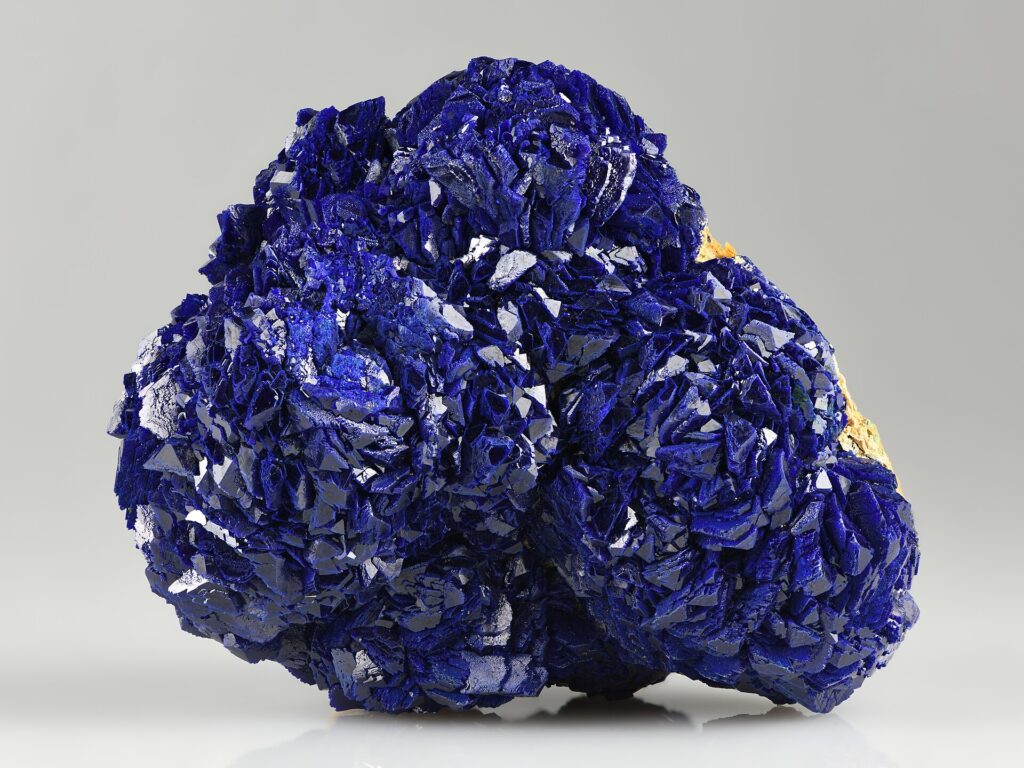
Cover Image Credit: A photo of the azurite mineral, as found in nature. Wikimedia Commons

Related Articles

Three-Year-Old Discovers 3,800-Year-Old Canaanite Seal at Archaeological Site of Tel Azekah

2 April 2025

2 April 2025

At the site of the famous battle between David and Goliath, a three-year-old girl named Ziv Nitzan discovered a scarab-shaped...

Rare gold gifts 2300 years old discovered in the famous Phoenician city of Carthage

17 August 2023

17 August 2023

Archaeologists excavating the sanctuary of Tophet, Carthage uncovered a collection of offerings, Tunisia’s Ministry of Cultural Affairs announced in a...

42,000-year-old Shell Jewellery Workshop Discovered – The Oldest in Western Europe

27 September 2025

27 September 2025

Archaeologists have made a groundbreaking discovery in Saint-Césaire, Charente-Maritime, uncovering what is now considered the oldest shell jewellery workshop in...

‘Incredibly Rare’ Roman Mausoleum Unearthed Near London Bridge Station

13 June 2023

13 June 2023

Archaeologists report discovering an “incredibly rare” and featured preserved floors and walls Roman mausoleum near London Bridge Station, UK. Archaeologists...

Archaeologists Uncovered a 1,600-Year-Old Rare Mikveh and Synagogue in Ostia Antica, Near Rome

13 March 2025

13 March 2025

In a remarkable archaeological discovery, researchers have unearthed a 1,600-year-old rare mikveh (ritual bath) and an ancient synagogue at the...

Marvelous Marble Floor Of Sunken Roman Villa Restored in Bacoli

19 July 2024

19 July 2024

In Bacoli, Italy, an underwater restoration project has uncovered the marvelous marble floor of a submerged Roman villa. This remarkable...

4,500-Year-Old ‘Gifted Graves’ Unearthed at Ikiztepe Mound in Northern Türkiye

25 October 2025

25 October 2025

Archaeologists working at the prehistoric site of Ikiztepe Mound in northern Türkiye have uncovered two extraordinary burials — one belonging...

Ushabti figurines on display at Izmir Archeology Museum

18 September 2021

18 September 2021

The 2,700-year-old “Ushabti” statuettes, discovered in archaeological digs in western Turkey and used in Egyptian burial ceremonies, are being shown...

Mysterious 1,600-Year-Old Roman-Era Burial Unearthed in Delbrück-Bentfeld, Germany

15 June 2025

15 June 2025

Archaeologists have uncovered a rare and mysterious Roman-era burial in Delbrück-Bentfeld, Germany, revealing a unique glimpse into the region’s ancient...

Viking Tomb Discovery in Denmark May Reveal Elite Family Linked to King Harald Bluetooth

20 June 2025

20 June 2025

A stunning archaeological discovery near Aarhus, Denmark, has revealed 30 Viking Age graves that may belong to a powerful aristocratic...

Europe’s earliest cities had a predominantly vegetarian diet

27 December 2023

27 December 2023

The population of the Copper Age mega-sites in what is now Ukraine and Moldova had a predominantly vegetarian diet. In...

Archaeologists find a 5,000-year-old piece of wood in Orkney, which they describe as “astonishing”

10 August 2021

10 August 2021

Archaeologists continue to make surprising discoveries in Orkney. Although organic materials are quite difficult to find, archaeologists have found a...

4,900-year-old Copper Age Fortress with a Violent Past and Odd Roman Burial Found in Spain

13 February 2025

13 February 2025

A remarkable 4,900-year-old Copper Age fortress, featuring a pentagon shape, three concentric walls, 25 bastions, and three ditches, has been...

The Headless Corpses of Somersham was Victims of Roman Executions

30 May 2021

30 May 2021

Excavations at Knobb’s Farm in Somersham, Cambridgeshire, unearthed three small late Roman graves on the outskirts of an agricultural village....

Italian Research Team May Have Found Plato’s Burial Site in Athens

23 April 2024

23 April 2024

Graziano Ranocchia, a papyrologist at the University of Pisa, said he found Plato’s exact burial place based on papyri findings...