23 January 2026 The Future is the Product of the Past

An unexpected shipwreck was unearthed at the Tallinn construction site

During the construction of the office building on Lootsi Street in Tallinn, Estonia’s capital on the Baltic Sea, a shipwreck was found underground, exceeding the size of any wreck previously excavated here.

The surprise didn’t stop there; Construction at Lootsi 8 began with the knowledge of a shipwreck on the property that wouldn’t be affected by planned work, however, an unexpected second wreck was unearthed as well, and it may be one of the best-preserved in the region.

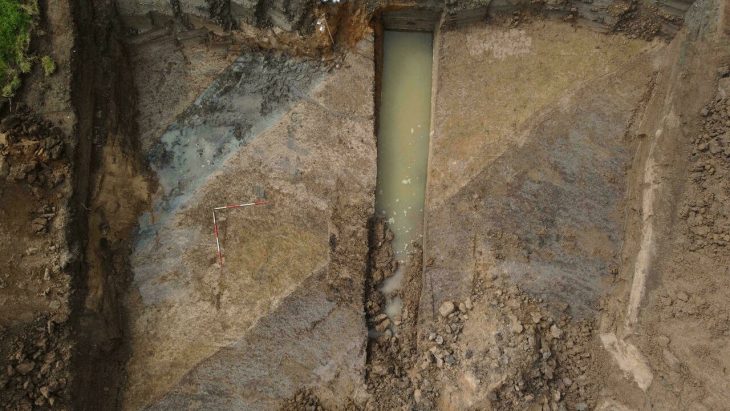
The wreck was found at the mouth of the Härjapea River. The wreck was measured to be 24.5 meters long by 9.5 meters wide, and experts hope to unearth it in as large of pieces as possible.

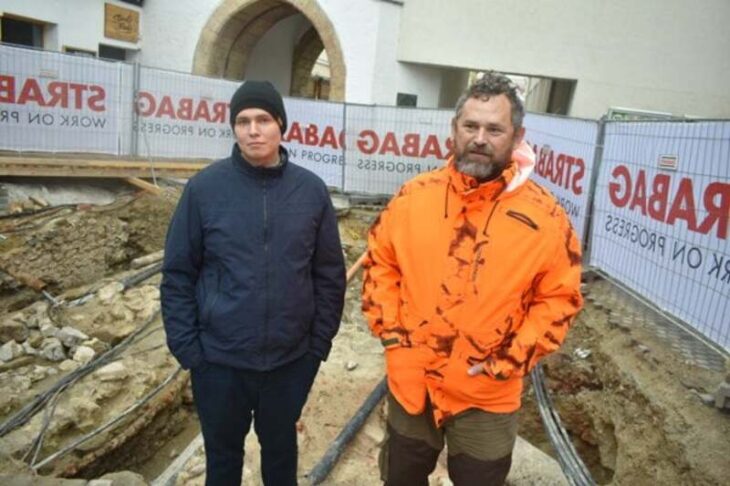
“We have another 13th-century wreck on our property whose location is known, but the second one came completely unexpectedly,” said EHC Lootsi representative Tarmo Mill.

Ragnar Nurk, an archaeologist in Tallinn City Planning Board’s Department of Heritage Conservation, said the previously known wreck was three to four meters deep, but the newly found wreckage was much closer to the ground, about one and a half meters deep.


📣 Our WhatsApp channel is now LIVE! Stay up-to-date with the latest news and updates, just click here to follow us on WhatsApp and never miss a thing!!
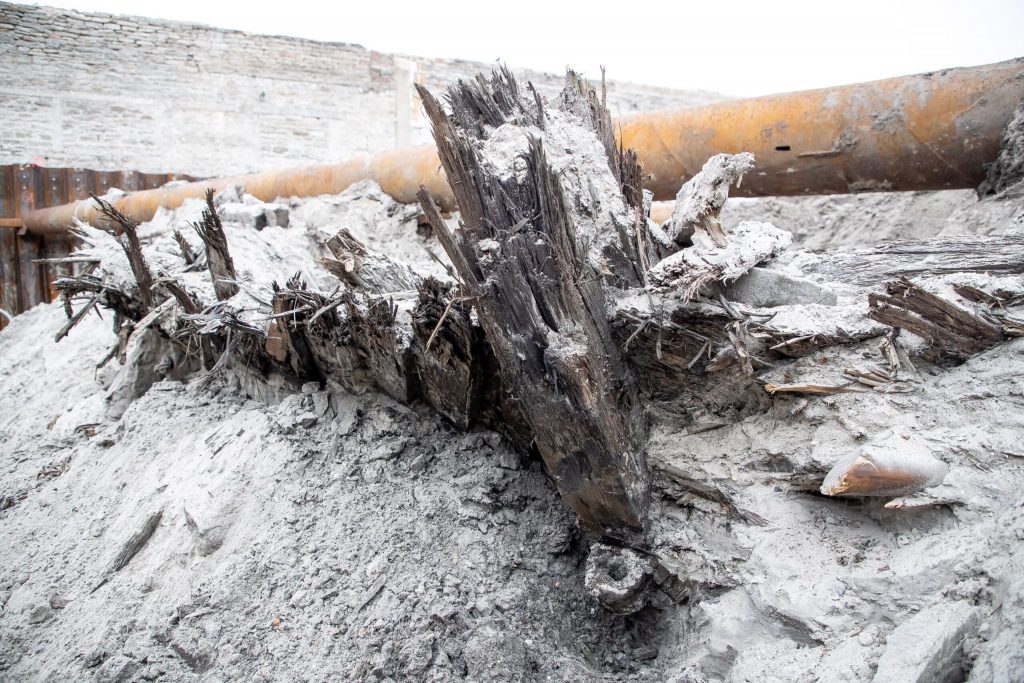


 Shipwrecks were found at Lootsi 8 construction site in Tallinn. Photo: Scanpix
Shipwrecks were found at Lootsi 8 construction site in Tallinn. Photo: Scanpix

Although the site is 200 meters (ca. 220 yards) from the water today, for centuries it was a port. In the late 1930s, the area was infilled with ash and household refuse. It’s not clear if the ships sank there are were gradually buried over time by siltification, or if they were deliberately sunk after reaching the end of their natural lives.

Archaeologist Mihkel Tammet, who led the excavations at OÜ Muinasprojekt, thinks that next Thursday the debris will be cleared, the water will be pumped out and all details of the wreck can be seen.

According to Estonian Maritime Museum Priit Lätti, initial dendroanalyses indicated that the recently discovered wreck may date back to the late 13th or early 14th century, an estimate which is being increasingly supported as more details are unearthed, but that further analysis would be necessary to confirm the dating.

According to Tammet, “Definitely one of the best-preserved shipwrecks ever found.”
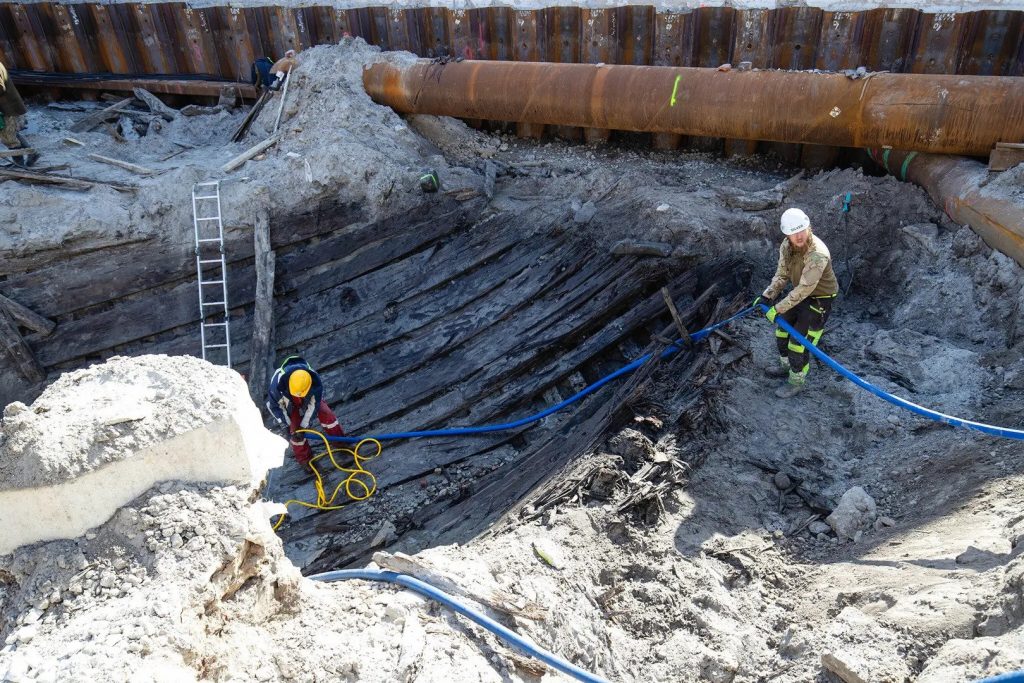
An unexpected shipwreck was unearthed by construction work at Lootsi 8 in Tallinn's Sadama neighborhood, near the Port of Tallinn.  Photo: Patrik Tamm/ERR
An unexpected shipwreck was unearthed by construction work at Lootsi 8 in Tallinn’s Sadama neighborhood, near the Port of Tallinn. Photo: Patrik Tamm/ERR

Finding the wreckage brought some controversy. Heritage conservationists have suggested that the overall goal might be to get the wreckage underground as much as possible.

“We will do everything we can to get these wreck out of the ground, but what’s sad is that the state’s contribution to preserving our common heritage is nonexistent,” said EHC Lootsi representative Tarmo Mill, stressing that the wreck doesn’t belong to the company and the state should support its excavation.

Small interesting finds were also found from the wreckage. One of the interesting finds is a mallet. It is a tool made of pigskin, used by sailors to tie the ends of a rope.

Postimees

Related Articles

Unveiling the Secrets of the “Air-Dried Chaplain”: A Unique Mummification Method Discovered in Austria

4 May 2025

4 May 2025

Researchers investigating a remarkably well-preserved mummy discovered in the church crypt of St. Thomas am Blasenstein, a small village in...

New Study Exposes Origins of Welsh Dragons

7 June 2024

7 June 2024

In a new study conducted by a team from the University of Bristol and published in the Proceedings of the...

Ancient tombs discovered at Paris’ Notre-Dame Cathedral

15 March 2022

15 March 2022

Archaeologists discovered several graves and a leaden sarcophagus possibly dating from the 14th century at Paris’ Notre Dame church, France’s...

Europe’s First Toolmakers Were Innovators — Not Imitators, New Study Reveals

17 October 2025

17 October 2025

Europe’s first toolmakers developed their own stone technology 42,000 years ago, according to a new study that challenges the idea...

According to new research, medieval warhorses were shockingly diminutive in height

12 January 2022

12 January 2022

Medieval warhorses are often depicted as massive and powerful beasts, but in reality, many were no more than pony-sized by...

Medieval Moat and Bridge Discovered Protecting Farmhouse in England

14 March 2024

14 March 2024

Cotswold Archaeology’s excavations in Tewkesbury, a historic riverside town north of Gloucestershire, England, have revealed a medieval moat and bridge...

Two Durham Archaeology Students, One from Türkiye, Earn Prestigious Awards for Research on Ancient Lycia

26 July 2025

26 July 2025

In a remarkable achievement for Anatolian studies, two Durham University-affiliated archaeology students have received prestigious awards for their research on...

The Old Fisherman Founded the Turkish Sea Creatures Museum

26 March 2021

26 March 2021

The sea gives another life to man, sometimes love, sometimes a disappointment, often a longing. The sea is reminiscent of...

Southeast Asia’s oldest stringed instrument may be a 2,000-year-old antler

21 February 2023

21 February 2023

Archaeologists unearth a 2,000-year-old stringed instrument made from deer antler in southern Vietnam. This unusual deer antler may be one...

From Justinian’s Glory to Ruin: The Last Stand of Montenegro Triconch Church

10 August 2025

10 August 2025

In the heart of Bar, just off the bustling Ulica Maršala Tita, lie the weathered remains of the Triconch Church...

Using Algorithms, Researchers Reassemble Jewish Text Lost Centuries Ago

27 January 2022

27 January 2022

Using new technology, researchers were able to comb a 19th-century text for the original study of a Bible interpretation attributed...

A Fig Dating Back Over 2,000 Years has been Discovered in North Dublin – A First of Its Kind for Ireland

28 November 2024

28 November 2024

The discovery of a fig dating back 2,000 years during an archaeological excavation of Drumanagh in north Dublin, has been...

Hornelund Brooches: Exquisite Viking Gold Ornaments with Norse and Christian Symbolism Unearthed in Denmark

5 August 2025

5 August 2025

The Hornelund Brooches are rare and captivating examples of Viking Age goldsmithing, discovered in southwestern Jutland, Denmark. These two intricately...

Nineteen Ancient Tombs from the 4th Century BC Unearthed in Padula, Campania

8 February 2025

8 February 2025

In Padula, located in the Campania region of southern Italy, authorities announced the remarkable discovery of nineteen ancient tombs during...

Iron Age Children’s a Unique Funerary Building Discovered in Oman

3 March 2024

3 March 2024

Archaeologists have uncovered a unique Iron Age children’s funerary building at the Manaqi archaeological site in Rustaq, South Al Batinah...