9 December 2025 The Future is the Product of the Past

The Half of the Rare Oil Lamp Found in Jerusalem May be in Budapest

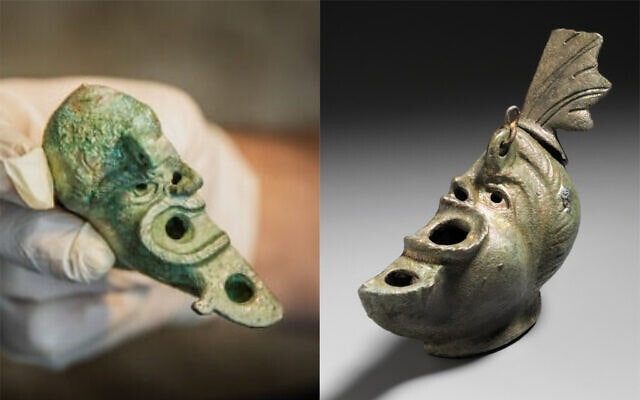
We had recently reported on a grotesque lamp found in Jerusalem. The other half of the oil lamp, which is in the shape of a half-face, may have been found.

A 2,000-year-old oil lamp shaped like half of a  grotesque face discovered in Jerusalem last week seems to have a mate, which was discovered nine years ago in Budapest.

The Israel Antiquities Authority announced last week that the lamp, dated to date from the late first or early second centuries CE, was the first of its kind discovered in Israel and one of only a few worldwide.

According to Jerusalem’s City of David archeological site, after the announcement of the find, Hungarian archeologist Dr. Gabor Lassanyi reached out to say that he may be in possession of the other half, which was uncovered during a 2012 excavation in Budapest.

“In an excavation, we conducted at Aquincum (modern-day Budapest), we found a remarkably rare object: at the bottom of the building, we discovered a bronze half-lamp depicting the right half of a face shaped like a Roman theater mask,” Lassanyi wrote to Ari Levy, the head of the Jerusalem excavation.


📣 Our WhatsApp channel is now LIVE! Stay up-to-date with the latest news and updates, just click here to follow us on WhatsApp and never miss a thing!!
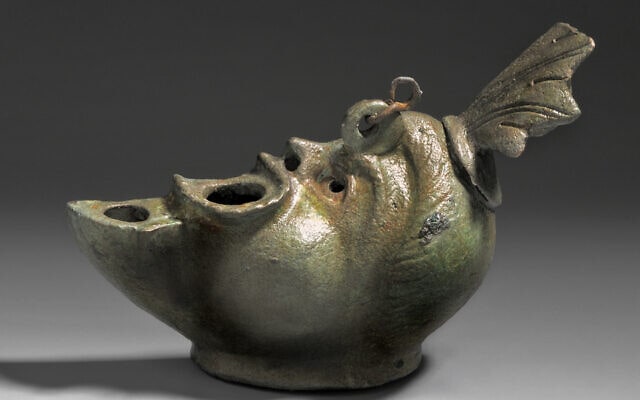


A bronze oil lamp discovered in Budapest

A bronze oil lamp discovered in Budapest in 2012 matched one found in Jerusalem’s City of David in May 2021. (Ágnes Bakos/Bence Tihanyi)

According to Lassanyi, “Only a few known creations that resemble this exist from this time period, and they sit in museums and throughout private collections in the world, yet none of them are like these two halves.  It is very difficult to craft in such an accurate way, and therefore, it is likely that the two halves of the lamps were created in the same artisan house and may even have served as a pair to one complete piece.”

The lamp found in Jerusalem is on the left-hand side of a face, while the Budapest lamp is on the right-hand side.

Lassanyi and Levy discovered that the two lamps’ halves were identical in size when they first examined them. Furthermore, the lamp discovered in Hungary has a depressed connecting slot, while the lamp discovered in Israel has a protruding ridge, suggesting that they may be related.

According to a statement from the City of David, Israeli archeologists are currently exploring different options to determine if the two lamps are actually a similar pair, including the prospect of printing a three-dimensional model of the lamp in Israel and sending it to Hungary for researchers to try to link the two halves.

Source: The Times of Israel

Related Articles

Oldest footprints of pre-humans identified in Crete

11 October 2021

11 October 2021

Six million-year-old fossilized footprints on the island show the human foot had begun to develop. The oldest known footprints of...

Evidence of a 1500-year-old Byzantine church found on the beach of Ashdod, Israel

22 February 2022

22 February 2022

Recent rain in Israel has unearthed the remains of a marble pillar dating to around 1,500 years ago on a...

Assyrian seal found in the ancient Kef Fortress built by the Urartians

18 November 2024

18 November 2024

An alabaster seal, believed to be from the Assyrian Empire and belonging to a nobleman, was discovered in the ancient...

8000 years old fingerprint and ceramic production workshop found in İzmir Ulucak Mound

22 August 2022

22 August 2022

It was understood that the structure unearthed during the ongoing excavations in the 8850-year-old Ulucak Mound (Ulucak Höyük), the oldest...

Turkish researchers use Artificial Intelligence to read cuneatic Hittite tablets

9 January 2023

9 January 2023

Thanks to a project implemented in Türkiye, 1,954 ancient Hittite tablets are being read for the first time using artificial...

12,000-Year-Old Grid-Plan Structures and Water Channel Discovered at Çayönü Mound

29 July 2025

29 July 2025

New Neolithic-era discoveries at Çayönü in southeastern Türkiye, dating back to approximately 10,200–6,500 BCE, include four grid-plan buildings and a...

Scientists Create a 3D Model of Lost Temple Relief from a 134-Year-Old Photo Using AI

13 November 2024

13 November 2024

The researchers developed a neural network that can take a single 2D photo of a three-dimensional object and produce a...

In Medieval burial ground, a rare embroidered Deisis depicting Jesus Christ was discovered

26 February 2023

26 February 2023

Russian archaeologists have uncovered a rare embroidered Deisis depicting Jesus Christ in a medieval burial ground. 46 graves have been...

6,000 Years of Human History Unearthed in Brittany: From Stone Age Villages to Roman Farms

25 October 2025

25 October 2025

A large-scale archaeological excavation in the heart of Brittany has unveiled more than six thousand years of continuous human occupation,...

“Unprecedented” Phoenician necropolis found in southern Spain

28 April 2022

28 April 2022

A 4th or 5th-century B.C Phoenician necropolis has been found at Osuna in Southern Spain. A well-preserved underground limestone vault...

An 8500-year-old wooden ladder remain was discovered at Çatalhöyük

12 April 2022

12 April 2022

Remains of the wooden ladder were discovered for the first time in Çatalhöyük, one of the best-preserved Neolithic settlements in...

Researchers may have found the wreck of British explorer James Cook’s Endeavour

3 February 2022

3 February 2022

The wreck of Captain James Cook’s famed vessel the Endeavour has been found off the coast of the U.S. state...

The Lost Troy of Roman Britain: How a Chance Discovery in Rutland Unlocked an Ancient Story Forgotten for 1,500 Years

7 December 2025

7 December 2025

A lost Aeschylean version of the Trojan War emerges from the Rutland mosaic, revealing Roman Britain’s surprising cultural ties to...

When the waters receded, the mounds of Pulur Sakyol and Yeniköy, bearing the traces of Kura-Aras Culture, came to light

8 December 2021

8 December 2021

The important cultural areas of Pulur Sakyol and Yeniköy mounds, which bear the traces of Kura-Aras Culture, represented by kurgans...

“They Depicted Lake İznik as an Ancient Woman”: Newly Unearthed Roman Mosaic in İznik

21 November 2025

21 November 2025

An extraordinary archaeological discovery in the town of İznik, Türkiye, is reshaping modern understanding of Roman art and regional mythology....