
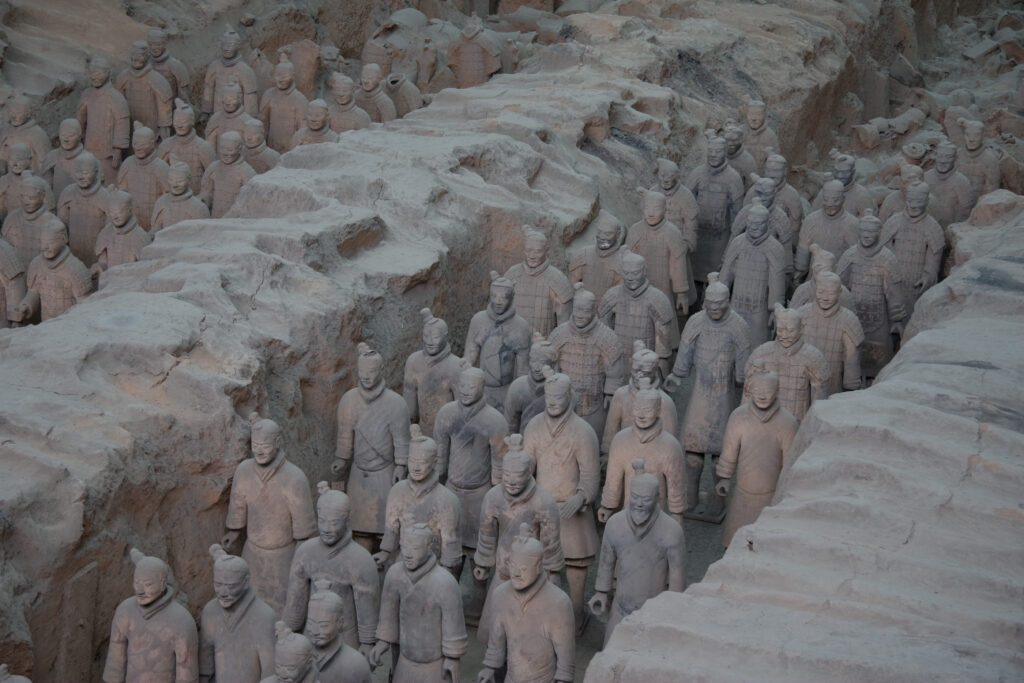
Fingerprints preserved on China’s 2,200-year-old Terracotta Warriors suggest that women and children may have worked alongside adult men to create the famous army, challenging long-standing assumptions about who produced one of the world’s most remarkable archaeological monuments.
For more than two millennia, the clay soldiers guarding the tomb of China’s first emperor have preserved traces of the people who made them. Some of those traces are fingerprints, accidentally pressed into wet clay as ancient workers shaped and assembled the figures. Now, a new scientific study suggests that the enormous workforce behind the Terracotta Army may have included women and children, not just adult men.
Researchers examined 79 well-preserved fingerprints on 36 terracotta soldiers from Unit T23 in Pit 1 of Emperor Qin Shi Huang’s mausoleum. Their statistical analysis suggests that approximately 45% of the fingerprints came from adult men, 32.7% from adult women, and 22.3% from individuals younger than 15. Although these figures do not represent the actual proportions of workers, they raise important questions about how the Qin Empire organised labour for its most ambitious burial project.
The research, published in the Journal of Cultural Heritage, was conducted by Xiaoxi Li and colleagues using a statistical technique known as a Bayesian mixture model. The findings provide new biological evidence suggesting that the people who manufactured the Terracotta Army came from a more diverse workforce than scholars traditionally assumed.
An Army Built to Guard China’s First Emperor
The Terracotta Army formed part of the vast funerary complex of Qin Shi Huang, the emperor who unified China in 221 BCE. Construction of his mausoleum began in 246 BCE, long before his death in 210 BCE, and mobilised enormous quantities of materials and labour. The thousands of life-sized clay soldiers, horses, and chariots were intended to protect and serve the emperor in the afterlife.
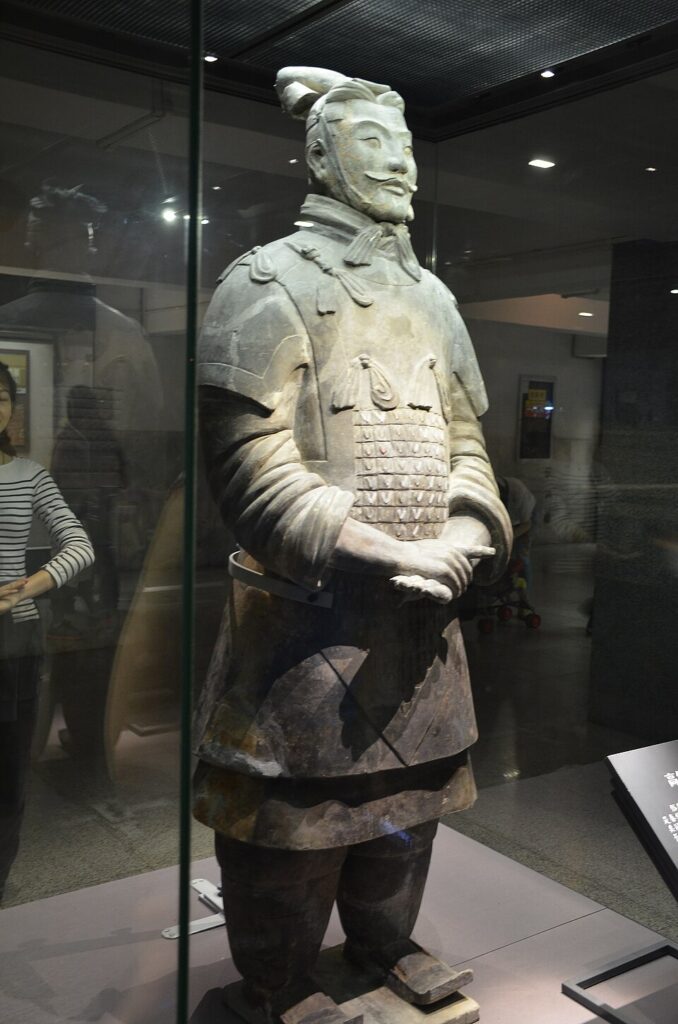
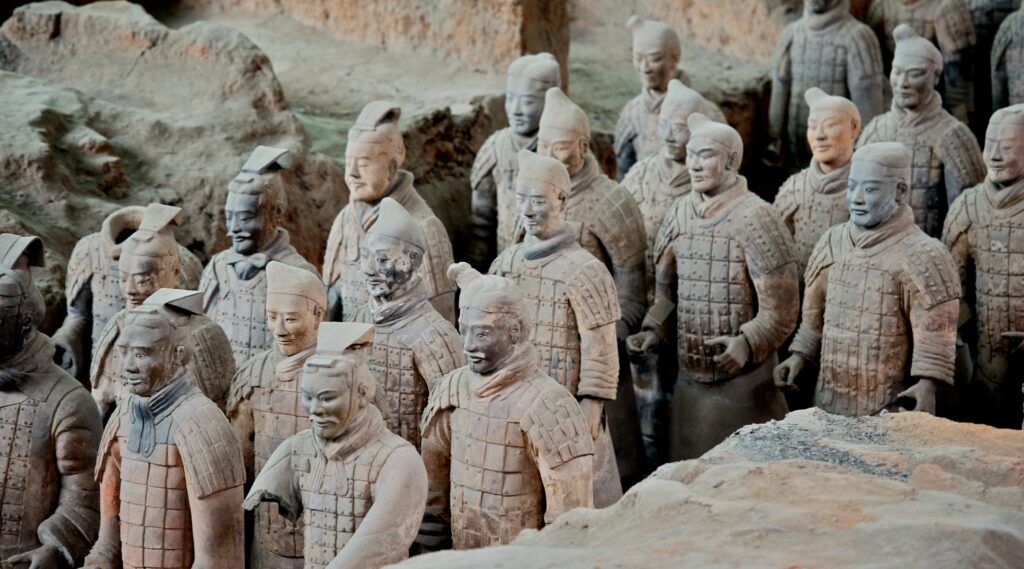
Discovered near Xi’an in 1974, the army remains one of China’s most celebrated archaeological discoveries. Its soldiers display distinctive facial features, hairstyles, armour, and military equipment, reflecting the remarkable skills of the craftspeople who created them. Yet despite decades of excavation and research, archaeologists still know relatively little about the individuals who shaped the figures.
Previous studies have revealed a sophisticated production system involving different workshops, specialised tasks, and carefully organised supplies. Some researchers proposed that workshops mass-produced separate body parts before assembling them, while others argued that individual workshops manufactured complete figures.
Chemical analyses of the clay associated with the inscriptions “Gong” and “Xianyang” have also revealed compositional differences consistent with production in separate workshops, providing further evidence that multiple teams contributed to the emperor’s vast terracotta army.
Ancient Fingerprints Challenge Traditional Assumptions
The new research approaches that question through marks left by human hands rather than workshop inscriptions or historical accounts. As workers handled soft clay, their fingers sometimes pressed against its surface, leaving impressions that survived the firing process. Those marks preserve physical characteristics that researchers can examine more than 2,000 years later.
The researchers analysed the average breadth of fingerprint ridges, a measurement that can help estimate age and sex at a population level. Fingerprint ridges generally change in size during physical development, although considerable overlap exists between different demographic groups.
Earlier studies often relied on two measurements: ridge breadth and ridge density, or the number of ridges within a given distance. The problem is that these are not independent characteristics. Wider ridges naturally mean fewer ridges within the same space, so treating both measurements as separate evidence can introduce statistical errors and create misleading confidence in the results.
To address this problem, the researchers used a Bayesian mixture model that considers the underlying relationship between fingerprint measurements and estimates the demographic composition of the entire sample. The method also accounts for uncertainty arising from similarities between groups, particularly adult women and adolescent boys, whose fingerprints can share comparable characteristics.
Rather than identifying the person behind each fingerprint, the analysis provides a statistical picture of the population that may have left the impressions. Its results suggest that the Terracotta Army’s production involved a broader range of people than the traditionally imagined workforce of adult male craftsmen.
Qin Records Also Mention Women and Young Craftspeople
The suggestion that women and children participated in imperial manufacturing does not emerge entirely without historical precedent. Qin-period inscriptions on lacquerware contain references to adult women, young girls, and young boys who participated in craft production under state supervision. These records indicate that the empire could draw on labour from different age and sex groups.
The inscriptions use terms including da nüzi (adult woman), xiao nüzi (young girl), and xiao nanzi (young boy). Although these references concern lacquerware rather than terracotta sculpture, they offer an important parallel to the new fingerprint evidence. Women and younger workers already had documented roles in at least some branches of Qin craft production.
The new findings suggest that a similar arrangement may have existed in the workshops supplying the emperor’s mausoleum. They also invite further investigation into how ancient authorities distributed tasks among experienced artisans, younger workers, and people with different skills.
If women and children worked in these imperial workshops, their daily experiences remain largely unknown. They may have shaped clay, assembled parts of the figures, or carried out other tasks, but the surviving fingerprints offer few clues about how they spent their working days or the conditions under which they laboured.
How Certain Are the Fingerprint Results?
Despite their significance, the findings require careful interpretation. The researchers stress that the percentages describe the estimated distribution of fingerprints, not the proportion of individual workers employed in the workshops. One person could have left several impressions, while others may have left no identifiable traces.
Another limitation concerns the reference data used to estimate age and sex. The Bayesian model draws on measurements from modern European populations, whose fingerprint characteristics may differ from those of people living in Qin-era China. The researchers acknowledge that this could lead to an overestimation of female and juvenile representation.
The investigation also focuses on a limited group of figures from one excavation unit rather than the entire Terracotta Army. Consequently, the results cannot establish the demographic composition of every workshop involved in the massive imperial project.
Even with these uncertainties, the fingerprints add a new source of evidence to a long-standing archaeological debate. Qin-period lacquerware inscriptions already show that women and young people participated in state-supervised craft production, while the new analysis suggests that their involvement may have extended to the emperor’s terracotta soldiers.
Li, X., Shen, J., Lan, D., Wang, J., Yu, Y., Cai, J., Xia, Y., & Zhou, P. (2026). Who produced Emperor Qin Shihuang’s Terracotta Army, China? A Bayesian mixture model approach to fingerprint age and sex determination. Journal of Cultural Heritage, 82, 274–281. https://doi.org/10.1016/j.culher.2026.09.014
