
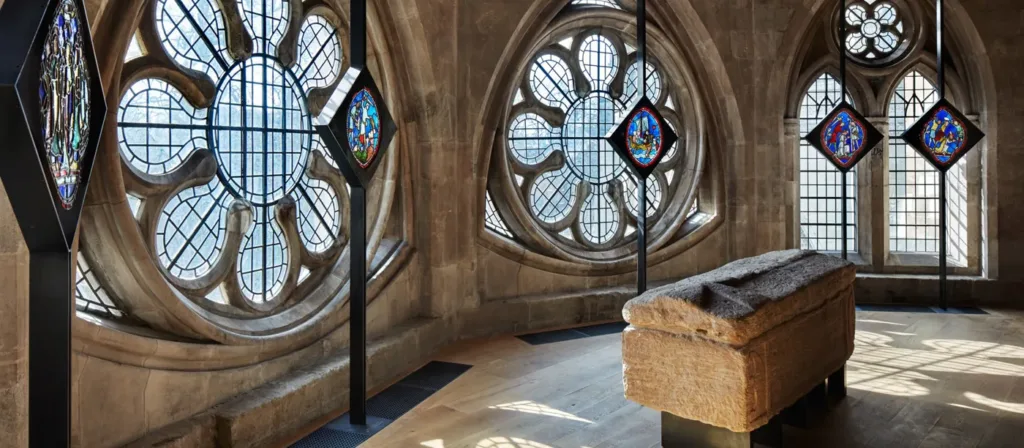
A Roman sarcophagus discovered at Westminster Abbey more than 150 years ago may contain the remains of an Anglo-Saxon abbot who died around 1,000 years ago. New research points to two possible candidates, Ælfwig and Wulnoth, both of whom led the monastery during the 11th century. The findings offer a possible answer to a longstanding mystery and reveal how an ancient Roman coffin came to be used for a prominent medieval burial.
The mystery begins with a name carved into stone. When archaeologists examined the limestone sarcophagus at Westminster Abbey in 1869, they found an inscription commemorating Valerius Amandinus, a wealthy resident of Roman London who lived during the fourth century AD. But the coffin’s lid told a different story. A large Christian cross had been carved onto its surface centuries later, suggesting that the sarcophagus had been reused long after its original owner died.
The question of who was buried inside remained unanswered for generations. Now, Professor Warwick Rodwell, Westminster Abbey’s consultant archaeologist, has brought together evidence from the skeleton, the coffin, and the abbey’s history to identify two men who may have occupied the Roman sarcophagus. His findings appear in the Journal of the British Archaeological Association.
Two Anglo-Saxon Abbots Emerge as Possible Candidates
The first candidate is Ælfwig, who became abbot of Westminster in 993 and died around 1020. At the time, Westminster was a Benedictine monastery, long before the present Gothic abbey was built. Ælfwig had already been a member of its religious community before taking charge, a detail that Rodwell considers significant.
The second possibility is Wulnoth, Ælfwig’s successor, who died in 1049. Both men are believed to have been buried at Westminster, and the available evidence places them within the period when the Roman coffin was reused.
Rodwell explains that either man could fit the estimated age of the skeleton. Their birth dates are unknown, but both could have become abbots in their early twenties and died around the age of fifty. Ælfwig’s earlier connection to the monastery gives him a slight advantage, although there is no decisive evidence linking either man to the burial.
The care taken over the funeral offers another clue. Rather than being buried in an ordinary grave, the deceased was placed inside a wooden coffin, which was then enclosed within an elaborate Roman sarcophagus. Its lid was adapted with a prominent Christian cross, suggesting that the burial was intended for someone of considerable importance.
A Skeleton That Was Thought to Have Disappeared
The sarcophagus had already experienced a complicated history by the time archaeologists began studying it. Workers first encountered the stone coffin in 1820 while carrying out construction work on the abbey grounds. During that discovery, they broke its lid into six pieces, although the damage was later repaired.
The sarcophagus was formally excavated in 1869, but uncertainty surrounding the fate of its contents continued for more than a century. At one point, researchers believed the skeleton had been lost.
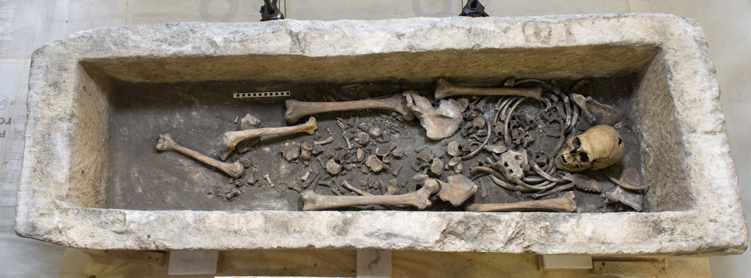
That assumption proved mistaken in 2016. When conservators opened the sarcophagus for a detailed examination, they discovered that an almost complete skeleton was still lying inside. The find gave researchers an opportunity to reconsider both the identity of the deceased and the circumstances of the burial.
James Young Langthorne, a human bone specialist with Pre-Construct Archaeology, examined the remains and determined that they belonged to a man who died between the ages of 35 and 49. He was approximately 1.75 meters tall, somewhat taller and considerably older than nineteenth-century researchers had estimated.
The most important evidence came from radiocarbon dating. A sample of bone was analyzed at the Scottish Universities Environmental Research Centre, producing a date range of AD 987–1052. The result confirmed that the man had lived in Anglo-Saxon England, roughly seven centuries after the Roman sarcophagus was made.
The Wooden Coffin That Left a Trace Behind
The researchers also discovered something unexpected inside the stone coffin. Although the original wooden burial container had completely disappeared, a rectangular outline was still visible against the interior of the sarcophagus.
The outline consisted of white residue left by lime, which had been placed over the body during burial. According to Rodwell, its shape indicates that the deceased had first been laid in a wooden coffin before being placed inside the larger stone sarcophagus.
Over the centuries, the timber decayed, but the lime preserved the impression of its former position. The surviving outline gives archaeologists a rare glimpse of a burial arrangement that would otherwise have left little evidence.
The finding also helps explain why the Roman sarcophagus was chosen. Its original inscription was left intact, but the medieval burial was given a new Christian identity through the cross carved onto the lid. An object made to commemorate a Roman citizen had become the resting place of someone important to Westminster’s early religious community.
A Burial Moved During the Rebuilding of Westminster Abbey
The sarcophagus did not remain in its original medieval burial place. Rodwell believes it was first installed in the eastern part of the Anglo-Saxon abbey church, with the stone coffin buried beneath the floor. Its cross-carved lid would have served as a visible grave marker.
That arrangement changed when King Henry III began rebuilding Westminster Abbey in the 1240s. The project transformed the medieval church and required the relocation of several earlier burials. Rodwell argues that the Roman sarcophagus was among those moved during this period.
Around 1258, the coffin was reburied in the courtyard of the newly constructed sacristy on the abbey’s northern side. It remained there for centuries, eventually coming to the attention of workers in 1820 and archaeologists in 1869.
The sequence reveals how the same stone coffin served different purposes over a remarkably long period. First made for a Roman citizen, it was later adapted for an Anglo-Saxon religious figure and eventually moved again as Westminster Abbey underwent major architectural changes.
An Ancient Mystery With Two Possible Answers
Recent investigations around Westminster Abbey have helped researchers better understand the setting in which the sarcophagus was discovered. Channel 4’s Time Team examined the historic sacristy in 2009, while Pre-Construct Archaeology completed further excavations in 2025 ahead of the construction of the King Charles III Sacristy.
Those investigations, together with the examination of the skeleton and earlier historical records, have allowed Rodwell to reconstruct much of the coffin’s history. Yet one question remains open: whether the man inside was Ælfwig or Wulnoth.
Both men fit the available evidence, and neither can currently be identified with certainty. Rodwell favors Ælfwig, but the absence of a surviving name or other direct evidence means the identification remains a historical interpretation rather than a confirmed result.
The sarcophagus is now displayed in Westminster Abbey’s Queen’s Diamond Jubilee Galleries.
Rodwell, W. (2026). Westminster Abbey’s Roman Sarcophagus and its Afterlife. Journal of the British Archaeological Association, 1–35. https://doi.org/10.1080/00681288.2026.2675788
