
15 April 2026 The Future is the Product of the Past

Scotland’s Earliest Known Coin Minted in Edinburgh Discovered by Metal Detectorist

A groundbreaking archaeological discovery has revealed the earliest known coin minted in Scotland, shedding new light on the country’s medieval history. The 12th-century silver coin, dating back nearly 900 years, was unearthed in a wooded area near Penicuik, Midlothian, by a local metal detectorist.

The medieval coin, issued during the reign of King David I of Scotland (1124–1153), has now been allocated to National Museums Scotland (NMS) after review by the Scottish Archaeological Finds Allocation Panel.

A Revolutionary Find in Scottish Numismatics

King David I is credited with introducing Scotland’s first native coinage. Until now, historians believed that all of his earliest coins were minted in Carlisle, Cumbria, which David controlled in the 1130s. However, the new coin bears an inscription indicating it was minted in Edinburgh, marking the first known Scottish coin produced outside Carlisle.

“This coin is really significant because it’s the first of its type to be minted in Edinburgh,” said Alice Blackwell, senior curator of medieval archaeology and history at NMS. “Before this discovery, all of David’s earliest coins were thought to be from Carlisle. Now we can see evidence of early Scottish coinage being produced in the heart of the kingdom.”
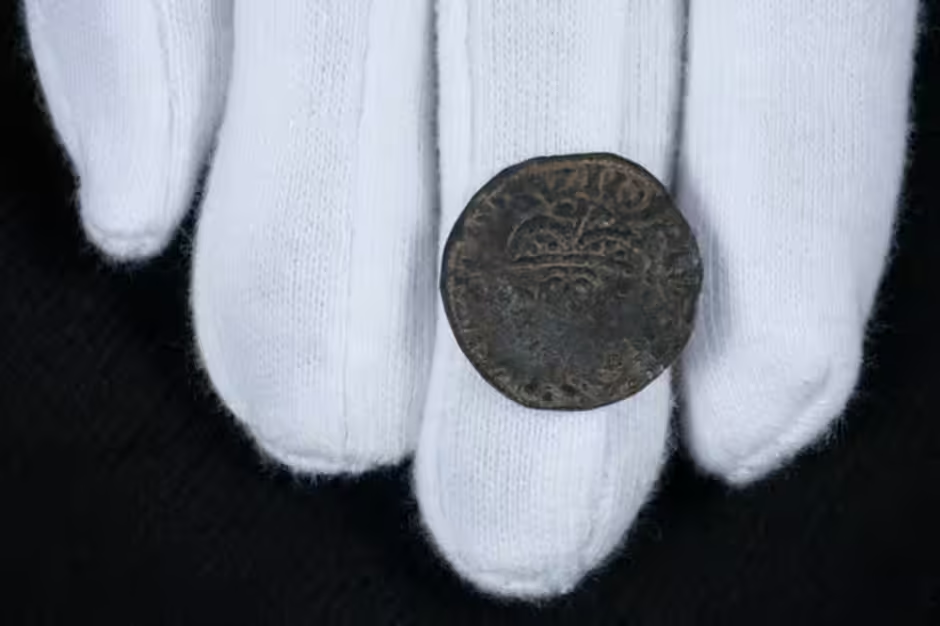
The earliest known coin minted in Scotland - almost 900 years ago - which has been acquired for the nation after it was found by a metal detectorist. Credit: Neil Hanna/PA Wire
The earliest known coin minted in Scotland – almost 900 years ago – which has been acquired for the nation after it was found by a metal detectorist. Credit: Neil Hanna/PA Wire

Features and Historical Context

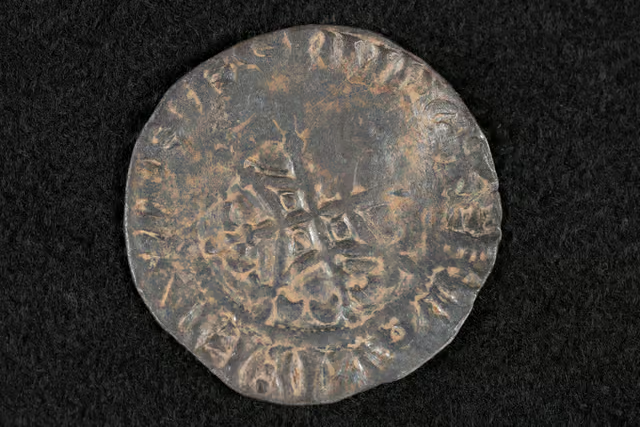
The coin, dated to the second half of the 1130s, features a portrait of King David I on one side and a cross-based design on the other. Its inscription, +E(A?)BALD:EONESBVRG, includes “ESBVRG,” confirming Edinburgh as the mint location.


📣 Our WhatsApp channel is now LIVE! Stay up-to-date with the latest news and updates, just click here to follow us on WhatsApp and never miss a thing!!


Dr. Blackwell emphasized that coins are vital historical sources for understanding medieval Scotland: “There are virtually no surviving documents explaining how coins were minted, where, or why designs changed. These coins themselves are the primary historical evidence.”

During David I’s reign, coin production later expanded to locations including Perth, Berwick-upon-Tweed, Aberdeen, St Andrews, and Roxburgh in the Scottish Borders. Beyond coinage, David I’s reign was transformative for Scotland, introducing royal burghs like Perth, Dunfermline, and Stirling, and reorganizing civil institutions.

Discovery and Future Plans

The coin was found in 2023 and reported to Treasure Trove, as required by law. It was valued at £15,000, a reward that was paid to the finder by the Crown. Allocated to NMS in autumn 2025, the coin will primarily be used for research, though there are plans to eventually display it to the public.

“This discovery not only enriches our understanding of Scottish medieval coinage but also provides insights into economic and political history during King David I’s reign,” Dr. Blackwell added.

The coin may have been dropped accidentally in medieval times, but its discovery has monumental significance for historians and numismatists. It confirms that Edinburgh was a central hub for early Scottish coinage and provides a tangible connection to Scotland’s first steps in monetary independence.

Cover Image Credit: The medieval David I silver coin was discovered in a wooded area near Penicuik. Credit: Neil Hanna/PA Wire

Related Articles

Archaeologists Reveal a Hair Style They Think Was Fashion 2000 Years Ago

19 February 2021

19 February 2021

The small 5 cm figurine found during excavations at Wimpole in Cambridgeshire surprised with its details. National Trust archaeologists and...

1,400-year-old royal hall found in Suffolk, UK

5 October 2022

5 October 2022

Archaeologists, evidence of a 1,400-year-old royal Hall of the first Kings of East Anglia has been discovered in Rendlesham, Suffolk,...

Hand disease known as Viking disease may have its origins in Neanderthal genes

14 June 2023

14 June 2023

A recent study in the Oxford University Press journal Molecular Biology and Evolution demonstrates that a condition known as Dupuytren’s...

3,000-Year-Old Conical Axe Believed to Have Fallen from the Sky: Possibly Made from Meteorite

27 August 2025

27 August 2025

A rare Bronze Age conical axe, over 3,000 years old and possibly crafted from meteorite metal, has been recently discovered...

6,000-year-old Finds in Dorset Downs

11 June 2021

11 June 2021

In the Dorset Downs, a significant landscaping project has revealed a plethora of intriguing findings on a grand scale. Excavations...

Ancient Christian Cross Over 1,400 Years Old Linked to Church of the East Unearthed on Abu Dhabi’s Sir Bani Yas Island

19 August 2025

19 August 2025

A remarkable archaeological discovery on Sir Bani Yas Island has brought to light an ancient Christian cross dating back more...

A Scientific Surprise: Bering Land Bridge formed surprisingly late during last ice age

1 January 2023

1 January 2023

A new study shows that the Bering Land Bridge, the strip of land that once connected Asia to Alaska, emerged...

3,000-Year-Old Lost Anatolian language ‘Kalašma’ deciphered

5 July 2024

5 July 2024

In 2023 excavation site at the foot of Ambarlikaya in Boğazköy-Hattusha in Turkey, a cuneiform tablet with a previously unknown...

Ancient Baekje Tombs in Korea Unearth Gold Ornaments and Pottery Treasures

31 August 2025

31 August 2025

A major archaeological discovery has been made in Jeongeup, South Korea, where the Eunsun-ri and Dogye-ri tomb clusters have yielded...

Archaeologists Unearth 78,000-Year Oldest Human Burial

5 May 2021

5 May 2021

A 78,000-year-old group of bones discovered at the mouth of a Kenyan coastal cave constitutes the oldest recorded formal human...

Magnificent Romanesque and Peasant war fury in the lost Kaltenborn monastery near Allstedt

18 August 2023

18 August 2023

From the 12th to the 16th century, the Kaltenborn monastery near Allstedt was a religious, cultural, and economic center of...

In Medieval burial ground, a rare embroidered Deisis depicting Jesus Christ was discovered

26 February 2023

26 February 2023

Russian archaeologists have uncovered a rare embroidered Deisis depicting Jesus Christ in a medieval burial ground. 46 graves have been...

Early Anatolian Genes: Genetic Links Between Girmeler Mound and 17,000-Year-Old Pınarbaşı Skeletons

16 April 2025

16 April 2025

Recent archaeological excavations at Girmeler Mound, located near the ancient Lycian city of Tlos in southwestern Türkiye, have not only...

Archaeologists discovered a mausoleum dating back to Golden Horde era in Kazakhstan

8 July 2023

8 July 2023

Remains of a mausoleum dating back to the Golden Horde in the 15th century were discovered on the territory of...

Portugal’s Enigmatic Roman Building “Tower of Centum Cellas”

4 February 2024

4 February 2024

The Tower of Centum Cellas (also known as the “Tower of St. Cornelius”), located in the Mount of Santo Antão...