
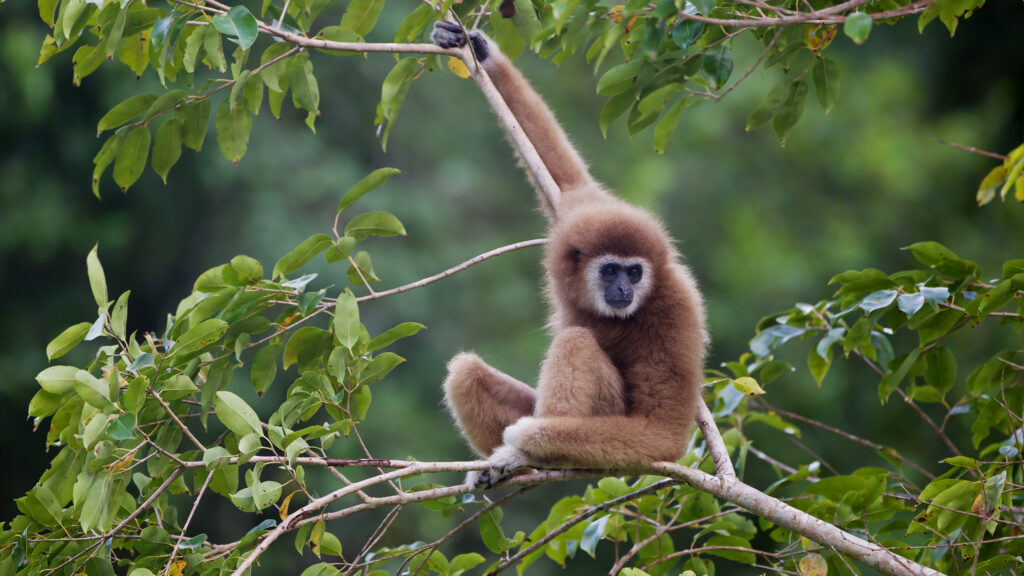
A groundbreaking international study led by Chinese scientists has confirmed that a gibbon unearthed from a 2,000-year-old royal tomb in Xi’an belongs to a previously unknown extinct species of the genus Nomascus. The finding, published in Cell, rewrites scientific understanding of gibbon evolution and provides fresh insight into ancient China’s imperial culture and biodiversity.
The remains were originally discovered in 2004 during excavations at the mausoleum of Empress Dowager Xia, grandmother of Qinshihuang—the first emperor of the Qin Dynasty (221–206 BC). Archaeologists from the Shaanxi Academy of Archaeology uncovered a collection of animal bones in Pit No. 12, including leopard cats, lynxes, Asiatic black bears, red-crowned cranes, and a nearly complete gibbon skeleton. These animals were believed to have been royal pets, buried as part of funerary rituals intended to “treat the dead as the living.”
Ancient DNA Reveals a Long-Lost Species
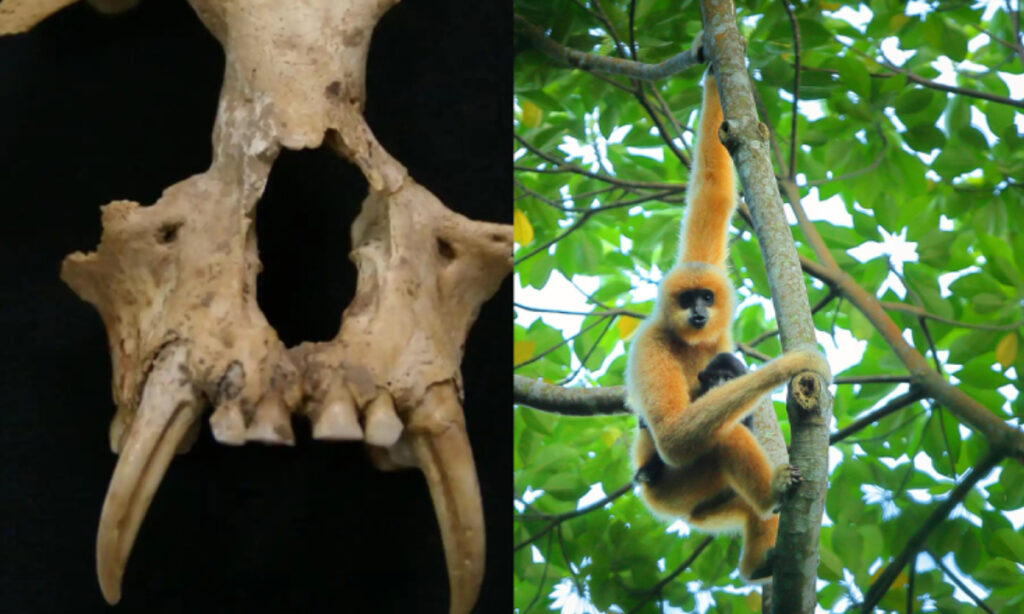
In 2018, morphological analysis by Chinese and British researchers concluded that the gibbon represented an entirely new genus and species, naming it Junzi imperialis. However, the classification sparked debate, as the findings were based solely on bone structure rather than genetic evidence.
The mystery was resolved in 2025 when a team led by Fu Qiaomei, a research fellow at the Institute of Vertebrate Paleontology and Paleoanthropology (IVPP) under the Chinese Academy of Sciences (CAS), successfully extracted and sequenced ancient mitochondrial DNA from the gibbon’s teeth. This marked the first time ancient DNA had been recovered from gibbon remains in East Asia, a region where humid conditions typically degrade genetic material.
According to the new genomic analysis, Junzi imperialis does not represent a separate genus. Instead, it is now officially classified as a new extinct species within the existing gibbon genus Nomascus, which today includes species such as the critically endangered Hainan gibbon.
“We corrected the previous classification and confirmed that Junzi imperialis is a new species of Nomascus. It is closely related to today’s Hainan gibbon,” said Wu Dongdong, corresponding author of the study and a researcher at the Kunming Institute of Zoology, CAS.
A Window Into Ancient Imperial Life
The pit where the gibbon was found lies along the southeastern side of Empress Dowager Xia’s tomb, located in the southern suburbs of Xi’an. Along with the animal remains, archaeologists uncovered bronze chains and feeding utensils—strong evidence that these creatures were not sacrificial offerings but cherished palace animals that accompanied the empress in death as they had in life.
According to Hu Songmei, co-author of the Cell article and a research fellow at the Shaanxi Academy of Archaeology, the discovery highlights the Qin royal family’s fascination with exotic fauna. “This suggests that more than 2,000 years ago, Empress Dowager Xia enjoyed keeping rare birds and exotic animals as pets in the imperial gardens,” Hu explained.
Genomics Sheds Light on Gibbon Evolution and Conservation
The newly published study goes beyond species identification. Using extensive whole-genome sequencing—covering 18 living gibbon species and three ancient samples—the team resolved long-standing debates about gibbon phylogeny.
Their results support the evolutionary order: (Hylobates, (Nomascus, (Symphalangus, Hoolock))), clarifying relationships among the four major gibbon genera.
Genomic data also revealed how past climate changes shaped gibbon population sizes and habitat suitability. These findings provide valuable insight for the conservation of surviving gibbons, many of which are now critically endangered due to habitat loss and human activity.
In one of the study’s most intriguing discoveries, researchers identified a 205-base-pair deletion in the Sonic Hedgehog (SHH) gene, which appears to contribute to the remarkably elongated limbs that characterize gibbons. Comparative genomics and functional testing in transgenic mice supported the gene’s role in limb development, offering new clues into the species’ distinctive arboreal adaptations.
A Collaborative Scientific Milestone
The research represents one of the most comprehensive gibbon genomic studies ever conducted. It was led by the Kunming Institute of Zoology at CAS and carried out in collaboration with IVVP, Sun Yat-sen University, the Shaanxi Academy of Archaeology, Shandong University, and the National Museum of Scotland.
Beyond revealing the identity of a long-lost species, the project demonstrates how ancient DNA can unlock deep evolutionary history and inform modern conservation strategies. It also underscores the cultural richness of China’s earliest imperial era, where exotic animals were not only symbols of prestige but became eternal companions in royal tombs.
As scientists continue to uncover more genomic data from extinct and surviving gibbons, the discovery of the Nomascus species from Empress Dowager Xia’s tomb marks a major step forward in understanding the evolution, biology, and protection of one of the world’s most endangered primate families.
Wang, S., Chen, Z., Luo, A., You, X., Kitchener, A. C., Tu, X., Thakur, M., Umapathy, G., Hu, S., Zhang, T., Zhang, Y., Liu, S., Ding, Y., Liu, F., Dai, Q., Feng, X., Li, L., Pan, Y., Zhang, M., Roos, C., Fan, P., Fu, Q., & Wu, D.-D. (2025, November 7). Genome sequences of extant and extinct gibbons reveal their phylogeny, demographic history, and conservation status. Cell. https://doi.org/10.1016/j.cell.2025.11.007
Cover Image Credit: White-handed Gibbon. Wikipedia
