
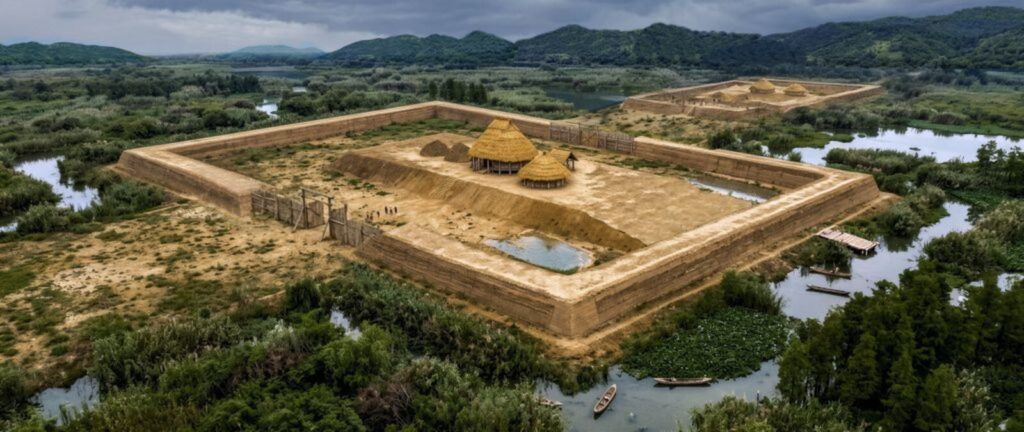
Five thousand years ago, the rulers of China’s Liangzhu civilization may have been honored in monumental ceremonies held beside their tombs. Archaeologists have reconstructed three ancient buildings near one of the country’s most remarkable prehistoric cemeteries, raising the possibility that elaborate royal funerary rituals existed far earlier than previously documented at the site.
The discovery comes from Fanshan, an elite burial ground on the outskirts of the ancient city of Liangzhu in eastern China’s Zhejiang Province. Famous for its extraordinary jade treasures, the cemetery has long offered a glimpse into the wealth and authority of a society that flourished thousands of years before China’s imperial dynasties.
Now, researchers believe the graves may have been only one part of a much larger ceremonial landscape. New architectural reconstructions suggest that three wooden buildings once stood beside the cemetery, enclosed within a substantial walled precinct. The largest may have served as a hall where ceremonies honoring the dead took place.
Three Buildings Hidden Beneath the Earth
The breakthrough began with an investigation of the ground east of the Fanshan cemetery. Excavations identified 120 postholes, the surviving traces of wooden supports that had disappeared long ago. Although the buildings themselves had vanished, the arrangement of these holes provided archaeologists with evidence of their original footprints.
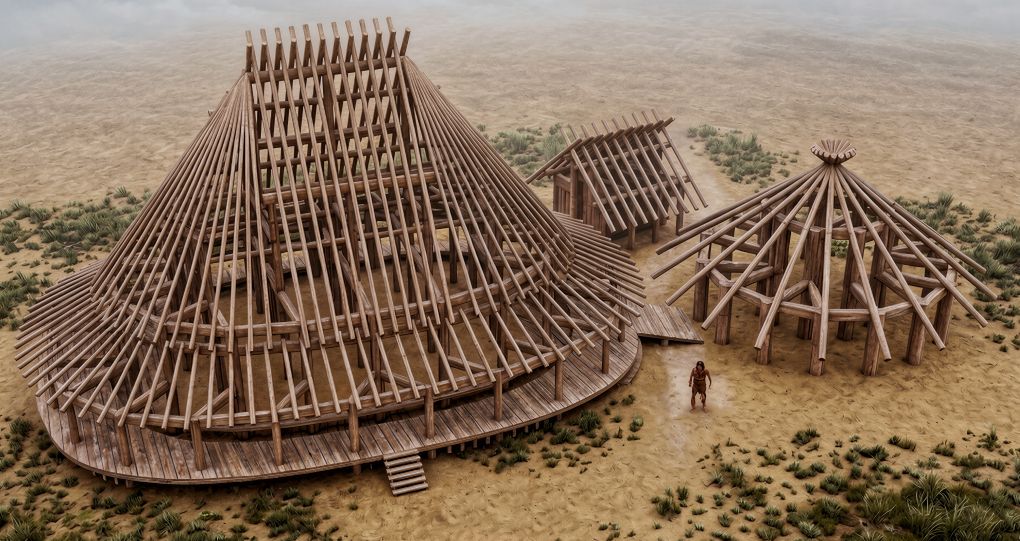
Researchers at the Zhejiang Provincial Institute of Cultural Relics and Archaeology divided the postholes into three groups, representing buildings designated F1, F2, and F3. During their latest reconstruction work, they combined measurements of the postholes with architectural analysis and comparisons with ancient models and images of buildings preserved on Liangzhu pottery.
The results revealed a striking architectural arrangement. The largest building, F1, had an oval footprint measuring approximately 25.2 meters by 16 meters and covered about 316 square meters. Nearby stood a circular building of roughly 105 square meters and a much smaller, approximately square structure occupying just 23 square meters.
The oval building was particularly unusual. Its reconstructed design features a raised wooden floor, a surrounding corridor, and a substantial roof that may have brought its total height to approximately 15 meters. Archaeologists also identified evidence suggesting that a passageway connected the main building to the circular structure.
Was the Largest Building a Royal Ritual Hall?
The three buildings stood beside Fanshan’s highest-status graves, including the famous Tomb M12, which produced some of the most prestigious jade objects associated with Liangzhu civilization.
The relationship between the buildings and the cemetery has encouraged archaeologists to consider a ceremonial function. Wang Ningyuan, a senior researcher leading the Liangzhu archaeological investigations, has suggested that the large oval structure could have been a xiangdian, a hall associated with rituals commemorating deceased rulers or high-ranking ancestors.
Its considerable size, unusual architecture, and prominent position beside the burial ground support that possibility. The proposed reconstruction places the building in a commanding position on the raised landscape, potentially making it a focal point within the cemetery complex.
However, researchers are careful not to describe its ritual function as established fact. Further excavation will examine evidence of how the buildings were used, including whether they contain traces of domestic activities such as hearths or everyday refuse. Such findings could help distinguish a ceremonial hall from an elite residence or another type of structure.
A Walled Cemetery for Liangzhu’s Elite
The buildings form part of a wider investigation that has transformed archaeologists’ understanding of Fanshan. Earlier excavations revealed a rectangular enclosure around the burial area, measuring approximately 180 meters from east to west and 140 meters from north to south.
Radiocarbon dating of sections of its eastern and southern walls suggests that the enclosure dates to around 5,000 years ago. This places its construction broadly in the same period as the cemetery’s most prestigious burials, strengthening the possibility that the walls, tombs, and adjacent buildings formed a coordinated architectural complex.
Such an arrangement would have implications far beyond the identification of three prehistoric structures. It could indicate that Liangzhu’s elite developed a formally organized royal burial precinct, complete with boundaries and buildings potentially intended for ceremonial observances.
For researchers investigating the emergence of complex societies in East Asia, this is an important question. The architecture may preserve evidence of how political authority, ancestor commemoration, and monumental construction became connected in one of China’s earliest urban civilizations.
The Jade Treasures of Fanshan
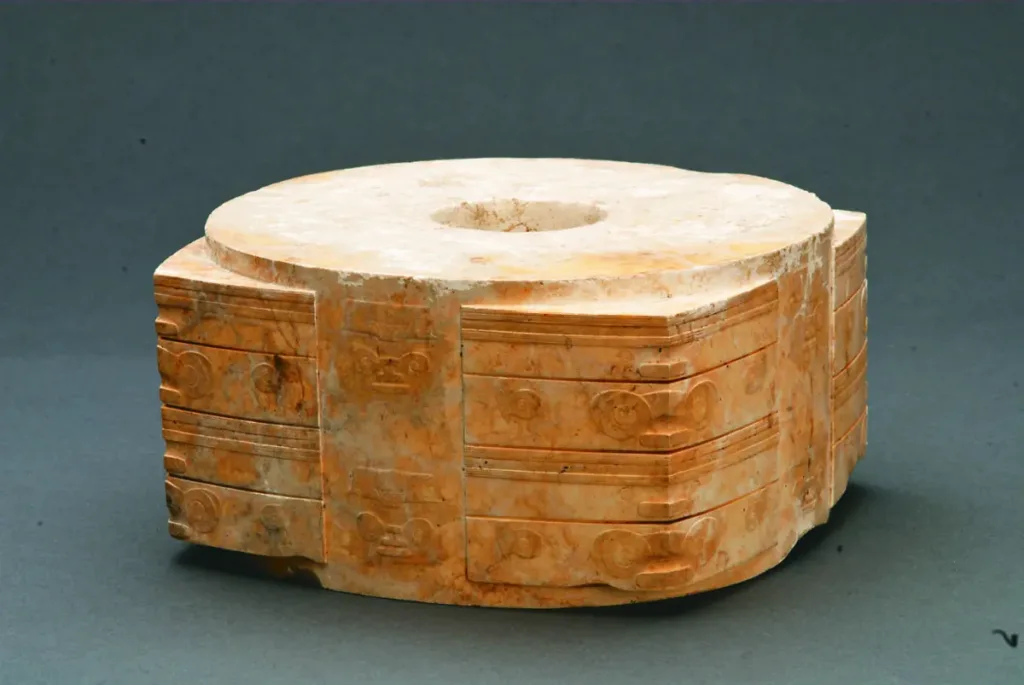
Fanshan first attracted widespread archaeological attention in 1986, when excavations uncovered exceptionally rich graves containing elaborate jade objects. Among the most celebrated discoveries were a monumental jade cong, a squared ritual object with a circular opening, and a ceremonial jade axe associated with elite status.
These treasures demonstrate the extraordinary craftsmanship and social hierarchy of Liangzhu society. The objects were not simply valuable possessions; their placement in high-status burials suggests that they also played roles in expressing authority, identity, and ceremonial traditions.
The newly reconstructed buildings add another dimension to that story. Instead of viewing Fanshan only as a cemetery filled with prestigious objects, archaeologists can now investigate how the surrounding architecture helped shape the experience of visiting, maintaining, and possibly conducting rituals at the burial grounds.
