
14 January 2026 The Future is the Product of the Past

Mystery in Speyer: 1,000-Year-Old Human Remains and Ancient Cloth Found in Abandoned Glass Case

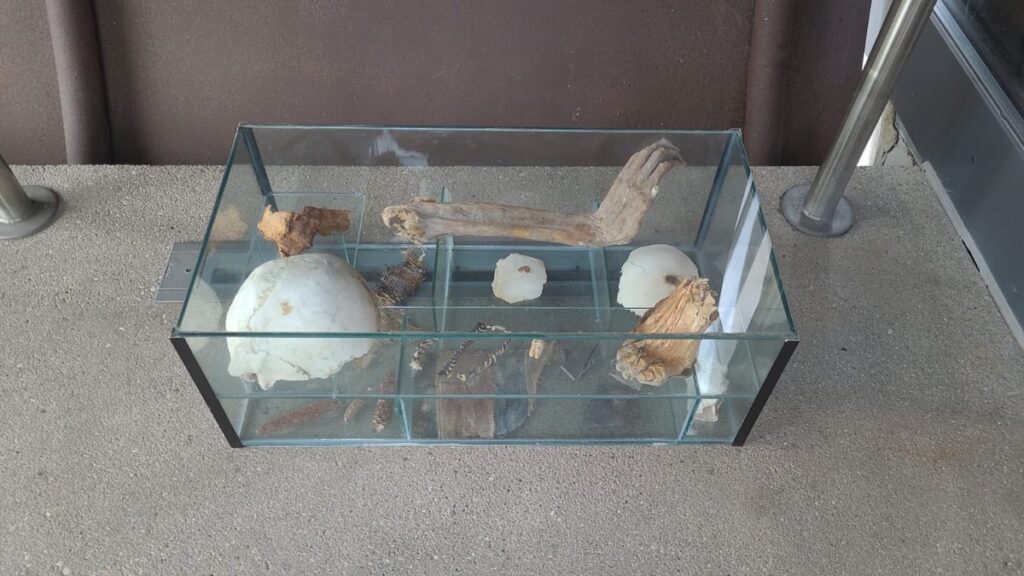
A strange discovery in the German city of Speyer has left archaeologists and police puzzled. A glass display case containing human bones and fragments of ancient clothing — believed to be over a thousand years old — was mysteriously left outside the State Archaeology Department earlier this month. Authorities are now investigating where the remains came from, who placed them there, and whether a crime was committed.

The story began in the early hours of October 4, when staff at the local branch of the State Archaeology Office of Rhineland-Palatinate found an unfamiliar glass vitrine standing on the sidewalk outside their building on Gilgenstraße. Inside the case were several bone fragments, including parts of a skull and limbs, along with textile remains that appeared to be from an ancient burial. Unsure of what they were looking at, the staff called the police.

Officers from the Ludwigshafen police department soon arrived and secured the roughly 50-centimeter-wide glass case. What initially looked like a macabre prank quickly turned into a serious archaeological mystery. Forensic experts were called in to examine the contents, and early analyses suggested that the bones and fabric were indeed extremely old — possibly dating back to the early Middle Ages. According to the State Office for Archaeology, the remains could be at least 1,000 years old.

The police have since opened a formal investigation. In their official press release, the Rhineland-Palatinate Police stated that they have not ruled out theft from a museum or private collection. The craftsmanship of the vitrine itself — a solid glass and metal construction with professional finishing — suggests it was not made for temporary use or a prank. Instead, it appears to have been built for exhibition or preservation, possibly indicating that it once belonged to a museum display.

Authorities are now working to trace the origin of the bones and the display case. They are also seeking witnesses who might have seen the object being placed outside the archaeology office between the evening of October 3 and the early morning hours of October 4. Police believe it would have required at least one vehicle or multiple people to transport the vitrine, given its size and weight. Anyone with information has been asked to contact the Ludwigshafen Criminal Police at +49 621 963-23312 or by email.


📣 Our WhatsApp channel is now LIVE! Stay up-to-date with the latest news and updates, just click here to follow us on WhatsApp and never miss a thing!!


The lack of context has sparked speculation in Speyer and beyond. Some wonder whether the case was an anonymous attempt to return stolen archaeological materials, perhaps taken from a museum years ago. Others suspect a hoax — though the age and authenticity of the remains make that increasingly unlikely. There is also the possibility that the vitrine was privately owned, passed down or kept illegally, and then discreetly abandoned to avoid legal trouble.

Experts say the inclusion of textile fragments alongside the bones could help narrow down the period and origin. Textiles degrade quickly, so their survival usually points to specific burial conditions, such as tombs or early Christian graves. If confirmed, the find could provide valuable insights into medieval burial customs in the Rhineland region — but only if its provenance can be reliably determined.

For now, the mysterious glass case remains in police custody. The bones are being examined by forensic anthropologists and archaeologists at specialized laboratories. Carbon dating and material analysis are expected to provide more definitive answers in the coming weeks.

Until then, one of Germany’s oldest cities finds itself at the center of a modern archaeological thriller — a riddle that bridges a millennium, blending crime investigation with the echoes of the Middle Ages. As police continue to search for clues, one question still dominates: who left a thousand years of history on the doorstep of Speyer’s archaeologists — and why?

Presse Portal

Cover Image Credit: Police Headquarters of Rhineland-Palatinate (Rheinpfalz District)

Related Articles

Remains of a Roman stylobate found in Montenegro

19 July 2023

19 July 2023

In ancient Rhizon (Risan) in Montenegro, remains of a Roman stylobate (a shared base for multiple columns) were uncovered. In...

The Celts’ Astronomical Secrets: The Chão de Lamas Lunula and the Coligny Calendar Connection

2 March 2025

2 March 2025

A groundbreaking study published in the journal Palaeohispanica has shed light on the ancient timekeeping practices of the Celts, centering...

Centuries-old burials discovered near Antandros Ancient City in Turkey

10 January 2022

10 January 2022

Ancient tombs were discovered during a foundation excavation at a building site near the ancient city of Antandros, which is...

Submerged Roman structure of concentric walls discovered on Italy’s western coast

3 June 2024

3 June 2024

Archaeologists have recently uncovered a significant Roman-era structure submerged near the coastline of Campo di Mare on Italy’s western coast....

1300-Year-Old Communion Bread with ‘Farmer Christ’ Image Discovered in Ancient Eirenopolis

10 October 2025

10 October 2025

In the rugged hills of Karaman province, Türkiye, a remarkable archaeological discovery has emerged from Topraktepe, the site of ancient...

Researchers Define the Borders of El Argar, the First State-Society in the Iberian Peninsula

18 March 2025

18 March 2025

Recent research conducted by scholars from the Autonomous University of Barcelona (UAB) and the Max Planck Institute for Social Anthropology...

Stone Age Architectural Marvel Unveiled Deep in the Baltic Sea: It may be one of the largest known Stone Age structures in Europe

13 February 2024

13 February 2024

Hiding deep beneath the Baltic Sea, an architectural wonder of the Stone Age has been discovered by researchers. This megastructure,...

In the ancient city of Syedra: a unique mosaic with the 12 labors of Heracles depicted on a single panel found

25 July 2022

25 July 2022

During the excavations in the ancient city of Syedra in the Alanya district of Antalya, approximately 164 square meters of...

Largest Excavation in 50 Years Unveils Benin City’s Hidden History and the Origins of the Legendary Benin Bronzes

4 November 2025

4 November 2025

In a historic archaeological effort, researchers in Benin City have uncovered long-buried traces of royal architecture, artistry, and metalworking —...

Centuries-old boardwalk discovered

22 December 2023

22 December 2023

During construction work in November 2023, road construction workers in Fürth came across an archaeological sensation: a centuries-old boardwalk under...

Jomon Ruins Adding to UNESCO World Heritage List

26 May 2021

26 May 2021

An international advisory panel has recommended that a group of ruins from the ancient Jomon period in northern Japan is...

The ancient necropolis area in Turkey’s Antalya becomes a museum

22 July 2023

22 July 2023

The East Garage Necropolis Area, which was once a public market in the southern province of Antalya and where archaeological...

The Stolen Frescoes were Returned to the Pompeii Archaeological Park

20 May 2021

20 May 2021

Six frescoes ripped from the remains of ancient Roman villas years ago have been returned to the Pompeii archaeological site,...

Ancient Mosaic Room Featuring “Solomon’s Knot” Unearthed in Smyrna to Ward Off the Evil Eye

5 January 2026

5 January 2026

Archaeologists working in the heart of İzmir have uncovered a remarkable mosaic-floored room in the ancient city of Smyrna, revealing...

A 3200-year-old trepanned skull discovered in eastern Turkey’s Van province

12 November 2022

12 November 2022

A 3200-year-old trepanned skull was discovered in eastern Turkey’s Van province. In the prehistoric era, Anatolia served as a transitional...