25 February 2026 The Future is the Product of the Past

Environmentalists react to the rehabilitation works in the Assos ancient port

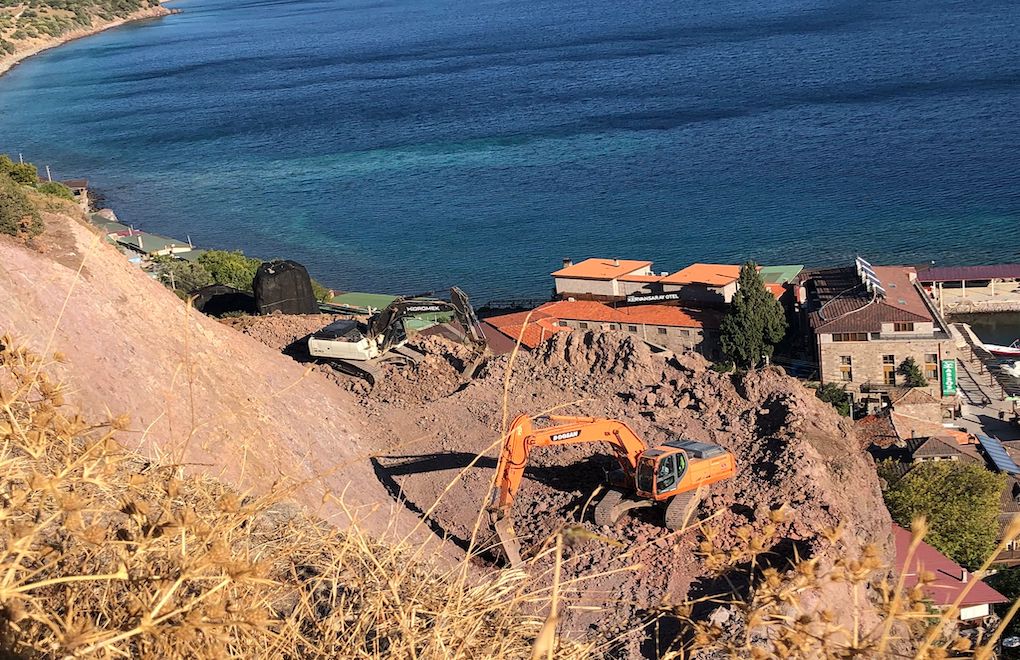
Among the continuing landscaping and restoration works at the historic city of Assos in the northern province of Canakkale, a large hill at the port has been cut, turning the region’s lush environment into dust, causing outrage among nature lovers.

Since the stones falling on the road leading to Assos Ancient City created a security problem, the ancient city was closed to visitors for 500 days and rehabilitation work was started.

The ancient city of Assos was closed to entrances with the conclusion of the tender made by the Ayvacık District Governorate in April.

During the rehabilitation works that started after April, the images that the construction machines disrupted the historical texture became the agenda on social media.

Two environmental organizations, Friends of Assos and the Protection of Natural and Cultural Properties in Mount Ida Society, made an effort to stop the landscape work and uploaded photos of the region before and after the work on social media.


📣 Our WhatsApp channel is now LIVE! Stay up-to-date with the latest news and updates, just click here to follow us on WhatsApp and never miss a thing!!


While environmentalists applied for legal complaints, hotel owners in the region supported the landscape project saying, “Rocks from the hills fall on people on rainy days.”

“Things done with heavy equipment at Assos completely contradicts with the European Landscape Pact, which is in force since 2003,” archaeologist Nezih Başgelen told daily Milliyet on Oct. 1.

“The region flattened with bulldozers is an archaeological and protected site,” said Cem Tüzün, an official from Friends of Assos.

“This is a culture extermination,” he added.

However, the business owners in the region do not think the same.

Giving a firm response to those who criticize the work, Erdal Çakır, the head of Assos Hotel Owners Association,” said: “Five years ago, rocks fell from the hill on a vehicle and the roof of a hotel. Human life is under risk.”

Video: Kazdagi Natural and Cultural Heritage Preservation Association


Reminding that there is an official report highlighting this risk, Çakır asked: “Does anybody want that someone gets killed here?”

Tüzün, unlike Çakır, wants the project to stop to save the habitat.

“The project comprises of landscape on six parts. Unfortunately, three parts have been damaged; we are trying to save the remaining three,” he said.

Süheyla Doğan, another environmentalist, posed two questions to the authorities via her interview at the daily: “If rocks fell, why didn’t you think of an easier solution, such as installing barbed wires? Is it true that amid the excavation work, an ancient temple was found under the soil?”

Agreeing with the criticisms that the landscape has started looking ugly because of the works, Çakır said: “The vegetation cover is gone, and it looks ugly, yes. But, it will gain its charms after the landscape work.”

Friends of Assos and the Protection of Natural and Cultural Properties in Mount Ida Society demanded that the construction activities be stopped immediately, those responsible for the murder of Assos be brought to justice, and the destruction in the ancient city should be urgently rehabilitated with scientific methods.

The harbor city of Assos is an ancient city located in Behramkale village about 17 kilometers from Çanakkale’s Ayvacık district. The city, founded some 3,000 years ago, has been known as a famous teaching center since antiquity.
Related Articles

An extraordinary archaeological discovery in Spain: A new decorated stela has been found in context, in the 3000-year-old funerary complex

15 October 2023

15 October 2023 2

Archaeologists have discovered a new decorated stela in the 3000-year-old burial complex of Las Capellanías in Cañaveral de León (Huelva,...

Archaeologists in Iraq find 2,700-year-old wine press

24 October 2021

24 October 2021

Stone bas-reliefs carved into the walls of an irrigation canal some nine kilometers (5.5 miles) long, and the remains of...

Roman Marching Camps Discovered in Saxony-Anhalt for the First Time

15 January 2026

15 January 2026

Archaeologists in Germany have uncovered the first confirmed Roman marching camps in Saxony-Anhalt, providing groundbreaking evidence of Roman military operations...

Archaeologists Unearthed a Rare Hoard of Hasmonean Coins in Jordan Valley

31 December 2024

31 December 2024

A team of archaeologists from the University of Haifa discovered a rare hoard of approximately 160 coins during an excavation...

Coin hoard found in fireplace ‘belonging to Scottish clan chief’ murdered at infamous Glencoe Massacre

17 October 2023

17 October 2023 1

Coins believed to have belonged to a Scottish clan chief murdered in an infamous 17th-century Glencoe massacre, have been found...

A Roman Urn Found in Cartagena Reveals a Forgotten Governor and Rare Lot-Casting Rituals

24 November 2025

24 November 2025

The recent discovery of a Roman inscription in Cartagena has illuminated an obscured chapter of Hispania Citerior’s history, revealing the...

Roman era total of 46 early settler burials discovered in Germany

17 September 2023

17 September 2023

Students from Goethe University Frankfurt, in collaboration with the Hesse archeology department at the Darmstadt branch of the State Monument...

One of Northern Europe’s Oldest Wooden Doors Found, Estimated to Be 650 Years Old

17 January 2026

17 January 2026

Researchers in Estonia have identified what is now believed to be the oldest surviving wooden door in the country, and...

Rare Roman Cavalry Swords Lead to Major Archaeological Discovery of Iron Age to Roman Settlement in Gloucestershire

4 July 2025

4 July 2025

A remarkable archaeological excavation in Gloucestershire has unveiled a vast settlement site dating back over 2,000 years, bridging the Iron...

3800-years-old Akkadian Cuneiform Tablet found in Turkey’s Hatay

11 August 2023

11 August 2023

A 3,800-year-old Akkadian cuneiform tablet was found during the archaeological excavations carried out in the Aççana Mound, the old city...

Human Relief Found at Million Stone Excavation Site in İstanbul

18 July 2021

18 July 2021

The Milion Stone (also known as the Million Stone) from the Eastern Roman period is one of important the historical...

Archaeologists Discover Ancient Horse-Bone Skates

27 December 2025

27 December 2025

Archaeologists working on the Taman Peninsula in Russia’s Krasnodar Region have uncovered a remarkable example of ancient ingenuity: bone skates...

First Trilobite Fossil Amulet from Roman Early Empire (1st–3rd Century CE) Found in Spain

22 July 2025

22 July 2025

In a discovery that may reshape our understanding of how ancient Romans perceived the natural world, archaeologists have uncovered a...

Cuneiform Clues Reveal Körzüt as “The Sacred City of Haldi,” in Urartu Kingdom

6 August 2025

6 August 2025

Excavations in eastern Türkiye uncover a major religious center of the Urartian Kingdom—The Sacred City of Haldi, shedding new light...

Bears in a Sacrificial Pose: A Bronze Plaque from Early Medieval Altai Reveals an Unknown Southern Tradition

4 February 2026

4 February 2026

More than thirteen centuries after it was placed in the ground, a bronze plaque depicting bears in a sacrificial pose...