
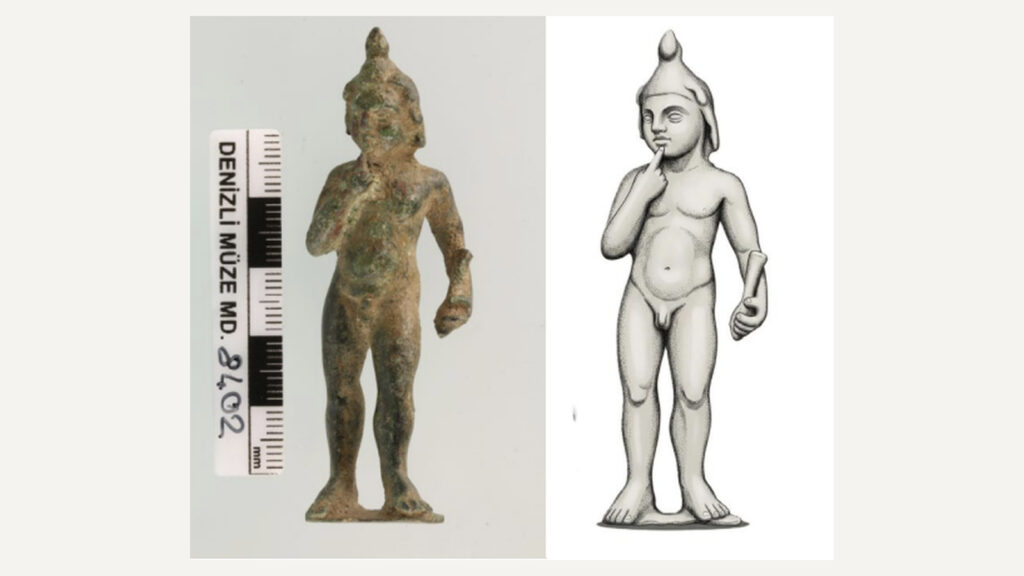
A small bronze figurine preserved in the Hierapolis Archaeology Museum in western Türkiye offers a striking example of how Egyptian religious traditions changed as they spread through the Greek and Roman worlds. Depicting Harpocrates, the Egyptian child god Horus, the figure combines an Egyptian royal headdress, Greek sculptural influences, and symbols of abundance and protection. A new archaeological study examines how these features reflect the blending of religious beliefs in Roman Anatolia nearly 2,000 years ago.
Archaeologist Esma İvrendi Şenol of Pamukkale University conducted the research, published in the journal Cedrus, which focuses on the figurine’s iconography and cultural significance. By comparing it with other ancient representations, the study places the bronze figure within the religious environment of the Roman Imperial period, stylistically dating it to between the first and third centuries AD.
Although the object belongs to an existing museum collection rather than a newly excavated archaeological context, its distinctive combination of symbols provides a rare opportunity to examine how ancient communities adapted foreign deities to their own religious traditions.
Harpocrates: From Egyptian Child God to Greco-Roman Deity
Harpocrates originated in Egyptian religion as Hor-pa-khered, meaning “Horus the Child.” In Egyptian mythology, Horus was the son of Isis and Osiris, and his childhood represented renewal, divine protection, and the continuation of legitimate kingship.
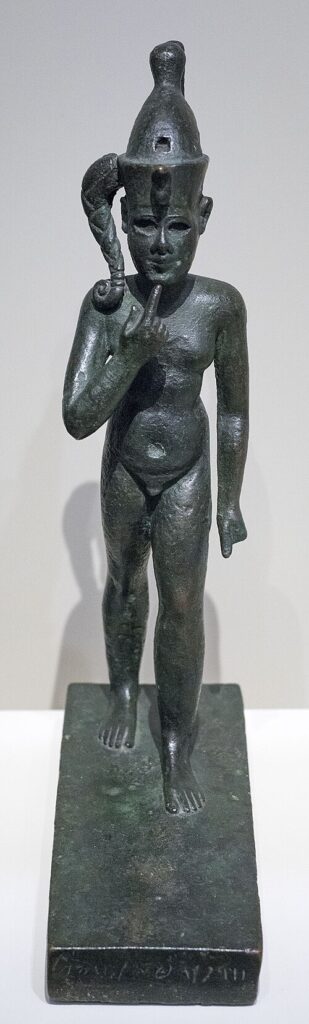
Egyptian artists commonly portrayed the young god as a child with a finger near his mouth, a gesture associated with childhood in Egyptian visual conventions. When Greek communities encountered this imagery, however, they interpreted the gesture differently, connecting Harpocrates with silence, secrecy, and the protection of sacred knowledge.
This reinterpretation illustrates how the same religious image could acquire new meanings as it moved between cultures. Rather than simply adopting an Egyptian deity unchanged, Greek and Roman worshippers incorporated Harpocrates into a broader religious world that included their own artistic traditions and ideas about divine protection.
Harpocrates also maintained a close association with Isis, whose worship spread extensively throughout the Mediterranean during the Hellenistic and Roman periods. Together with deities such as Serapis, the goddess and her divine child became familiar figures within religious communities far beyond Egypt.
A Bronze Figurine Combining Three Cultural Traditions
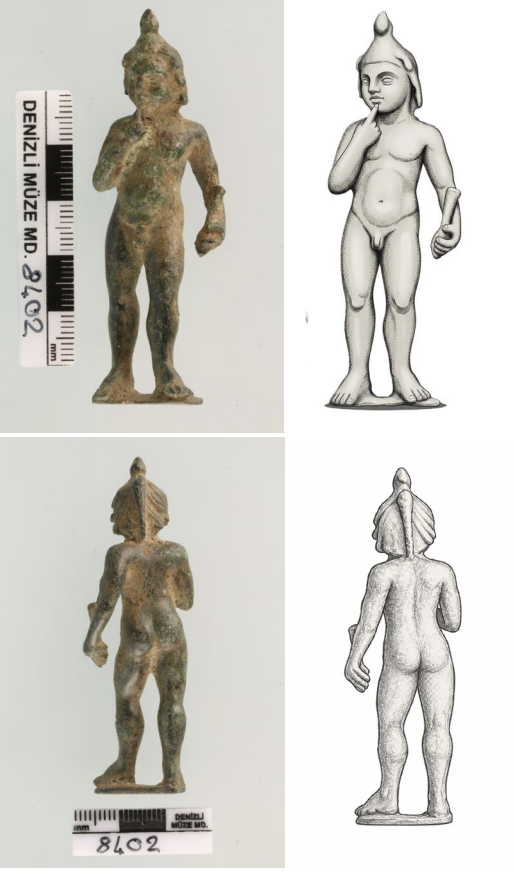
The Hierapolis figurine brings these influences together in a single representation. The figure raises a finger toward its mouth, wears a headdress reminiscent of the Egyptian double crown, and carries a cornucopia, the horn of plenty associated with prosperity and abundance.
Each detail contributes to the object’s religious identity. The Egyptian-style crown preserves the god’s association with his homeland, while the modeling of the body and the figure’s stance reveal the influence of Greek sculptural conventions.
The cornucopia introduces another important dimension. In Greek and Roman religious imagery, this symbol frequently accompanied deities associated with fertility, prosperity, and the provision of material well-being. Its presence alongside Harpocrates suggests that worshippers could understand the Egyptian child god through concepts familiar within their own religious environment.
Şenol’s analysis identifies this combination as an example of religious syncretism, the process through which traditions interact and acquire new forms and meanings. The figurine does not simply reproduce an Egyptian model; it presents a deity whose appearance reflects the artistic and religious influences of the wider Mediterranean world.
The study also suggests that portable figures of this type may have served purposes beyond decoration. Owners could have associated them with personal devotion, protection against harmful influences, or the blessings of deities connected with the Isis cults.
Hierapolis: A City Where Religion and Nature Intersected
Ancient Hierapolis, near modern Denizli in southwestern Türkiye, was far more than a Roman city famous for its thermal springs. Founded under the Attalid rulers of Pergamon in the late second century BC, it developed around a landscape where natural phenomena held profound religious significance. Its principal deity was Apollo, whose sanctuary stood near geological faults that released gases from beneath the earth.
One of the city’s most extraordinary sacred places was the Ploutonion, which ancient worshippers regarded as an entrance to the underworld. Poisonous gases emerging from a nearby cave could kill animals brought into the sanctuary, creating a spectacle that reinforced its supernatural reputation. Modern research has identified exceptionally high concentrations of carbon dioxide at the site, providing a scientific explanation for a phenomenon that ancient observers associated with the realm of the dead.
Hierapolis flourished during the Roman Imperial period, when its religious landscape included sanctuaries, monumental temples, and rituals connected with healing and the forces of nature. This was the historical environment in which Egyptian, Greek, and Roman religious traditions circulated throughout Anatolia.
İvrendi Şenol, E. (2026). A Harpocrates Figurine in the Hierapolis Collection: The Iconographic Reflection of Cultural Syncretism. Cedrus, 14, 349-361. https://doi.org/10.5281/zenodo.22928944
