1 December 2025 The Future is the Product of the Past

Authorities in New York have been accused by leading academics of repatriating fake Roman artifacts to Lebanon

Leading academics from France and the United Kingdom have accused New York authorities of returning fake Roman artifacts to Lebanon.

The artifacts were sent back to their country at a ceremony held in New York on September 7. The nine items were mosaics from the third through fifth centuries when Rome ruled the Mediterranean region that includes what is now known as Lebanon. Investigators valued the mosaics at $7 million.

The mosaics, which depict gods, gladiators, and mythical beasts, were seized along with 15 other objects in 2021 from a New Jersey storage unit by officials from U.S. Homeland Security Investigations and the district attorney’s office.

The unit was rented by Georges Lotfi, 82, a retired Lebanese-born pharmaceutical executive and sometime New York resident who collected and dealt in art.

Eight out of nine mosaic panels that the US authorities recently returned to the Middle Eastern country are not what they seem, according to claims made by Djamila Fellague of the University of Grenoble.


📣 Our WhatsApp channel is now LIVE! Stay up-to-date with the latest news and updates, just click here to follow us on WhatsApp and never miss a thing!!
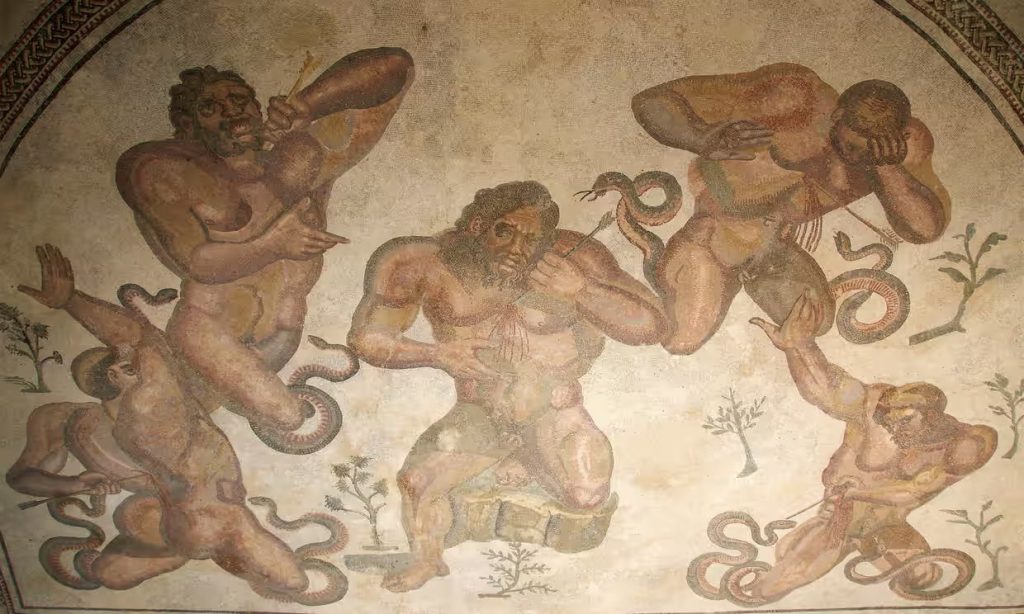


Mosaic fragment from the Villa Romana del Casale, Sicily, a Unesco world heritage site.

Fellague claims to have uncovered proof that forgers had copied designs from original mosaics in archaeological sites or museums in Sicily, Tunisia, Algeria, and Turkey.

Academician said. “Eight of the nine ‘returned’ mosaic panels were fakes that [are] relatively easy to detect because the models used are famous mosaics,”.

Fellague particularly highlighted a panel depicting an ‘Anguiped Giant.’ The academician claimed that this panel was copied from a mosaic at Villa Romana del Casale in Sicily, a UNESCO World Heritage Site.”

“The expert mentioned that only one of the returned artifacts was copied from an item housed at the Beirut National Museum in Lebanon.

Fellague suspects that a forgers’ mosaic workshop was located somewhere in the Middle East, probably in the 1970s and 1980s, judging from other pieces that have surfaced on the art market.

Christos Tsirogiannis, a guest lecturer at the University of Cambridge and a leading expert in looted antiquities and trafficking networks, believes the evidence is irrefutable.

Tsirogiannis said that were the revelation to be shown to be true it would be extremely embarrassing for the office of the Manhattan District Attorney (DA), which had announced the repatriation of antiquities to Lebanon on 7 September.

“Even if you are not an expert, if you put the fake next to the authentic mosaic, you see how similar they are, but also how the quality is actually not that good,” claims Tsirogiannis.

Tsirogiannis added that the alleged forgers had made the mistake of copying well-known mosaics, which have been extensively photographed by tourists with images widely available on the internet and in academic publications. “The whole thing is crazy. The authorities continually do these things without consulting experts.”
Related Articles

Bronze Age family systems deciphered: Paleogeneticists analyze 3,800-year-old extended family

31 August 2023

31 August 2023

A Bronze Age family living 3,800 years ago in the Southern Urals may have taken a flexible approach to marriage,...

AI Uncovers Lost Babylonian Hymn After 3,000 Years — A Glorious Ode to the Ancient City

3 July 2025

3 July 2025

Archaeologists and AI experts uncover a 3,000-year-old hymn praising Babylon‘s grandeur, revealing rare insights into ancient urban society, education, and...

2,500-Year-Old Burial Site in Negev Highlands Reveals Ancient Trade Routes and Evidence of Human Trafficking

5 February 2025

5 February 2025

The Israel Antiquities Authority announced on Wednesday the discovery of a 2,500-year-old burial site in the Negev Highlands. This significant...

Archaeologists uncovered an Aztec altar with human ashes in Mexico City

1 December 2021

1 December 2021

Archaeologists in Mexico have discovered a 16th-century altar in Plaza Garibaldi, the center in Mexico City famous for its revelry...

Fragments of ‘unique’ 17th-century iconostasis discovered in Polish church

28 October 2023

28 October 2023

Researchers from the Institute of Art at the Polish Academy of Sciences (IS PAN) have discovered substantial fragments of a...

An important discovery in Haltern: Mini temples and sacrificial pit discovered in Roman military encampment

16 November 2023

16 November 2023

Archaeologists from the Westphalia-Lippe Regional Association (LWL) have found remains of the foundations of two mini Roman temples and a...

A Remarkable Discovery from a Gaza Shipwreck: Olive Pits from 1100 Years Ago

10 March 2025

10 March 2025

The recent underwater excavations off the coast of Türkiye have unveiled an extraordinary find that has captivated scientists: olive pits...

Archaeologists may have found Lyobaa, the Zapotec Land of the Dead

1 July 2023

1 July 2023

An archaeological team from the Lyobaa project has confirmed the existence of a vast Zapotec underground complex in their study...

Excavations at Coleshill may rewrite English Civil War history

5 February 2023

5 February 2023

Archaeologists excavating the site of Coleshill Manor in Warwickshire have revealed evidence of what could be one of the first...

Earliest Known Stone Mold for Coin Production in Roman Hispania Unearthed

27 March 2025

27 March 2025

Researchers from the University of Jaén have made a groundbreaking discovery at the archaeological site of Obulco, modern-day Porcuna, revealing...

11,000-Year-Old LSU Campus Mounds Are Oldest Known Human-Made Structures In North America

23 August 2022

23 August 2022

According to new research published in the American Journal of Science, two six-meter (20-foot) high mounds on the campus of...

Women May Have Ruled El Algar in the Bronze Age

12 March 2021

12 March 2021

The diadem found in the Bronze Age tomb belonging to the El Algar culture may have belonged to a queen....

Ancient Rome’s city borders were discovered in a rare stone

17 July 2021

17 July 2021

Archaeologists unearthed a rare stone outlining ancient Rome’s city borders during excavations for a new sewage system. The stone comes...

“Last Rhodes shipwreck” of Roman period found in Turkey’s Fethiye

5 March 2022

5 March 2022

Turkish researchers, a Rhodes shipwreck from the third century A.D. was discovered in the depths of the Gulf of Fethiye...

A Unique Discovery in Europe: Ancient Stone Circles Cover 2,800-Year-Old Graves of Children in Norway

29 June 2024

29 June 2024

Archaeologists from the Museum of Cultural History in Oslo discovered an unknown burial site in a quarry near Fredrikstad, in...