25 December 2025 The Future is the Product of the Past

Romanian Police Find the Stolen Viking Helmet

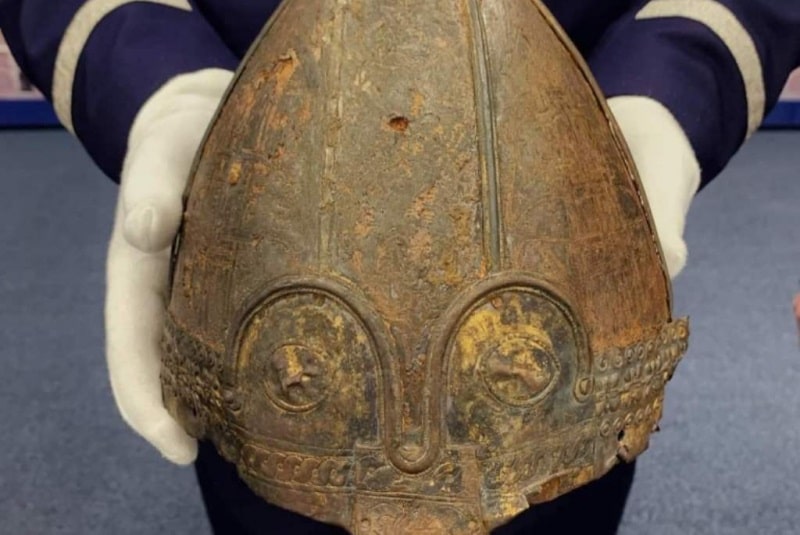
Romanian police specializing in heritage crimes recovered a medieval helmet of “Viking origin” on February 7, which had disappeared a decade ago and which, in an announcement released on Friday, they called “unique in Romania” and very rare in the rest of Europe.

A Romanian expert on historical illustration, Radu Oltean, said the helmet dates from the 11th century. It was first discovered in 2010 during the remodeling works of the Siret River in northeastern Romania, but it was never handed over to state conservation services and was lost by the authorities.

The investigation that led to the recovery of the precious item began in December 2020, when police officers obtained information about its whereabouts.

The helmet “may be dated between the 11th and 13th centuries and represents a type of helmet that is found more frequently in the Baltic countries and Kiev Rus,” said police, who did not offer additional information on how the helmet disappeared or where it was saved.

“Investigations to clarify all the circumstances continue, and the cultural good has been handed to the Moldova National Museum in Iasi so the procedures to list it as national cultural heritage can start,” the statement concluded.


📣 Our WhatsApp channel is now LIVE! Stay up-to-date with the latest news and updates, just click here to follow us on WhatsApp and never miss a thing!!


The Vikings were the nautical Nordic people of the Nordic people, they roamed extensively, establishing settlements and states in modern Britain, Ireland, Iceland, the Baltic Sea, and northern France.

But some people go further. The Vikings created Russia’s first Kievan Rus Oblast in the middle of the 9th century, and its capital is today Kiev. It lasted until the middle of the 13th century, after which it succumbed to the Mongol invasion.

At its peak in the early to mid-11th century, it stretched from the White Sea in the north to the Dniester River in present-day Moldova, which borders the northeastern part of Romania, where the helmet was first discovered in 2010.

It is unknown when the helmet, which was delivered to the National Museum of Moldova, will be exhibited.

Source: https://balkaninsight.com/
Related Articles

Divers Uncover Over 1,000 Spanish Coins Worth $1 Million from Florida’s 1715 ‘Treasure Fleet’ Shipwrecks

3 October 2025

3 October 2025

More than three centuries after one of the most devastating maritime disasters of the Americas, divers off Florida’s east coast...

Largest Excavation in 50 Years Unveils Benin City’s Hidden History and the Origins of the Legendary Benin Bronzes

4 November 2025

4 November 2025

In a historic archaeological effort, researchers in Benin City have uncovered long-buried traces of royal architecture, artistry, and metalworking —...

A 2,000-year-old monumental Roman villa Found Under a Seaside May Be Pliny the Elder’s house

23 January 2024

23 January 2024

Researchers have discovered the remnants of a massive Roman villa thought to have ties to Pliny the Elder while working...

Mysterious 1,600-Year-Old Roman-Era Burial Unearthed in Delbrück-Bentfeld, Germany

15 June 2025

15 June 2025

Archaeologists have uncovered a rare and mysterious Roman-era burial in Delbrück-Bentfeld, Germany, revealing a unique glimpse into the region’s ancient...

Gaza bulldozers unearth Roman-era a burial site

1 February 2022

1 February 2022

Bulldozers digging for an Egyptian-funded housing project in the Gaza Strip have unearthed the ruins of a tomb dating back...

Five New Roman-Era Theatrical Masks Unearthed in Kastabala, Including a Rare Depiction of an Elderly Philosopher

19 November 2025

19 November 2025

Archaeological excavations in the ancient city of Kastabala, located in Türkiye’s southern Osmaniye province, have revealed five additional theatrical mask...

Neolithic Twin of Knossos: First 8,800-Year-Old Architectural Remains Unearthed on Gökçeada

28 August 2025

28 August 2025

Archaeologists excavating the Uğurlu-Zeytinlik Mound on Türkiye’s westernmost island in the Aegean Sea, Gökçeada (Imbros), have uncovered something never before...

In Turkey’s western Uşak province, 2,000-year-old statues have been unearthed

19 December 2021

19 December 2021

During the excavations in the ancient city of Blaundos in the Ulubey district of Uşak, two statues of 2000 years...

Lead Glass Jewelry was Mass-Produced in Medieval Poland from Local Raw Material

7 April 2025

7 April 2025

Recent archaeological research has unveiled significant insights into the mass production of lead glass jewelry in medieval Poland, confirming that...

Archaeologists unearth human spines threaded onto reed posts in Peru

5 February 2022

5 February 2022

Archaeologists have found almost 192 examples of human vertebrae threaded onto reed posts 500 years ago in the Chincha Valley...

Archaeologists Reveal Earliest Suburbs of Glasgow Beneath Gallowgate

4 October 2025

4 October 2025

Archaeologists in Glasgow, Scotland, have uncovered rare traces of the city’s earliest medieval suburbs during excavations in the Gallowgate district,...

Return of a 4,250-year-old Hattian golden beak-spouted ewer to Turkey

27 October 2021

27 October 2021

The 4,250-year-old golden beak-spouted ewer was returned to the Anatolian Civilizations Museum by the Gilbert Art Foundation. Culture and Tourism...

Extraordinary Discovery at Göbeklitepe: 12,000-Year-Old Human Statue Found Inside Wall

19 September 2025

19 September 2025

Türkiye’s Minister of Culture and Tourism Mehmet Nuri Ersoy has announced a groundbreaking archaeological discovery at Göbeklitepe, the world-renowned UNESCO...

The oldest evidence of human cannibalism as a funerary practice in Europe

7 October 2023

7 October 2023

According to a new study, cannibalism was a common funerary practice in northern Europe around 15,000 years ago, with people...

Archaeologists Find Severed Skull of Cantabrian Warrior in Palencia, Exhibited by Roman Troops as a War Trophy

22 November 2025

22 November 2025

When archaeologists began excavating the fortified Iron Age hilltop of La Loma in northern Spain, they expected to uncover weapons,...